I build AI forecasting tools at Crypticorn and still trade short-horizon crypto manually. I have subscribed to Telegram signal groups, copied indicator alerts, and watched dashboards print pretty arrows that meant nothing after fees. This page is the guide I wanted before I treated a direction score like a guaranteed win.
For the broader prediction stack (models, accuracy, risks), start with the AI crypto price predictions complete guide. For what can go wrong when you trust any forecast too much, read risks of crypto price prediction.
Last updated: August 2026. Not financial advice.
Direct answer
AI crypto signals are machine-learning outputs that suggest direction, probability, or a price range for a coin over a stated horizon. They are not magic entries. Honest signals show uncertainty (bands, scores near 50%, calibration notes). Risky ones hide it behind “95% win rate” screenshots and fixed take-profit/stop-loss packages. Crypticorn ships probabilistic forecasts on the Prediction Dashboard and short-horizon direction scores on Up/Down predictions. We do not sell a Telegram bot that fires leverage trades for you.
Key takeaways
- “Signal” is overloaded. It can mean a probability cone, a bullish/bearish score, a chart alert, or a Telegram entry with TP/SL. Mixing types causes bad trades.
- Ask for the label and horizon. A 15-minute up score and a 6-hour median path answer different questions.
- Uncertainty is data. Wide P10-P90 bands or scores near 50% mean “low conviction,” not “broken model.”
- Telegram hype is a category. Unverified win rates, deleted losing calls, and paid “VIP” upsells are common. Treat marketing screenshots as adversarial.
- Costs kill thin edges. Spread, taker fees, and overtrading erase small statistical advantages.
- Crypticorn today: dashboard cones, up/down direction views, and optional ChatGPT MCP access for the same analytics. Not autonomous trading agents on your exchange.
What AI crypto signals actually are
In 2023 copy, “AI signal” often meant “buy BTC here, TP there, 20x.” That is a trade recipe, not a forecast. Modern ML stacks usually output one of three things:
| Signal type | What you get | Good for | Failure mode |
|---|---|---|---|
| Probabilistic path | Median plus P10-P90 band over N hours | Swing context, risk framing, invalidation planning | Trading the median like a guarantee |
| Direction score | Bullish/bearish bias for 15m-1d windows | Short-horizon bias checks (including prediction-market style up/down) | Ignoring when score sits near 50% |
| Telegram / copy package | Entry, TP, SL, leverage, sometimes auto-copy | Hands-off users who accept counterparty risk | Survivorship bias, undisclosed fees, rug pull channels |
Chart indicators with AI labels (TradingView scripts, generic “buy/sell” badges) sit between column two and three. They look precise on a screenshot. They rarely publish live calibration.
How Crypticorn signals work (honest version)
Crypticorn is a forecasting and analytics product, not a signal vendor that DMs you “LONG ETH 25x.”
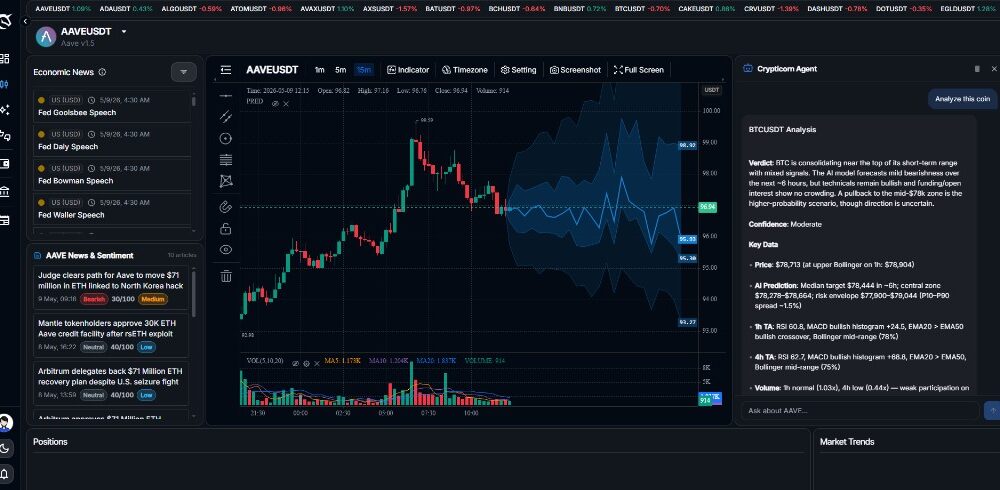
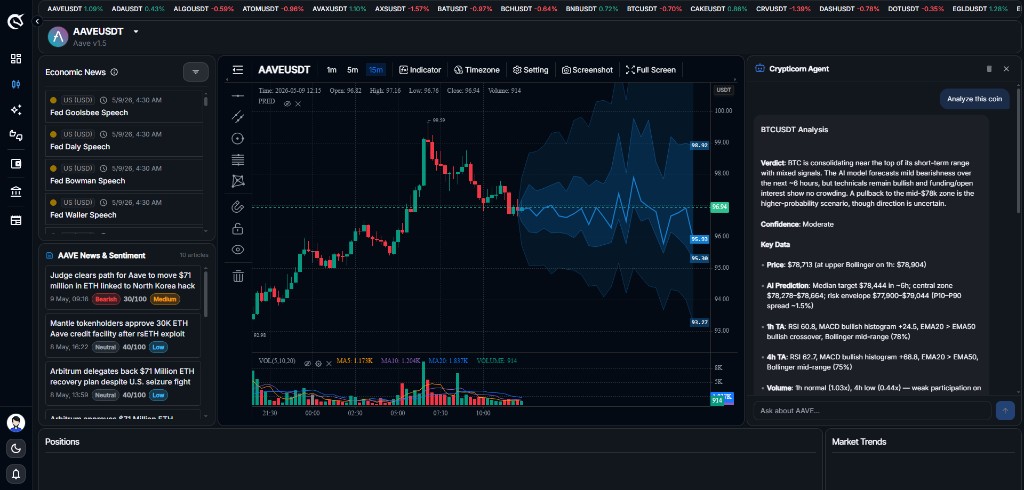
Prediction Dashboard (paid tier on pricing): chart-integrated probability cones for major pairs, roughly six hours forward, with P10-P90 bands plus median. The in-dashboard AI agent answers questions about the active symbol (context, not a substitute for your risk rules).
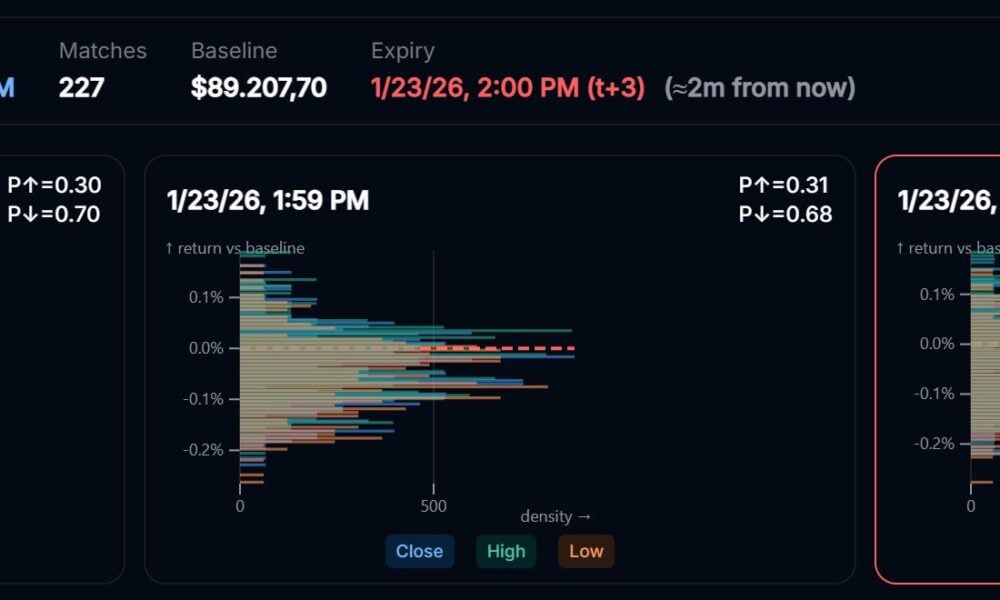
Up/Down predictions (separate plan or bundled per current pricing page): refreshed directional scores on 15m, 1h, 4h, and daily-style horizons. We built this for traders who also use Polymarket/Kalshi-style event contracts, but the scores are still probabilistic bias, not exchange orders.
What we do not claim: fixed win rates like “93.5% success,” guaranteed profits, or fully automated agents that trade your Binance account while you sleep. If you need a plain comparison of forecasting tools vs aggregators vs free pages, see crypto prediction tools compared.
How to read an AI crypto signal (step by step)
This is the workflow I use before any manual ticket:
- Name the question. “Will BTC beat a 1h up contract?” is different from “Where might ETH trade in six hours?”
- Match horizon to tool. Use up/down scores for short windows; use cones for path risk.
- Read uncertainty first. Wide band or ~50% score → smaller size or no trade.
- Add costs. Taker fee + spread + slippage. If edge is 2% and costs are 1.5%, you are one bad fill from flat.
- Write invalidation. What data would prove the signal wrong for your plan? (Level break, time stop, news event.)
- Log outcomes. Track hit rate by horizon for your execution, not the vendor’s marketing table.
More detail on turning forecasts into process: how to use AI crypto predictions for trading.
AI signals vs manual analysis vs Telegram groups
| Approach | Strength | Weakness | When I use it |
|---|---|---|---|
| ML dashboard (Crypticorn-style) | Consistent horizons, visible uncertainty, reproducible | Still wrong around news; needs interpretation | Pre-trade bias + risk framing |
| Manual TA + news | Flexible, handles narrative | Slow, emotional, inconsistent | Macro days, illiquid alts |
| Telegram / Discord signals | Fast, social proof, copy-trading hooks | Opaque track record, referral incentives, leverage bait | Rarely; only with verified logs I control |
| Copy-trading platforms | Execution bundled | Platform risk, lag, fee stack | When I want automation and accept third-party strategy risk |
If you want free/community angles without pretending they are audited ML, read best free crypto signals for trading and the definitional piece crypto signals explained. Those pages cover Telegram culture; this one focuses on reading AI output honestly.
Red flags when choosing a signal service
- Win rate without definitions: No horizon, asset list, or live log. Screenshots of three green trades are not statistics.
- Deleted history: Channels that edit or purge losing calls.
- Leverage as default: “10x minimum” turns a small edge into a liquidation machine.
- No uncertainty: Only arrows, never bands or confidence language.
- Upsell maze: Free group → VIP → “exclusive bot” with no methodology.
- Guaranteed income language: Violates basic YMYL honesty; walk away.
Accuracy expectations in plain language: how accurate are AI crypto price predictions. Model mechanics: how AI crypto price prediction models work.
Where AI signals fit in a real workflow
I treat Crypticorn output as input four, not input one:
- Market regime (trend, chop, event week)
- Liquidity and fees on the venue I will actually use
- My max loss for the day
- AI bias / cone
- Execution and logging
On volatile weeks I shrink size when cones widen. On quiet weeks I still do not crank leverage just because a direction score nudges above 55%. That discipline matters more than the last refresh timestamp.
If you trade prediction markets, crowd odds and ML forecasts answer different questions. Do not conflate them. Start with Polymarket crypto price predictions: crowd odds vs AI forecasts.
Final takeaway
AI crypto signals are useful when they expose probability and horizon. They are dangerous when they pretend to be certainty with leverage attached. Crypticorn gives you cones and up/down scores you can inspect in a dashboard (or via ChatGPT MCP if you prefer that interface). What we cannot do is promise you profits or replace your risk rules. Read the uncertainty, count the fees, and size like the next regime break is coming, because it always does.
FAQ
What are AI crypto signals?
Machine-learning outputs that estimate direction, probability, or a price range for a cryptocurrency over a defined time window. They can appear as dashboard scores, probability bands, chart alerts, or third-party Telegram trade packages. The label matters because each format implies different risk.
Are AI crypto trading signals accurate?
Sometimes slightly better than a coin flip on specific horizons when measured with honest backtests and live logs. They are not reliably “accurate” in the sense of exact prices or guaranteed wins. Judge services by calibration and your all-in costs, not marketing win rates.
What is the difference between AI signals and Telegram crypto signals?
AI signals from forecasting platforms usually show model-based bias or ranges with a stated horizon. Telegram signals often ship ready-made entries with take-profit and stop-loss levels, sometimes with copy-trading. Telegram can be faster and more social; it is also harder to audit and easier to manipulate.
Does Crypticorn send Telegram entry and exit signals?
No. Crypticorn provides probabilistic forecasts on the web dashboard, up/down direction scores for short horizons, and optional ChatGPT MCP access to the same analytics. We do not publish leveraged “LONG/SHORT” packages as our core product.
How should I use Crypticorn up/down scores?
As a bias check for the horizon on screen, not as an automatic trade trigger. When a score sits near neutral, that is the model saying conviction is low. Pair scores with your fee stack, invalidation level, and size limits.
Can AI crypto signals replace technical analysis?
Not fully. ML models compress price and feature history; they miss narrative unless you add news context yourself. Many traders use signals plus manual structure (levels, liquidity, events). See the foundational explainer on what AI crypto price prediction is.
Are free crypto signals safe?
“Free” often means you pay with attention, referrals, or upsells. Free groups can be useful for market chatter; they are rarely audited forecasting. Treat them as unverified ideas and read free signal options with the same skepticism as paid ones.