
Crypto Signals
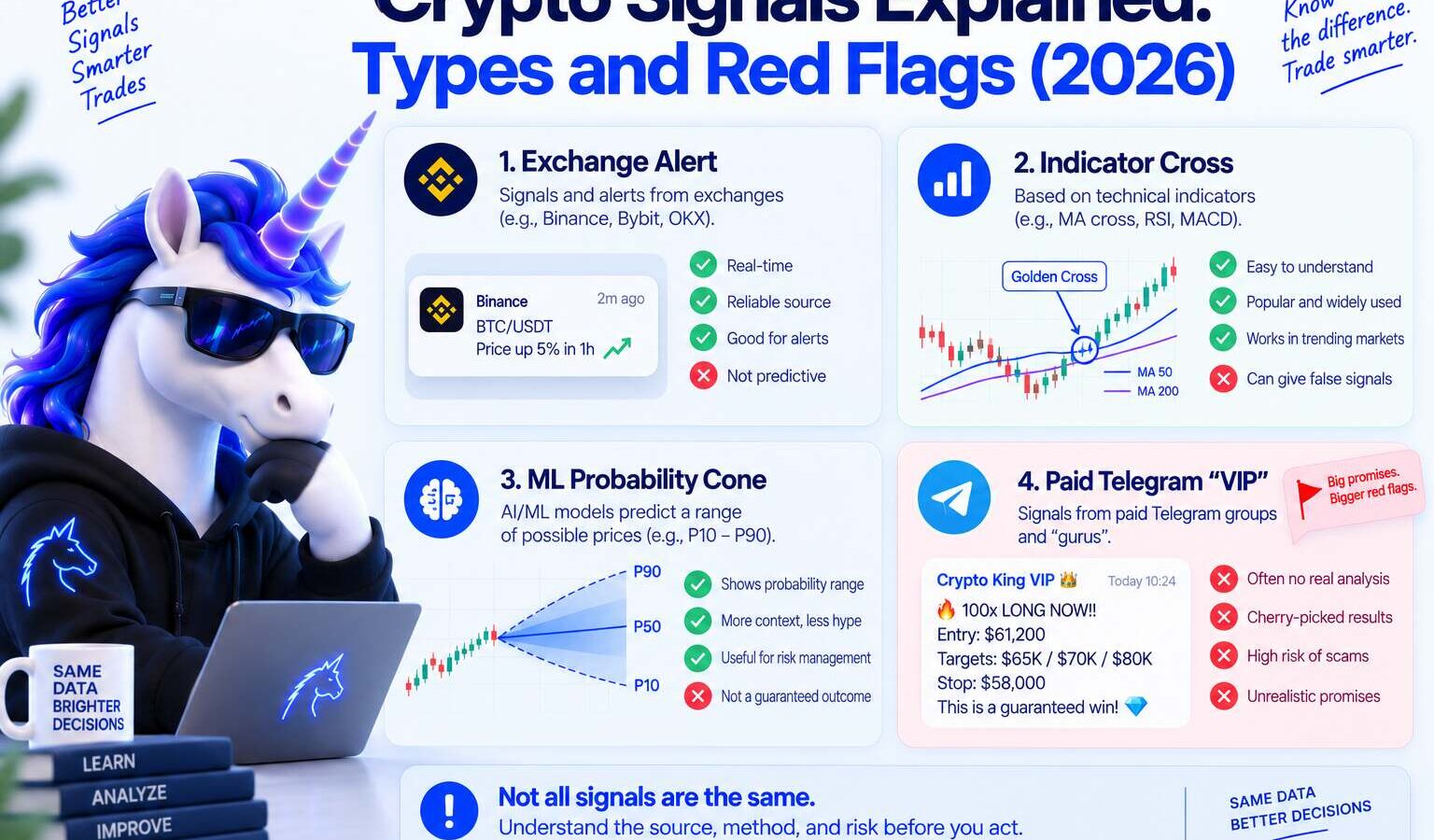
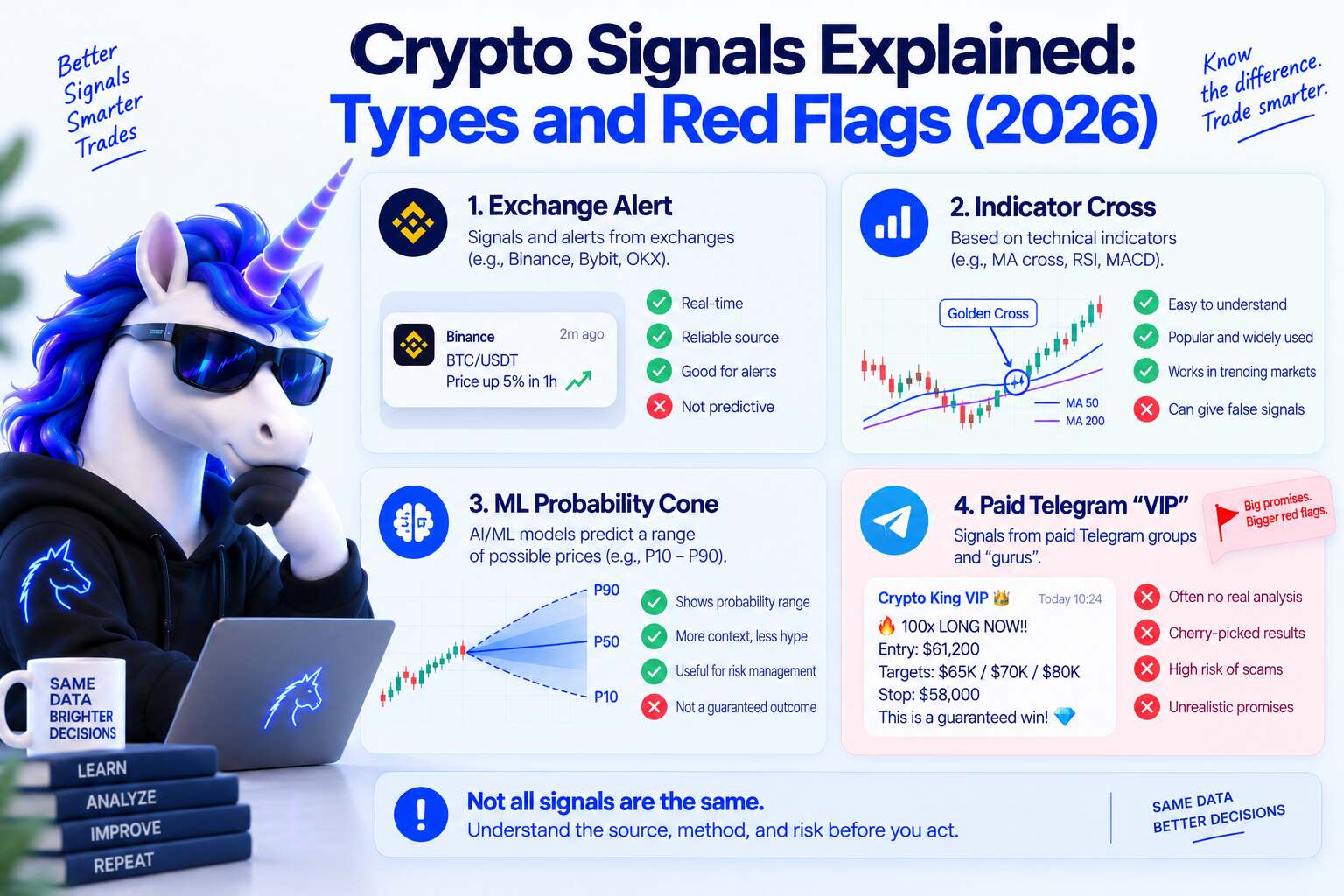
I build forecasting tools at Crypticorn and still trade crypto manually. Before I learned the vocabulary, I treated every alert like a buy order. That mistake cost me more than any single bad coin pick. This page defines what crypto signals are, how the main types differ, and how to evaluate providers without falling for win-rate marketing.
For the full workflow on reading AI outputs (cones, direction scores, calibration), use the cluster hub: AI crypto signals: how to read them honestly. For on-chain launches, see DEX trading signals.
Last updated: August 2026. By Johannes Thüroff, M.Eng. Not financial advice. See our disclaimer.
Direct Answer
Crypto signals are trade ideas or forecasts that suggest when and how to act on a coin: buy, sell, hold, or a probabilistic direction over a stated horizon. They come from humans (Telegram groups, paid "VIP" channels), rule-based indicators (TradingView alerts), machine-learning models (probability cones, up/down scores), or on-chain data (holder moves, liquidity events). A signal is only useful if you know its type, timeframe, and track record. Fixed entry/TP/SL packages without published losses are marketing, not evidence.
Related: Telegram signal providers: red flags and testing.
Key Takeaways
- Four families: manual/Telegram, indicator alerts, AI probabilistic, on-chain/DEX. Mixing them causes bad sizing.
- Telegram packages (entry, stop, take-profit) optimize for screenshots, not accountability. Deleted losing calls are standard.
- AI signals should expose uncertainty. Wide bands or scores near 50% mean low conviction.
- Evaluation checklist: horizon, asset, fees assumed, public log, max drawdown, not just win rate.
- Free vs paid is not quality vs junk. Many free channels upsell VIP; many paid groups recycle public calls.
- Crypticorn today: Prediction Dashboard cones and Up/Down direction views. Not a Telegram sniper bot.
What Crypto Signals Are (and Are Not)
A crypto signal is any structured hint about market action. That includes a Discord message saying "long ETH here" and a dashboard printing a 72% bullish score for the next hour. Both are "signals." They are not orders, guarantees, or substitutes for position sizing.
Signals are not:
- Proof that an asset will move (markets adapt; edges decay).
- A reason to skip fees, slippage, or funding on your venue.
- Permission to size larger than your plan allows.
If a provider promises "95% wins" without a verifiable log, treat that as a red flag, not a feature.
The Four Signal Types (comparison Table)
| Type | Typical source | What you receive | Main risk |
|---|---|---|---|
| Manual / Telegram | Human trader, paid group | Entry, TP, SL, leverage suggestion | No audit trail; front-running followers |
| Indicator alerts | TradingView, bot rules | Crossover, RSI zone, break of level | Repainting, curve-fit on past data |
| AI probabilistic | ML forecast stack | Direction score, P10-P90 band, horizon label | Read like a Telegram ticket; ignore uncertainty |
| On-chain / DEX | Explorers, screeners, holder labels | Whale move, LP add, concentration shift | Context-free alerts on illiquid tokens |
Chart-market AI signals and DEX on-chain signals need different workflows. Do not paste an RSI alert playbook onto a two-hour-old memecoin pool.
Anatomy of a Manual Crypto Signal
Most Telegram and "expert trader" packages include the same fields:
- Pair: e.g. BTC/USDT or a thin alt.
- Direction: long, short, or spot buy.
- Entry zone: a price band (often already passed when you read it).
- Stop-loss: max loss if wrong.
- Take-profit ladder: TP1, TP2, TP3 for screenshot wins.
- Leverage hint: sometimes reckless on purpose (engagement).
Reading the fields is easy. The hard part is knowing whether the call was timed for subscribers or for the admin's existing position. Channels can post entries after they fill, delete losses, and showcase only TP1 hits. That is why I prefer systems that log every forecast with timestamp and outcome.
How AI Crypto Signals Differ
AI stacks usually output probabilities or distributions, not a single "buy now" price. Examples:
- A median path with P10-P90 uncertainty bands over 1h / 4h / 24h.
- An up/down direction score for the next 15 minutes or hour.
- A sentiment or news-impact overlay (supporting context, not a standalone entry).
The failure mode is human: treating a 58% bullish score like a guaranteed long. The honest read is "slight edge, size accordingly, respect the band width." Full walkthrough: how to read AI crypto signals honestly.
On-chain and DEX Signals (separate Bucket)
On-chain signals track wallet behavior, liquidity, and contract events. Useful stacks combine price/volume with holder concentration and safety checks. CEX indicator copy breaks on fresh pairs with thin history.
Deep dive: DEX trading signals that actually work and the Ultimate DEX trading guide.
How to Evaluate Any Signal Provider
Use this checklist before you pay for VIP or wire a bot:
- Public log: Can you see every call with entry time, exit, and loss? Screenshots are not enough.
- Horizon match: Does the signal match how you trade (scalp vs swing)?
- Asset match: BTC signals do not transfer to low-cap alts without liquidity adjustment.
- Fee model: Are spreads, taker fees, and funding included in their "profit" examples?
- Drawdown honesty: Ask for worst streak, not best week.
- Conflict disclosure: Do they trade the same call before posting?
- Upsell pattern: Free channel → VIP → "exclusive leverage group" is a funnel, not proof.
If three or more items fail, skip. There is always another channel recycling the same chart.
Free Crypto Signals: What to Expect
Free signal channels and apps are useful for learning format, not for blind copy-trading. Many exist to sell premium tiers or referral links. A practical approach: paper-trade or micro-size until you have your own log comparing their calls to buy-and-hold on the same horizon.
Comparison listicle (updated separately): best free crypto signals for trading.
Where Crypticorn Fits (honest Product Tie-in)
We ship probabilistic tooling, not Telegram entry packages:
- Prediction Dashboard for chart markets: cones, agent Q&A, news sentiment.
- Up/Down predictions for short-horizon direction scores (Polymarket/Kalshi-adjacent workflows).
- DEX AI when the question is token safety and holders, not RSI on a new pool.
- ChatGPT MCP app for the same read-only analytics in chat.
Pricing: Crypticorn pricing. We do not position live autonomous trading agents as a retail product on exchanges.
Common Mistakes
| Mistake | Why it fails | Read next |
|---|---|---|
| Copying leverage from Telegram | One stop-out wipes weeks of small wins | Prediction risks |
| Chasing entries after the post | Slippage eats the advertised edge | AI signals hub |
| Using CEX TA on DEX launches | No meaningful history | DEX signals |
| Trusting win-rate screenshots | Survivorship bias | This checklist above |
Final Takeaway
Crypto signals explained in one sentence: they are structured trade hints from humans, rules, models, or chain data. Your job is to classify the type, match the horizon, and demand a log. AI signals earn trust when they show uncertainty. Telegram packages earn skepticism by default. Start with definitions here, then move to the AI crypto signals guide when you are ready to read forecasts like forecasts, not lottery tickets.
Faq
What are crypto trading signals?
Crypto trading signals are recommendations or forecasts about when to buy, sell, or hold an asset. They can come from human analysts, automated indicators, machine-learning models, or on-chain data feeds. They are inputs to your process, not guaranteed outcomes.
What is the difference between crypto signals and AI crypto signals?
Generic "crypto signals" often means manual Telegram calls with fixed entry and exit prices. AI crypto signals usually output probabilities, direction scores, or price bands with explicit horizons. The reading workflow differs; see the AI signals hub for ML-specific guidance.
Are free crypto signals worth it?
Free channels can teach format and vocabulary, but many monetize through VIP upsells or referrals. Paper-trade or micro-size until you verify a public track record. Never size up because a channel is free.
How do I read a crypto signal with entry, stop-loss, and take-profit?
Check whether the entry is still valid, whether the stop distance fits your account risk, and whether take-profit levels assume liquidity you actually have. Confirm the call timestamp. If the move already happened, skip rather than chase.
Can crypto signals be profitable?
Some edges exist briefly, but fees, slippage, overtrading, and false marketing destroy most follower P&L. Profitability depends on execution discipline and verification, not on the word "VIP" in the channel name.
What red flags indicate a scam signal provider?
Guaranteed returns, deleted losing calls, no public log, pressure to upgrade tiers, leverage prompts on thin alts, and win-rate screenshots without drawdown data.
How does Crypticorn differ from Telegram signal groups?
Crypticorn provides probabilistic dashboard and up/down views plus optional DEX token analysis. We do not sell copy-trade Telegram packages or promise fixed win rates.
Automate crypto prediction markets
New to crypto trading?
Further reading
Crypto Price Prediction
How Accurate Are AI Crypto Price Predictions? (2026)
Crypto Trading
Predict.fun vs Polymarket: The Honest Comparison (2026)
Crypto Trading
Ultimate Guide to Polymarket Crypto Trading (2026)
Crypto Trading
Polymarket Fees 2026: Taker Fees, Spread & Real Costs
Crypto Trading
The Polymarket 5-Minute Strategy I Actually Use (Tested)
Crypto Trading