
Crypto Price Prediction

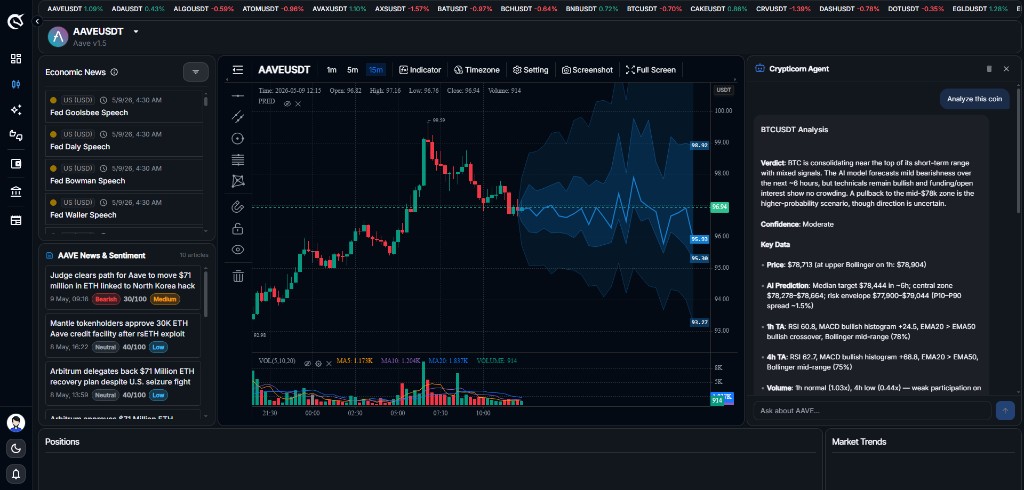
Most "AI crypto price prediction" pages still sell a fantasy: a model that knows where Bitcoin prints next week. I have spent years building and trading against the opposite, models that output probabilities and ranges, not prophecy. This is the primary hub for Crypticorn's price-prediction cluster: horizons, cone reading, workflow, tools, risks, and where prediction markets fit.
For the definitional explainer (what AI prediction is and is not), start with what AI crypto price prediction actually is.
Last updated: August 2026. By Johannes Thüroff, M.Eng. Not financial advice. See our disclaimer.
Direct Answer
AI crypto price prediction is useful when you treat it as a probability tool on short horizons, minutes to hours, sometimes a day, not as an oracle for exact prices. A serious model estimates where price is likely to land (for example a P10-P90 band and a direction probability). You compare that estimate to the market or your own bias, size the trade for uncertainty, and skip when the model says "no edge." Guides that promise profits from AI forecasts are selling the wrong product; the edge is small, compounding, and easy to destroy with fees, overtrading, or believing a single target.
Key Takeaways
- Pillar workflow: read the cone, compare to market odds, size for band width, define invalidation, log skips.
- Real outputs are distributions and direction odds, not "BTC at $X on Friday."
- Models are strongest on short horizons (15m-1d); year-ahead point targets are storytelling.
- Calibration beats win-rate screenshots. See how accurate AI predictions are.
- Prediction markets (Polymarket, Kalshi) are venues; ML forecasts are inputs. See Polymarket vs AI forecasts.
- Crypticorn ships the Prediction Dashboard and Up/Down predictions. Not autonomous trading agents.
Who This Guide Is for
If you want a marketing brochure for "AI that prints money," stop here. This is for traders who already suspect that sentence is nonsense and still want a structured way to use probability feeds on spot, perps, or event markets like Polymarket and Kalshi up/down contracts.
I reference Crypticorn's stack where it is the concrete example I know: cones, agent Q&A, sentiment context, and short-horizon direction distributions. The workflow works the same with any tool that shows uncertainty honestly.
Which Horizons Actually Matter
Timeframe is the first filter. Get it wrong and every downstream step is theater.
| Horizon | What models can often learn | What usually fails |
|---|---|---|
| Minutes-hours | Short-lived flow and volatility patterns; direction bias for the next window | Noise trading every tick; fee bleed |
| Intraday-1 day | Regime shifts, session effects, event aftermath | Forcing a daily target when the band is wide |
| Multi-day-weeks | Coarse bias at best | Overfitting news stories to the chart |
| Year-ahead price targets | Almost nothing actionable from price ML alone | Exact price prophecies sold as AI |
That is why our up/down products sit on 15-minute, 1-hour, 4-hour, and daily cadences. Those are windows where a probability statement can be checked against reality without pretending the model owns the macro cycle.
If someone will not tell you the horizon, they are not selling a forecast. They are selling vibes.
How to Read a Real AI Prediction
A usable screen usually has some mix of:
- Direction probability, e.g. "62% chance this window finishes up." Not "it will go up."
- A band (P10-P90 or similar), the range that should contain the outcome most of the time if the model is calibrated. Wide band = high uncertainty = smaller size or no trade.
- A median / central path, a summary line inside the cone, not a guarantee.
Read the band before the headline. A 55% up call with a huge P10-P90 span is not the same trade as a 55% up call with a tight span. Same direction number, different risk.
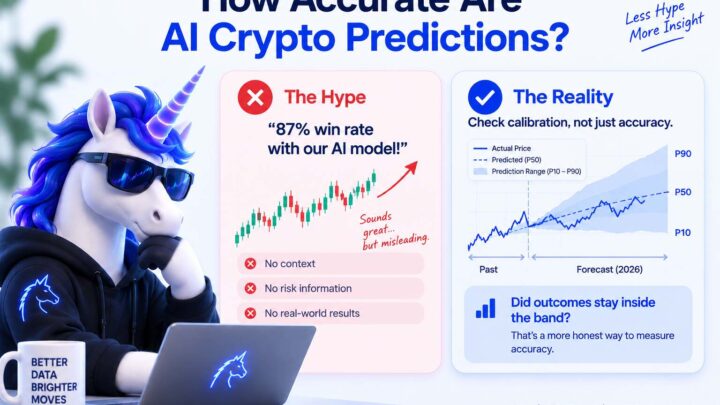
Calibration matters more than a flashy win rate screenshot. Over time, outcomes labeled "~70%" should land near 70%, not 95%. Tools that only show wins are not decision systems.
A Practical Workflow (check, Compare, Size, Invalidate)
- Check the output cold. Horizon, direction probability, band width. If the band is noise-wide or the model is flat (~50/50), that is a valid answer: skip.
- Compare to the market. Spot trend, funding, or for event markets, implied odds on Polymarket/Kalshi. No disagreement, no trade.
- Size for uncertainty. Wider cone, smaller risk. See position sizing on prediction markets for ticket math.
- Define invalidation before entry. Time stop, level stop, or thesis stop. AI does not remove exit rules.
- Log the skip. Recording when you did not trade because the model said no edge beats overtrading every refresh.
Lighter workflow page: how to use AI crypto predictions for trading. This pillar is the full map.
How AI Prediction Models Work (summary)
Under the hood, most stacks combine price/volume history, volatility features, and sometimes sentiment or funding data. Training fits patterns on past windows; inference outputs a distribution for the next window. Models drift when regimes change, which is why horizons stay short and calibration matters.
Deep dive with model families table: how AI crypto price prediction models work.
Accuracy, Calibration, and Honest Limits
"Accuracy" in marketing usually means cherry-picked wins. In practice you want calibration: when the model says 60%, it should be right near 60% over many samples. Direction accuracy without band width context is incomplete.
Full YMYL explainer: how accurate are AI crypto price predictions. Protective risk map: risks of crypto price prediction.
Prediction Markets Vs Ml Price Forecasts
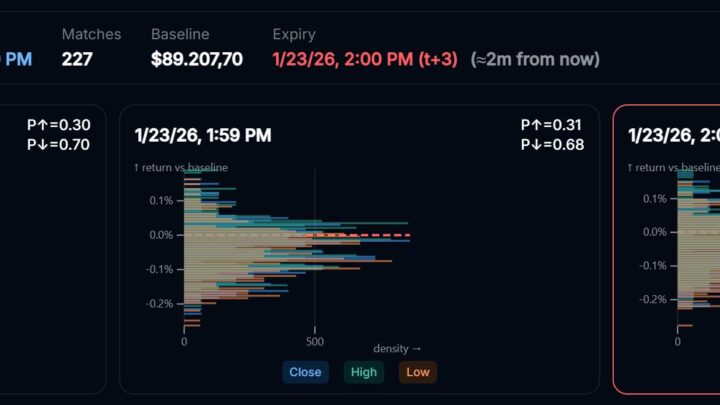
ML price prediction estimates probabilities from market data. Prediction markets (Polymarket, Kalshi, Predict.fun, and others) let traders buy and sell those beliefs as contracts. The layers complement each other: crowd odds show what believers pay; ML can flag when a short-horizon distribution disagrees with the ticket price.
- Bridge article: Polymarket crypto price predictions vs AI forecasts
- Venue comparison: best crypto prediction markets (2026)
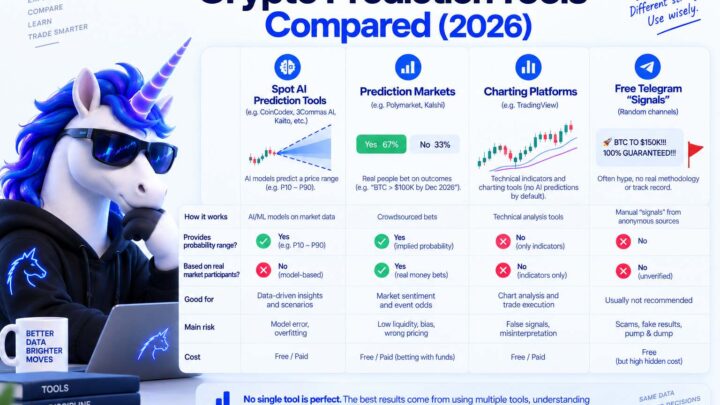
AI Prediction Tools: Honest Landscape
| Type | What you usually get | Watch-outs |
|---|---|---|
| Free "price prediction" sites | Point targets, long-range narratives | No uncertainty; SEO spam |
| Charting + indicator packs | Human setups with optional AI overlays | AI label on old RSI/MACD |
| Probability dashboards | Cones, direction scores, multi-horizon views | Still need your risk rules |
| Event-market up/down feeds | Short-window distributions for Polymarket/Kalshi-style markets | Fees and timing dominate PnL |
| Chat / agent interfaces | Explain-the-chart assistants beside forecasts | Interpretation aid, not a substitute for numbers |
Side-by-side comparison table: crypto prediction tools compared.
Crypticorn sits in the dashboard + up/down + agent lane. Optional: ChatGPT MCP app for the same read-only analytics in chat.
Price Predictions Vs AI Crypto Signals
These terms overlap in marketing but differ in product shape. Price prediction here means probabilistic paths and cones on chart markets. AI crypto signals often means direction scores, alerts, or (in Telegram) fixed entry/TP/SL packages. Do not mix workflows.
Signals cluster hub: how to read AI crypto signals honestly.
Reading the Crypticorn Dashboard (concrete Example)
When I open the Prediction Dashboard on a liquid perp or major spot pair, I look in this order:
- Horizon selector. Match the trade I am considering (15m scalp vs 4h bias). If the UI and my plan disagree on timeframe, I stop.
- Direction score or cone tilt. Is there a lean, or is it flat near 50%? Flat is information.
- P10-P90 width. Wide band on a small account means smaller size or no trade. I write down the band width in my journal.
- News/sentiment overlay. If sentiment spikes but the cone stays wide, I treat the spike as noise until the band tightens or price confirms.
- Agent question (optional). I ask "what would invalidate this setup?" not "where is price going?" The agent is useful for sanity checks, not entries by itself.
For Polymarket/Kalshi-style tickets, I switch to Up/Down predictions and compare the direction distribution to the contract price I can actually buy. If the market already prices 68% and the model says 70%, the edge is thin after fees.
That sequence takes two minutes. The expensive part is having the discipline to skip when step 2 or 3 says "no edge."
Common Mistakes (account Killers)
| Mistake | Why it fails | Read next |
|---|---|---|
| Point-forecast worship | Ignore the band, size like certainty | This workflow section |
| Horizon mismatch | 15m model justifying a swing hold | How to use predictions |
| Fee blindness | 2-3% edge erased on Polymarket/perps | PM vs AI |
| Refresh addiction | Overtrading every model update | Risk map |
| Trusting win-rate screenshots | No calibration or drawdown data | Accuracy guide |
Further Reading (prediction Cluster)
Foundations
Workflow and risk
- How to use AI predictions for trading
- Risks of crypto price prediction
- Crypto prediction tools compared
Prediction markets
Final Takeaway
- AI crypto price prediction is a probability workflow, not a profit system.
- Pick horizons where patterns can exist; ignore year-ahead price theater.
- Read the band before the bold direction number.
- Compare, size, invalidate, log skips. That is the whole game.
See cones and short-horizon direction scores on the Prediction Dashboard and Up/Down predictions. Keep the risk rules above even when the UI looks convincing.
Written by Johannes Thüroff, M.Eng.
Not financial advice. See Disclaimer.
Faq
What is the best way to use AI crypto price predictions?
Use them as short-horizon probability inputs: read direction odds and the uncertainty band, compare to the market, size small when the band is wide, and skip when the model is flat. Never treat a single price target as a plan.
Can AI crypto price prediction make you profitable?
Only if you have a small, calibrated edge and you do not destroy it with fees, oversized bets, and forced trades. No model makes you profitable by itself.
What timeframes work best for AI crypto predictions?
Minutes to hours, and carefully intraday to about a day. Multi-month and year-ahead exact price forecasts are mostly narrative.
How do I read a probability cone or P10-P90 band?
The band is the model's uncertainty: outcomes should land inside it most of the time if calibration is decent. A wide band means high uncertainty. The median path is a summary, not a promise.
Are free AI crypto price prediction websites worth using?
Most publish point targets without uncertainty. Prefer tools that show probabilities, horizons, and ranges you can audit.
How is this different from prediction markets?
AI estimates probabilities from data. Prediction markets are venues where people trade those beliefs as contracts. You can use AI feeds to inform tickets on those venues.
How is Crypticorn different from Telegram signal groups?
Crypticorn provides probabilistic dashboard and up/down analytics. We do not sell Telegram copy-trade packages or fixed win-rate bots.
Where should I start in this cluster?
Start here for the full workflow, then read what AI prediction is, accuracy limits, and the shorter how-to when you want a checklist only.
Automate crypto prediction markets
New to crypto trading?
Further reading
Crypto Price Prediction
Crypto Prediction Tools Compared (2026): Platforms, Aggregators, and What to Avoid
Crypto Price Prediction
Polymarket Crypto Price Predictions: Crowd Odds vs AI Forecasts (2026)
Crypto Price Prediction
How Accurate Are AI Crypto Price Predictions? (2026)
Crypto Trading
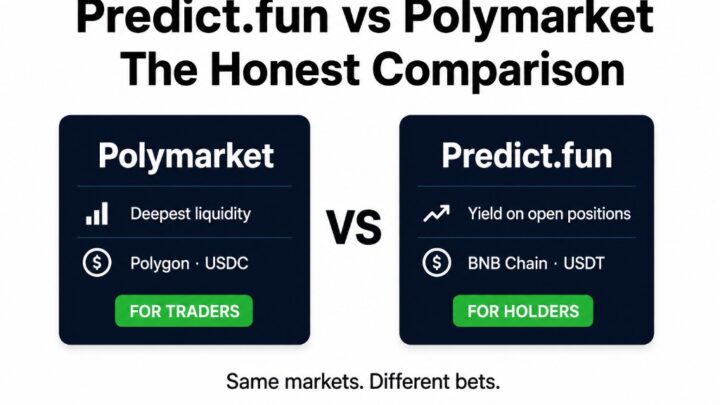
Predict.fun vs Polymarket: The Honest Comparison (2026)
Crypto Trading
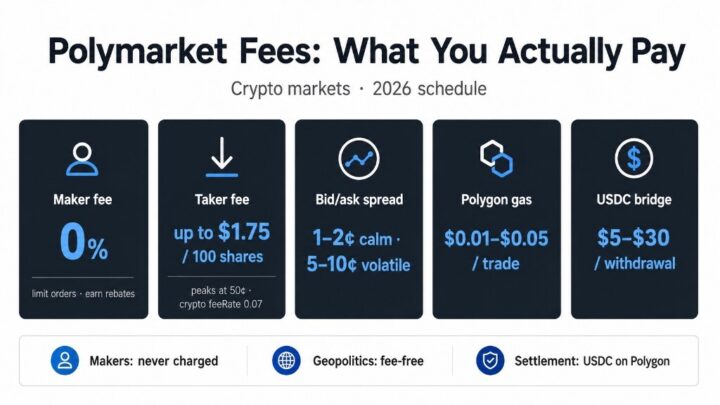
Ultimate Guide to Polymarket Crypto Trading (2026)
Crypto Trading