
Crypto Trading
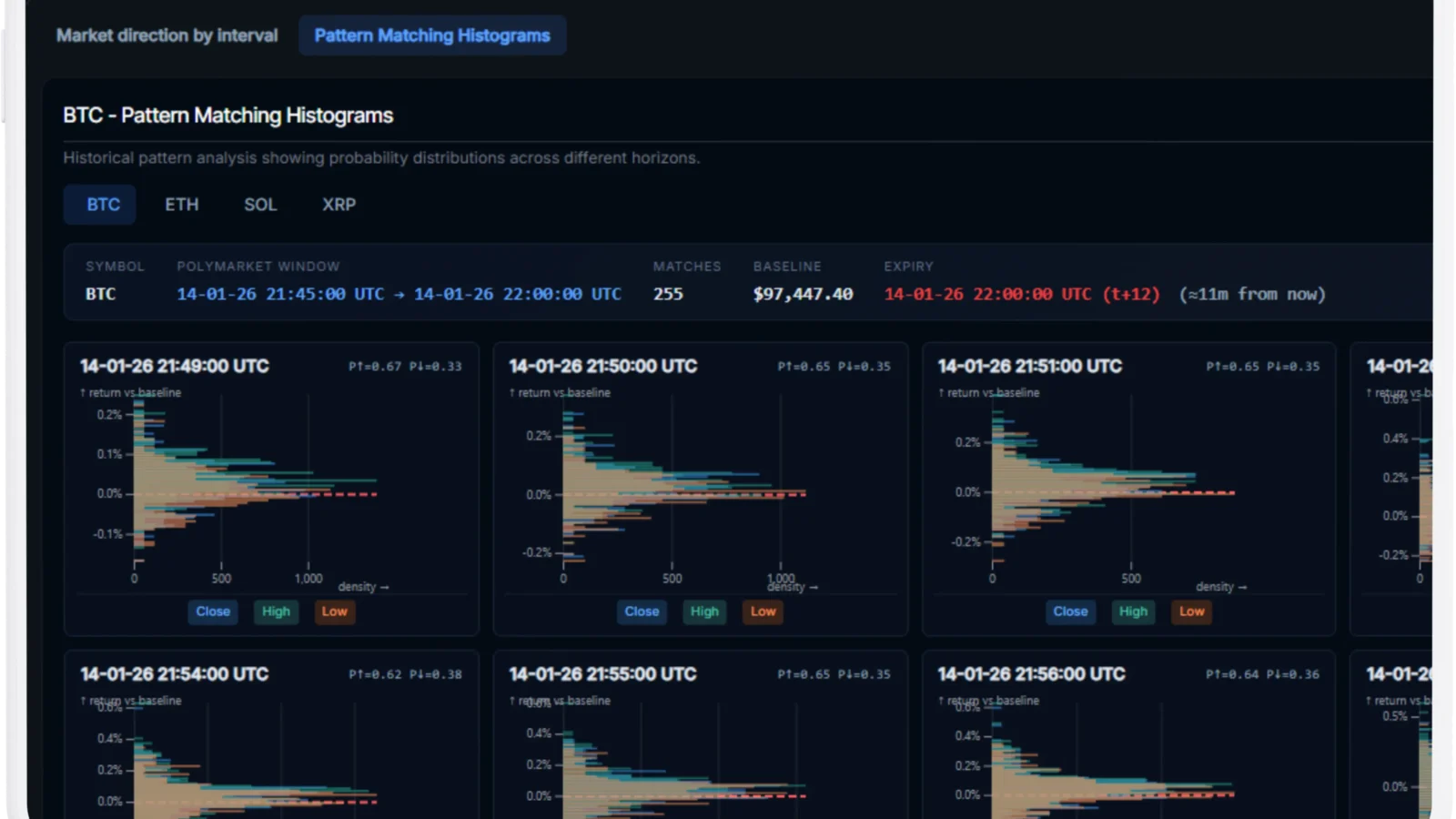
If you want to trade crypto up/down markets on Polymarket - the 15-minute, 1-hour, 4-hour, and daily Bitcoin and Ethereum markets - this guide is the whole picture in one place: how the platform works, what it really costs, how odds behave, how to size positions, which mistakes empty most accounts, what bots can and can't do, and where AI genuinely helps.
I trade these markets almost every day, and every section below links to a deeper article written from that experience - including the losses. This is the hub; the spokes go deep. Last updated: July 2026. Not financial advice.
In this guide: What Polymarket is · Setup · Real costs · Market types · Resolution · How odds work · Position sizing · Mistakes · Strategies · Bots · Alternatives · Where AI fits · FAQ
Direct Answer
Polymarket crypto trading means buying UP or DOWN shares on short-horizon Bitcoin and Ethereum price markets that resolve to $1 (right) or $0 (wrong). Winning consistently requires four things: understanding that odds are crowd positioning, not predictions; keeping all-in costs (~2–4% per round trip) below your edge; sizing positions by edge with fractional Kelly, never by streak; and skipping most markets - the edge appears a few times per day, not every 15 minutes.
Key Takeaways
- Polymarket's crypto UP/DOWN markets (15min/1h/4h/daily) are its deepest, tightest-spread markets - and the only ones I trade.
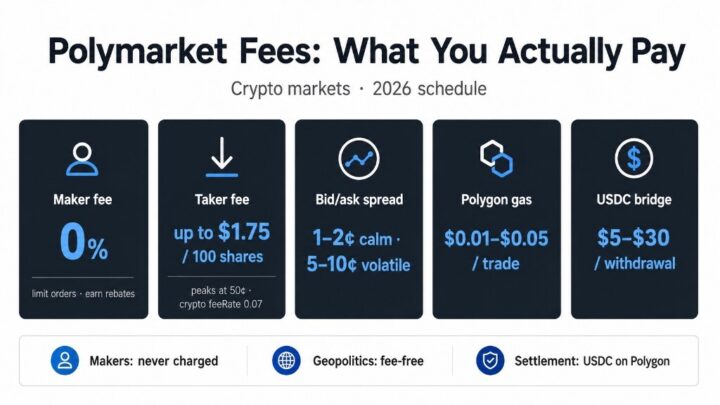
- Since 2026 Polymarket charges taker fees on crypto markets (up to $1.75 per 100 shares; makers still trade free) - on top of spread (1–2¢ calm, 5–10¢ volatile), Polygon gas, and $5–30 USDC bridge costs per withdrawal.
- A 65¢ price means ~65% implied probability - where money already sits, not what happens next. High odds after a fast move usually mean you're late.
- Sizing beats predicting: with a 4-point edge, Kelly says risk ~2% of bankroll. Most losing traders bet 5–10% on coin-flips.
- The two account-killers are entering in the first 5 minutes and doubling down after losses (a 6-loss martingale streak needs $640 to recover $10).
- Execution bots without a probability edge lose; signal-filtered, disciplined execution is what held up in our live tests.
- US users: direct access violates Polymarket's TOS since the 2022 CFTC settlement - Kalshi is the regulated route.
What Polymarket Is (and What You're Actually Trading)
Polymarket is a prediction market on the Polygon blockchain. You buy shares in outcomes - "BTC UP in the next 15 minutes" - priced between 1¢ and 99¢. If your outcome happens, each share pays $1. If not, $0. The price is the market's implied probability: a 65¢ UP share means the crowd currently prices a 65% chance of UP.
That's the entire mechanic. No leverage, no liquidations, no funding rates - which is why up/down prediction markets are structurally simpler than spot or perpetuals trading. Simpler doesn't mean easier to profit from; it means the ways you lose are different.
If prediction markets are new to you, start with what are prediction markets, and read my honest Polymarket review for 2026 - including the regulatory history and who shouldn't use the platform at all.
Polymarket also lists politics and sports. I don't trade them: political markets are dominated by whales with better information than you, and sports books price you better than Polymarket's thin sports pairs. The crypto up/down markets are where the liquidity and the repeatable structure live.
How to Start Trading on Polymarket: Wallet, Usdc, First Market
Polymarket is crypto-native. There's no fiat on-ramp inside it, and setup filters out most beginners:
- Create a Web3 wallet (MetaMask, Rabby, Phantom). Use a dedicated wallet for trading - not the one holding your long-term funds.
- Get USDC. Buy it on an exchange (Coinbase, Kraken), then withdraw to your wallet.
- Bridge to Polygon. Polymarket settles on Polygon; bridging from Ethereum mainnet costs $5–30 in gas depending on congestion. Deposit only what you're prepared to trade with.
- Fund your Polymarket account by sending USDC (on Polygon) to your deposit address.
- Open a 15-minute BTC UP/DOWN market and watch it - don't trade it. Seriously. Watch ten of them before you place anything. The patterns in the sections below will start appearing.
If you're in the US: Polymarket settled with the CFTC for $1.4 million in January 2022 and geo-restricts US users. VPN access violates their terms and risks account forfeiture. The regulated route is Kalshi - I compare them in Polymarket vs Kalshi.
What Does Trading on Polymarket Actually Cost?
The old "0% fees" era ended in 2026: crypto markets now charge taker fees (fee = shares × 0.07 × price × (1 − price), peaking at $1.75 per 100 shares at 50¢), while makers still pay nothing and earn rebates. Beyond that, the real costs hide in four places:
| Cost | Typical size | How to minimize it |
|---|---|---|
| Bid/ask spread | 1–2¢ calm, 5–10¢ volatile (on a 50¢ market that's 2–20% round trip) | Limit orders on wide spreads; only cross spreads ≤2¢ |
| Polygon gas | $0.01–0.05 per trade | Rounding error unless you're a bot |
| USDC bridge out | $5–30 per withdrawal to mainnet | Batch withdrawals; wait for a $500+ balance |
| Resolution risk | Rare (<1% of markets), but a 100% loss when it hits | Can't eliminate - never bet money you can't lose on one market |
The all-in effective cost on a typical trade is ~2–4% in calm conditions - comparable to a sportsbook vig despite the 0% headline. Every trade must clear that hurdle with edge to spare. Full numbers from a year of tracking in Polymarket fees explained.
Market Types: 15-minute Vs 1-hour Vs 4-hour Vs Daily
The crypto UP/DOWN markets differ more than the labels suggest:
| Market | Character | Spread | Who it suits |
|---|---|---|---|
| 15-minute | Fast, emotional, shakeout-driven; timing is everything | 1–2¢ calm | Active traders who can watch the open |
| 1-hour | Cleaner trends, less noise, more time to be right | 2–4¢ | Traders with a directional read |
| 4-hour | Macro-session driven | 3–6¢ | Swing-style views |
| Daily | Slowest, closest to a directional bet | 2–5¢ | Multi-day thesis traders |
The 15-minute and 1-hour markets have the platform's deepest liquidity, and they behave differently enough that strategies don't transfer blindly between them - I break that down in 15-minute vs 1-hour crypto markets on Polymarket.
How Do Polymarket Markets Resolve?
Every Polymarket market resolves against a specified resolution source defined in the market's rules - for crypto up/down markets, a price feed (typically Binance or Pyth) read at the exact resolution timestamp. If BTC is above the open price on that feed at 14:15:00, UP shares pay $1; if not, they pay $0. There's no judgment call in the normal case.
Three edge cases are worth knowing before real money is on the line:
- Feed disagreement: BTC trades at slightly different prices on different exchanges at any given second. Your position can win on Coinbase's price and lose on Binance's - only the named source counts. Read the market rules before entering.
- Source failover: if the primary feed goes down, the market may resolve on a backup that defines the outcome slightly differently.
- Disputes and voids: some markets resolve via UMA's optimistic oracle, where an outcome is proposed and can be disputed. Rarely, a market is voided and shares refund at entry price.
All of this affects well under 1% of crypto up/down markets - but when it hits, it's a 100% swing on your position. It's the reason the sizing rules below treat every single market as capable of a total loss.
How Do Polymarket Odds Actually Work?
This is the concept that separates traders from exit liquidity. Polymarket odds are not predictions. A 74¢ UP price doesn't mean Bitcoin is 74% likely to rise - it means traders have already positioned 74¢ worth of belief on UP.
Odds = crowd positioning. And in short-term crypto markets, crowds are emotional, impatient, and late. The recurring pattern:
- Market opens, BTC moves fast for 30–60 seconds
- Odds explode to 70–85¢ on the moving side
- Late money piles in at those prices
- Liquidity thins, price stalls or reverts
- The "obvious" side loses, or wins too little to beat the entry price
By the time odds look obvious, the move is usually priced in. The tradable edge is the gap between the market's price and the real probability - which appears when the crowd panics, not when it agrees. Full explainer: how Polymarket's Bitcoin odds actually work.
Position Sizing: the Part that Decides Who Survives
Most Polymarket traders lose - and mostly not because they pick the wrong side. They bet the wrong size: several percent of bankroll per trade on near-coin-flip outcomes, where variance crushes any small skill they have.
The professional frame is fractional Kelly: size each position by the gap between your estimated probability and the market's price.
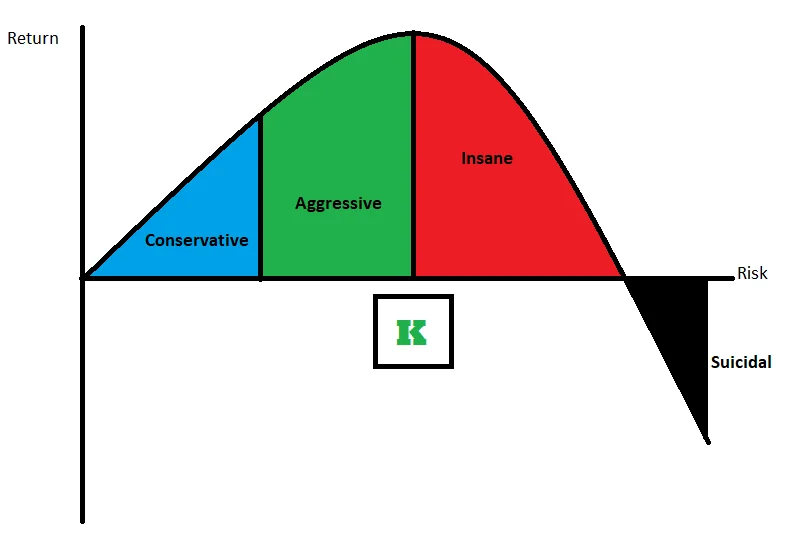
- Market prices UP at 50¢; your estimate is 54% → edge is 4 points
- Kelly: risk ~2.1% of bankroll. Not 5%. Not "conviction sizing."
- In practice use ¼ to ½ Kelly - full Kelly over-bets thin edges in volatile markets
- On a $1,000 bankroll, a typical short-horizon position is $30–80
The key property: position size scales with bankroll and edge, never with prior losses. Losing streaks shrink your bets automatically - the system self-corrects instead of self-destroying. Worked examples in position sizing on Polymarket and Kalshi.
The Mistakes that Empty Accounts
Most Polymarket losses follow the same few patterns, at the same wrong moments:
Entering immediately. The first minutes of a short market are bots repositioning, stop hunts, and panic - noise, not edge. It's the single most common mistake I see, and it has its own article.
Chasing the first big candle. By the time a move looks obvious on a 15-minute horizon, most of it is done. Late entries are punished brutally.
Doubling down after losses (martingale). The math is merciless: recovering a 6-loss streak requires a $640 position with $1,270 cumulative at risk - to make $10. I ran a capped martingale variant on a test account in early 2025: six smooth weeks of small wins, then one trending afternoon erased all of it and more. The full autopsy: why martingale blows up on Polymarket.
Buying both sides ("hedging"). Looks clever in screenshots, bleeds out over time - dissected in a popular strategy that looks smart but fails.
Trading every market. There are 96 fifteen-minute markets a day. Maybe 3–6 have a real setup. More trades = more mistakes; not trading is a strategy.
The complete list, with the psychology behind each one: why most traders lose on Polymarket crypto.
Which Polymarket Strategies Actually Hold Up?
What survives contact with real markets is boring and mechanical:
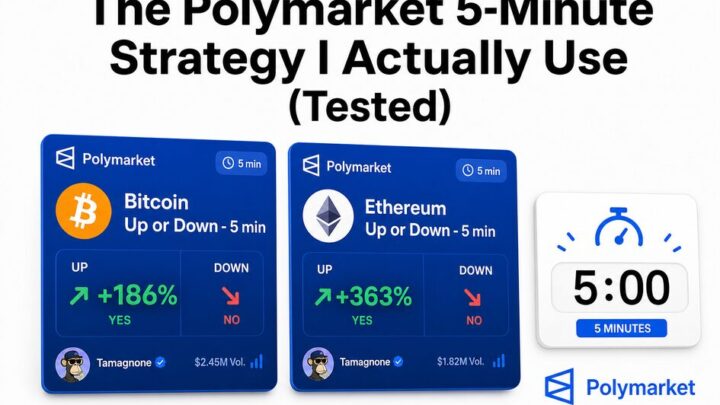
The 5-minute strategy - my daily approach on 15-minute BTC markets. No entry in the first 5 minutes, ever. After minute 5, enter only if the post-shakeout direction has held 60+ seconds, odds still lag the move, and no scheduled news lands before resolution. Exits are decided before entry (lock profit at 85–90¢, exit stalls, hold intact theses). Win rate runs 55–65% with wins 2–3x the losses. Full rules and real trades - including a losing one - in the Polymarket 5-minute strategy I actually use.
Bitcoin up/down fundamentals - reading early price behavior, respecting timing over direction: how to win Polymarket Bitcoin up/down.
The profitability framework - what we tested and what actually works across the cluster: how to trade Polymarket profitably in 2026.
Every strategy that survives shares one shape: it skips most markets, sizes small, and treats being flat as a position. Every strategy that blows up shares the opposite shape: high win rate, smooth equity curve, one catastrophic loss waiting off-screen.
Bots and Automation: What Works, What Doesn't
We tested this live for over four months (Feb–Jun 2026) on BTC, ETH, SOL, and XRP up/down markets. The short version:
- Execution-only bots fail - markets resolve at fixed times, so there are no stop losses, and automation makes timing mistakes permanent. What Polymarket bots are and whether they actually work.
- Copy-trade bots drift from the wallets they mirror - you enter later, at worse odds, with different size. Why you shouldn't copy-trade them.
- Rule-only bots ("odds above 70% = bet UP") break when crowd behavior shifts.
- What held up: probability signals filtering entries + disciplined execution with trailing exits + fractional Kelly sizing. The live test with account-level P/L is in best Polymarket bots for crypto.
Polymarket Vs the Alternatives
| Platform | Best for | Watch out for |
|---|---|---|
| Polymarket | Crypto up/down depth, tightest spreads, self-custody | Crypto-native UX, US restrictions, bridge costs |
| Kalshi | US-regulated, fiat in/out, instant ACH | Per-contract fees, less crypto market depth |
| Others | Niche coverage | Thin liquidity - spread is the fee |
The detailed comparisons: Polymarket vs Kalshi, the top 9 prediction markets for 2026, and a side-by-side platform comparison. For tooling around them: the best crypto prediction market tools and analytics platforms.
Where AI Fits (honestly)
Every section above eventually hits the same wall: you need an estimate of the true probability that's better than the crowd's. The entry rule needs it ("are odds still mispriced?"), Kelly sizing needs it (P_true is the hardest input), and bot filtering needs it.
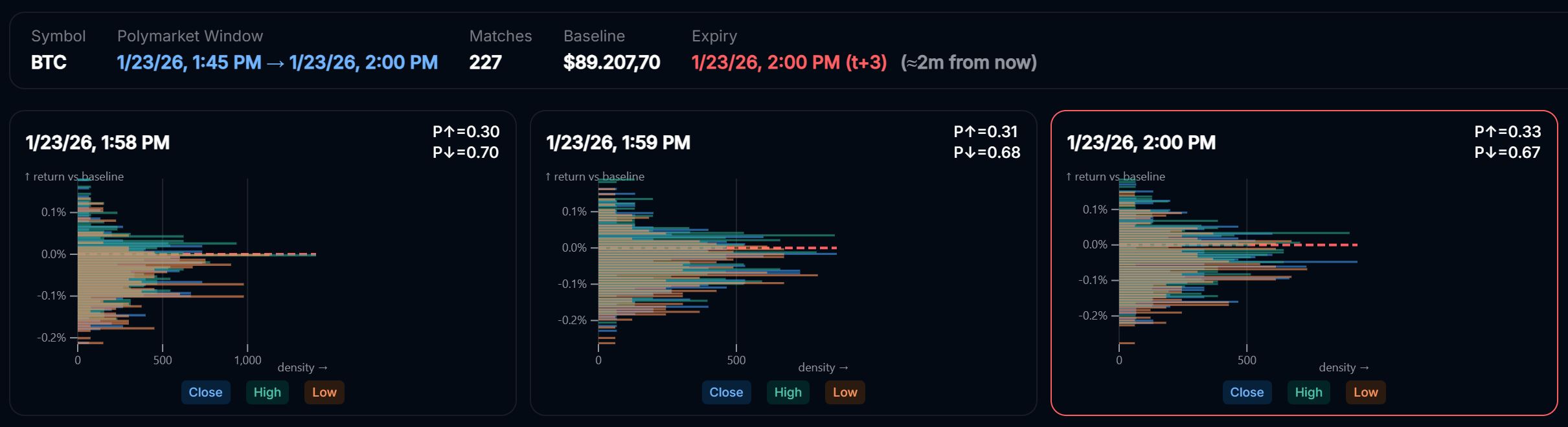
That's the specific job AI does well here - not predicting the future, but estimating short-horizon probabilities without getting emotional in minute 2. How that works in practice: how AI helps traders beat Polymarket odds and trading Polymarket up/down predictions with AI.
It's also what we build at Crypticorn: AI-based UP/DOWN probabilities for 15min, 1h, 4h, and daily markets. Not to guarantee wins - to skip the trades where there's no edge in the first place.
Faq: Polymarket Crypto Trading
Is Polymarket good for beginners?
Not really. The crypto-native setup (wallets, USDC, bridging) takes a weekend to learn, and the 15-minute markets punish inexperience quickly. US beginners should start with Kalshi (regulated, fiat-native). If you do start on Polymarket, watch markets without trading first, start with $50–100 you can lose entirely, and size positions at 2–3% of that.
How much money do you need to trade Polymarket?
Technically a few dollars. Practically, bridge costs set a floor: getting money in and out costs $5–30 each way, so a bankroll under ~$200 loses too much to logistics. A sensible learning bankroll is $200–500, with individual positions sized at 2–3% ($5–15) while you're learning.
Can you make money on Polymarket crypto markets?
Some traders do - the ones who treat it as probability trading, not betting. The realistic path is a small edge (a few percentage points over the market's implied probability), fractional Kelly sizing, and high selectivity (3–6 trades a day out of 96 possible). Most traders lose, and mostly to oversizing and overtrading rather than bad predictions.
Is Polymarket legal in the US?
Direct access from the US violates Polymarket's terms of service following its 2022 CFTC settlement ($1.4M). Using a VPN risks account forfeiture. The regulated US alternative for event contracts is Kalshi.
What's the best Polymarket strategy for crypto up/down markets?
The most durable approach I've found: skip the first 5 minutes of short markets, enter only when the post-shakeout direction has held 60+ seconds and odds still lag the move, exit mechanically at 85–90¢, and size at ¼ Kelly. It wins 55–65% of trades with wins larger than losses. Strategies promising higher win rates are usually martingale or both-sides structures with a hidden catastrophic loss.
Do Polymarket trading bots work?
Execution-only bots rarely do - fixed resolution times mean no stop losses, and automation makes timing errors permanent. In our four-month live test, what worked was probability signals filtering entries plus disciplined execution with trailing exits. The edge is in the probability estimate, not the automation.
What are Polymarket's fees?
Since 2026: taker fees on crypto markets (up to $1.75 per 100 shares, peaking at 50¢) while makers pay 0% and earn rebates - plus the bid/ask spread (1–2¢ calm, 5–10¢ volatile), Polygon gas ($0.01–0.05/trade), and USDC bridging ($5–30 per withdrawal). All-in: ~8–10% for market-order round trips at mid prices, ~2–4% via limit orders.
Final Takeaway
- Polymarket's crypto up/down markets are a probability game with a ~2–4% cost hurdle - every trade needs edge beyond that.
- Odds are crowd positioning. The edge is the gap between price and real probability, and it appears when crowds panic.
- Sizing beats predicting: fractional Kelly, never streak-based, $30–80 positions on a $1k bankroll.
- Skip the first 5 minutes, skip most markets, skip anything promising easy money.
If you want the probability side handled - real-time UP/DOWN estimates for the exact markets covered in this guide - that's what we build at Crypticorn: our AI-based UP/DOWN predictions are here. Not to guarantee wins, but to skip the trades where there's no edge.
Author: Johannes Thüroff, M.Eng. | Last updated: July 2026
Not financial advice. See Disclaimer.
Further reading
Crypto Price Prediction
Polymarket Crypto Price Predictions: Crowd Odds vs AI Forecasts (2026)

Crypto Price Prediction
How Accurate Are AI Crypto Price Predictions? (2026)
Crypto Trading
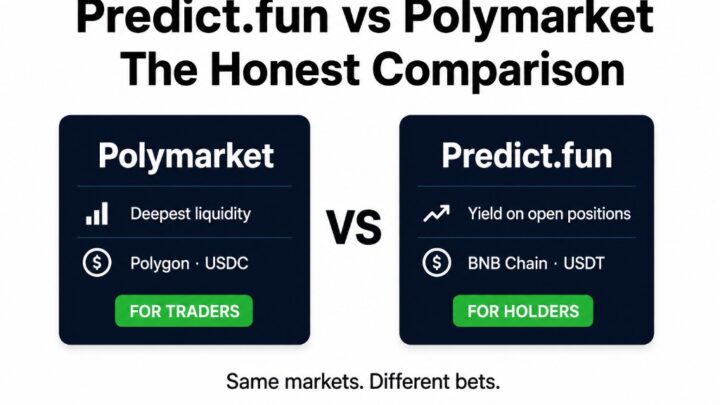
Predict.fun vs Polymarket: The Honest Comparison (2026)
Crypto Trading
Polymarket Fees 2026: Taker Fees, Spread & Real Costs
Crypto Trading
The Polymarket 5-Minute Strategy I Actually Use (Tested)
Crypto Trading