
Crypto Trading
Polymarket Bitcoin odds are a share price. If UP trades at 65¢, the market is pricing a 65% implied probability that Bitcoin finishes above the strike, before fees, and before you actually pay the ask. It is not a forecast, and it is not a signal that the trade is “easy.”
I'm Johannes Thüroff, M.Eng. I trade Polymarket 15-minute and 1-hour BTC UP/DOWN almost every day. I used to read 74% UP as “someone knows.” It took a stretch of dumb losses to treat that number as a price I might be paying too much for. This page is the mechanics; the full hub is the Ultimate Guide to Polymarket Crypto Trading. Timing lives in the 5-minute strategy. The rest of the process is in how to win on Polymarket Bitcoin UP/DOWN. Last updated: August 2026. Not financial advice.
Direct Answer
Polymarket Bitcoin odds are the last traded price of an UP or DOWN share. A share pays $1 if that side wins and $0 if it loses, so 65¢ is roughly 65% implied probability before fees. You do not trade the mid: you buy at the ask and sell at the bid, and since 2026 crypto markets also charge a taker fee. High odds after a fast move usually mean the crowd already paid up, not that the remaining risk is small. Read the number as a price. Then decide whether that price is wrong.
Key Takeaways
- Odds = share price. 65¢ UP means the market prices a 65% chance UP pays $1. It does not mean Bitcoin “will” go up.
- Payoff is binary. Right side → $1 per share. Wrong side → $0. Profit is $1 minus what you paid, after fees.
- Mid is not your fill. The number in the middle of the book can look fair while the spread eats the edge. You pay the ask.
- Fees sit on top of the price. Taker fees on crypto exist in 2026. Makers still pay 0%. The full schedule is in Polymarket fees explained.
- High odds are not a safe trade. 70–80¢ early in a 15-minute window often means you are buying the move that already happened. How I wait that out is the 5-minute rule, not this page.
What Polymarket Bitcoin Odds Actually Are
Polymarket Bitcoin odds are the market price of a binary share on a Bitcoin UP/DOWN contract. On a 15-minute BTC market, UP pays $1 if Bitcoin finishes above the “price to beat” at resolution. DOWN pays $1 if it finishes at or below.
That price is quoted in cents. Traders and the UI often show it as a percent. Same number:
- 65¢ UP = 65% implied probability for UP
- 35¢ DOWN = 35% implied probability for DOWN
In a complete market those two sides add up to about $1 before fees. If they don’t, someone is looking at stale quotes or a wide book, not a free lunch you should assume you can grab.
I keep repeating this because the UI trains you to read “74%” as a prediction. It is not. It is where other people have already been willing to trade.
Odds are crowd positioning, printed as a price. They are not a forecast of the next Bitcoin tick.
The $1 Payout: What 65¢ Actually Costs You
Every winning share redeems at $1. Losing shares go to $0. So the only math that matters at entry is: what did I pay, and what do I get if I’m right?
| Share price | Implied probability (before fees) | Cost of 20 shares | Payout if you win | Gross profit if you win |
|---|---|---|---|---|
| 30¢ | 30% | $6 | $20 | $14 |
| 50¢ | 50% | $10 | $20 | $10 |
| 65¢ | 65% | $13 | $20 | $7 |
| 80¢ | 80% | $16 | $20 | $4 |
| 1¢ | 1% | $0.20 | $20 | $19.80 |
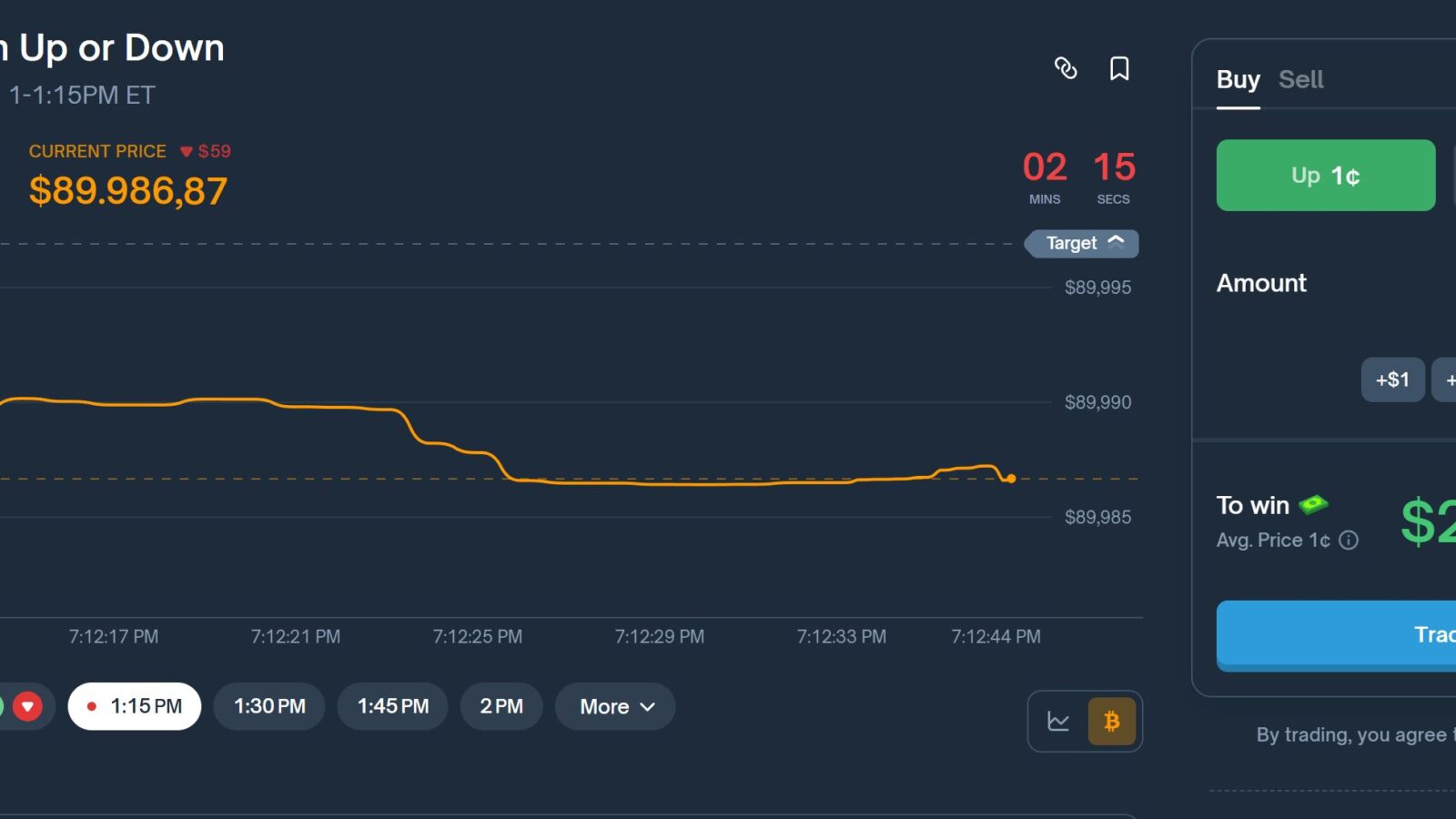
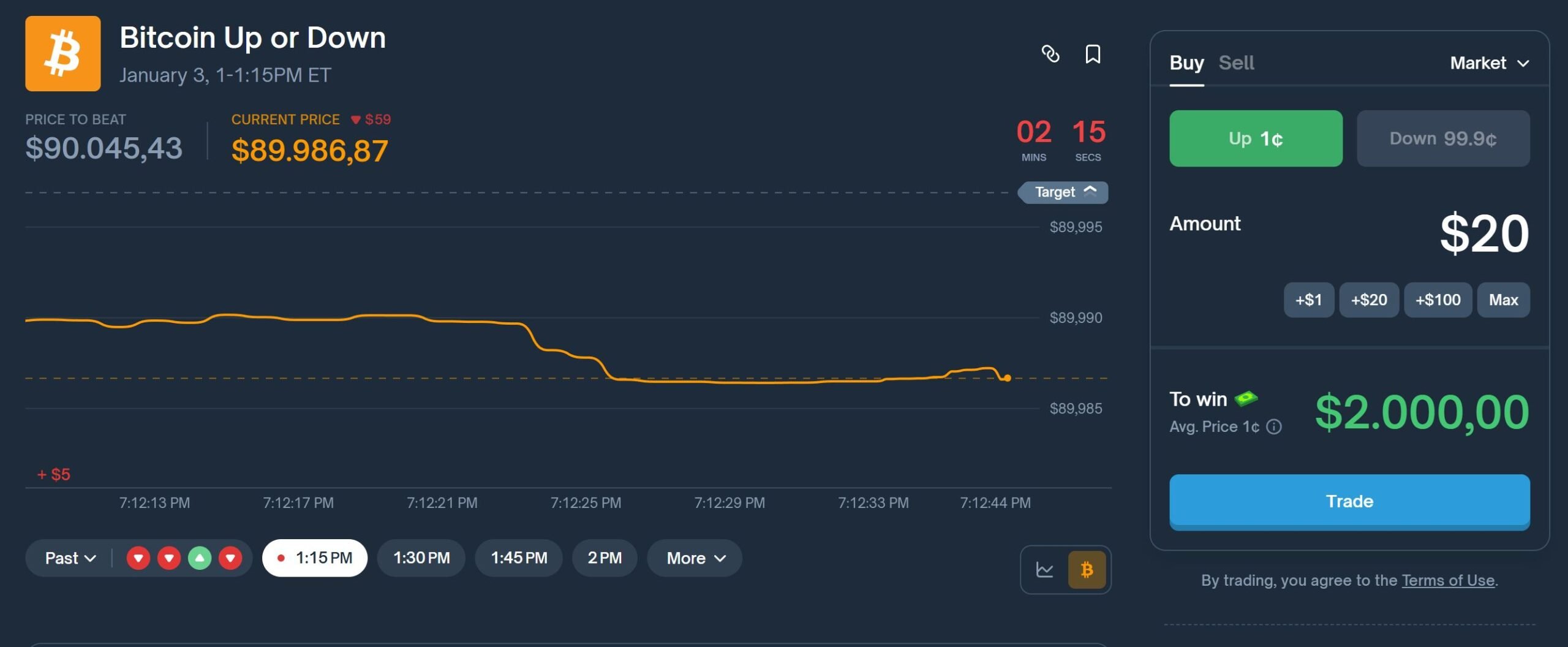
That last row is the screenshot at the top of this page. Two minutes left, Bitcoin already $59 below the price to beat, UP sitting at 1¢, DOWN at 99.9¢. A $20 buy of UP is 2,000 shares. If Bitcoin somehow rips $59 in two minutes, those shares pay $2,000. If it doesn’t, and it usually doesn’t, the $20 is gone.
Beginners see “to win $2,000” and think they found a lottery ticket with an edge. They found a 1¢ share because the market already decided UP was almost dead. The payout is large because the probability the market is pricing is tiny. Those two facts are the same fact.
I have bought cheap leftover shares like that. Sometimes they hit. Over a month they do not pay for the times they don’t. A 1¢ share that wins 1 time in 80 is still a losing bet.
Mid Price Vs What You Actually Pay
The number people screenshot is usually the mid: halfway between bid and ask. You cannot trade the mid. You buy at the ask. You sell at the bid.
On a calm 15-minute BTC book the spread is often 1–2¢. In a fast window it blows out to 5–10¢. If UP “looks like” 64¢ mid and the ask is 68¢, you just paid 68% implied, not 64%.
That gap is the first place my “edge” used to disappear. I would see 62¢, tell myself I had a small advantage, and fill at 66–67¢. The trade was never the trade I sized in my head.
If you need to exit before resolution, you sell at the bid. A 4¢ round-trip spread on a 50¢ share is 8% before any taker fee. On a 15-minute market you often don’t get a clean exit anyway, the position rides to $1 or $0.
Fees Sit on Top of the Odds
For years Polymarket’s headline was 0% fees. That era ended. Crypto markets picked up taker fees in 2026. Makers still pay 0% and can earn rebates.
The taker formula peaks around a 50¢ market. Extreme prices (1¢ or 99¢) pay less fee in dollars, which is why a 1¢ lottery ticket looks even cheaper than it is, the fee is not what kills you. The probability does.
I am not restating the whole schedule here. If you need maker vs taker, gas, and bridge costs, use Polymarket fees explained. The only point for this page: implied probability from the quote is before fees. Your real breakeven is a bit worse than the cent price you clicked.
Why 74% up Feels Safe, and Usually Isn’t
This is the trap I keep seeing, because I did it.
New 15-minute market opens. Bitcoin jumps. UP rips to 70–80%. It feels obvious. I buy UP. Then price goes nowhere, or it drifts back, and I watch an “easy” 75¢ share grind toward 40¢.
By the time odds look obvious, the move is usually already in the price. You are not getting 75% because the remaining path is easy. You are getting 75% because people already paid up, and the leftover 25% is the gap, the wick, and the last-minute mean reversion that 15-minute BTC loves.
High odds mean the crowd agrees. Agreement is not edge. Edge is when your probability is different from the price you can actually fill.
If the only reason you are buying is “the odds are high,” you are late.
How I wait out the open, and when I refuse a chase, is the Polymarket 5-minute strategy. This page stops at reading the number. That page is the clock.
How Odds Behave on 15-minute Vs 1-hour Vs 4-hour
Same $1 share. Different clocks. The number moves at the speed of the window.
| Horizon | How fast the odds move | What 70¢ usually means |
|---|---|---|
| 15-minute BTC | Seconds | The first impulse is often already priced. 70¢ early is frequently a chase. |
| 1-hour BTC | Minutes | More room for a second move. 70¢ can still be late; it is less instant-death than 15-minute. |
| 4-hour / daily | Slower | Odds can sit mid-range for a long time. A 70¢ print is less of a “you missed it” siren. |
I trade 15-minute and 1-hour BTC. I barely touch the 4-hour and daily UP/DOWN board. Not because those odds are “wrong”, because I do not sit those windows well, and a number I will not wait through is a number I should not trade.
Which horizon to pick is a process question. That lives in how to win on Polymarket, not here.
How I Actually Read the Odds Now
I do not ignore the price. I stopped treating it as a vote.
- Convert cents to implied probability. 58¢ = 58%. Say it that way so the brain stops hearing “safe.”
- Check the ask, not the mid. If I cannot buy at a price I like, there is no trade.
- Ask whether I have a reason the fill is wrong. If my only input is “everyone is on UP,” I am the exit liquidity.
- Size from the price I will pay. A $10 buy at 50¢ is 20 shares. A $10 buy at 80¢ is 12.5 shares and a tiny win if I’m right. Position sizing is a separate article: position sizing on Polymarket and Kalshi.
- Skip when the number already ran. Skipping is a position. Most 15-minute windows have no trade.
I also look at our own 15-minute probabilities in Crypticorn. I do not follow them blindly. I use them as a second number to compare against the Polymarket ask. If both say the same thing after a spike, I am usually late. If they disagree, I still need a fill I can live with, disagreement is not a market order.
Where This Page Stops
This article answers one question: what do Polymarket Bitcoin odds mean, and what do they not mean?
It does not answer:
- When to enter a 15-minute window, 5-minute strategy
- How to run the whole process (market, size, skip-rate, no martingale), how to win
- What the round trip actually costs, fees
Mixing those in here just turns a price explainer back into another strategy post. I already wrote those. Use them.
Faq: Polymarket Bitcoin Odds
What do Polymarket odds mean?
Polymarket odds are the share price of an outcome. On Bitcoin UP/DOWN, 65¢ UP means the market prices a 65% implied chance that UP pays $1 at resolution, before fees. It is not a prediction that Bitcoin will go up.
Does 65¢ mean 65% probability on Polymarket?
Yes, as implied probability before fees: a 65¢ share that pays $1 implies 65%. Your real breakeven is worse than 65% once you pay the ask and any taker fee. It is still not a guaranteed 65% hit rate on the next trade.
Do Polymarket odds predict Bitcoin price?
No. They show where traders have already been willing to buy and sell the binary share. That can lag, lead, or simply copy the last Bitcoin tick. I treat them as a price, not a forecast.
Should I always buy the higher-odds side?
No. The higher-odds side after a fast 15-minute move is often the crowded, already-priced side. Edge is paying less than your own probability, not buying whichever number is bigger.
What is the difference between mid price and bid/ask?
The mid is the midpoint of the book. You buy at the ask and sell at the bid. A 2–10¢ spread is normal on short BTC windows. If the mid looks like 50¢ and the ask is 54¢, you paid 54% implied, not 50%.
How do Polymarket fees change the odds?
Taker fees on crypto markets exist in 2026; makers still pay 0%. The fee is extra cost on top of the share price, so your true implied probability is a bit worse than the cent quote. Full numbers are in the fees article, this page does not duplicate the schedule.
Final Takeaway
- 65¢ is a price. Read it as 65% implied, then ask what you will actually pay at the ask.
- Winning shares pay $1. That is why 80¢ “safe” trades pay almost nothing when they hit, and why 1¢ tickets look like lotteries.
- High odds after a spike usually mean you are late, not that risk is gone.
- Timing, sizing, and skip-rate are separate pages. Do not turn this explainer back into a strategy dump.
If you want a second number to compare against the Polymarket ask on 15-minute and 1-hour BTC, that is what I built the up/down predictions for. They are decision support, not a bot and not a promise.
Author: Johannes Thüroff, M.Eng. | Last updated: August 2026
Not financial advice. See Disclaimer.
Further reading
Crypto Price Prediction
Polymarket Crypto Price Predictions: Crowd Odds vs AI Forecasts (2026)
Crypto Price Prediction
How Accurate Are AI Crypto Price Predictions? (2026)
Crypto Trading
Predict.fun vs Polymarket: The Honest Comparison (2026)
Crypto Trading
Ultimate Guide to Polymarket Crypto Trading (2026)
Crypto Trading
Polymarket Fees 2026: Taker Fees, Spread & Real Costs
Crypto Trading