
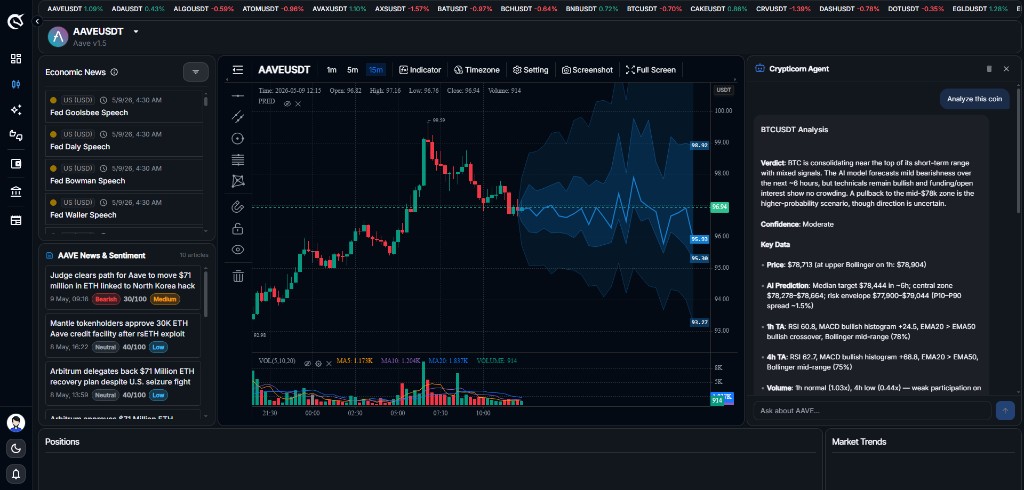
Type “AI crypto price prediction” into any search engine and you’ll find two kinds of content: sites claiming an AI knows Bitcoin’s price next Tuesday, and academic papers nobody can trade from. Neither tells you what AI price prediction actually is, what it can honestly do, and what every “97% accuracy” claim is hiding.
We build AI price prediction models at Crypticorn — they power our Prediction Dashboard and up/down probability feeds — so this explainer comes from the builder’s side: how these models really work, what they output, where they genuinely help traders, and the limits no honest vendor hides. Last updated: July 2026. Not financial advice.
Direct answer
AI crypto price prediction is the use of machine learning models to estimate probabilities of future price movements — not exact prices. A serious model ingests price history, volume, order-flow, on-chain and sentiment data, and outputs a probability distribution: “68% chance BTC finishes this hour higher; an 80% chance the price lands between X and Y in 6 hours.” Models that claim to know the exact future price are marketing. The honest value is a probability edge: knowing when the odds differ from what the market — or your gut — assumes.
Key takeaways
- Prediction ≠ prophecy: real AI models output probability distributions and ranges, never a single guaranteed price.
- The models learn repeating short-horizon patterns — crowd behavior, volatility regimes, order-flow signatures — which is why they’re strongest on minutes-to-hours timeframes and weakest on “where is BTC in a year?”
- A prediction is only useful with uncertainty attached: a forecast cone that widens with time is honest; a precise long-range target is a red flag.
- Accuracy claims are the scam tell: “97% accurate AI” either measures something trivial or is invented. Real edges are a few percentage points over 50/50, compounded by discipline.
- The practical use is pairing probabilities with position sizing and market prices — trading only when the model’s estimate diverges from the market’s implied odds.
- AI predictions cannot see news, black swans, or regime breaks before they happen — every honest system sits out what it cannot estimate.
What AI crypto price prediction actually is
Strip the buzzwords and the pipeline has three stages:
- Data: historical prices and volume at high resolution, order-book and flow data, volatility measures, and increasingly on-chain activity and social sentiment. The data decides everything downstream — a model trained on daily candles can’t say anything useful about the next 15 minutes.
- Model: anything from classical time-series statistics to gradient-boosted trees to deep learning. The architecture matters less than outsiders assume; the data quality, the target definition, and the validation honesty matter more.
- Output: a probability estimate for a defined question over a defined horizon — “up or down over the next hour,” “the distribution of returns over the next 6 hours.” Serious systems express uncertainty explicitly; this is the part most marketing skips.
The output shape is worth understanding because it’s what separates real tools from hype. Our dashboard renders it as a probability cone: the median expected path (P50) with a band showing where ~80% of modeled scenarios landed (P10–P90). The band is not a floor or ceiling, the median is not a target — and the cone widens with time because uncertainty grows. Any prediction product that doesn’t widen with the horizon is hiding the most important fact about forecasting.
What the models actually learn
Short-horizon crypto markets repeat themselves in ways long horizons don’t. The patterns a model can genuinely learn:
- Crowd behavior signatures — panic candles that revert, chased moves that exhaust, the shakeout patterns we’ve documented in how market odds lag real probability.
- Volatility regimes — quiet grind vs trending vs chop, and the different probability profiles each produces.
- Flow patterns — how order-book pressure and volume distribution precede short moves.
- Cross-market relationships — how BTC’s behavior conditions what altcoins do next.
Notice what’s not on the list: fundamentals, news, tweets from central bankers, exchange collapses. Models estimate the statistical component of price movement. The event-driven component is structurally unpredictable — which is why every serious quant system pairs its model with rules about when not to trade (we sit out scheduled news windows for exactly this reason).
Honest capabilities vs marketing claims
| Claim | Reality |
|---|---|
| “AI predicts Bitcoin’s exact price” | No model does this. Real output is a probability distribution that widens with time. |
| “97% accuracy” | Either measures something trivial (e.g., “price will move”) or is fabricated. Real short-horizon edges are single-digit percentage points over 50/50. |
| “Works on every timeframe” | Statistical patterns concentrate at short horizons. Beyond days, event risk dominates and honest uncertainty bands become enormous. |
| “Backtested 500% returns” | Backtests overfit. The honest questions: out-of-sample results, live track record, and what happened in regime changes. |
| “AI removes the risk” | Probability edges lose regularly by design. What manages risk is position sizing, not the model. |
How traders actually use AI predictions
A probability estimate becomes tradeable the moment you compare it against a price:
- Against prediction markets: if the model estimates 55% UP and the market prices UP at 40¢, that gap is the trade — the entire logic of using AI on Polymarket odds and our up/down feeds for 15min/1h/4h/daily markets.
- Against your own bias: the model doesn’t get excited by a green candle. When your conviction says “obvious long” and the model says 51/49, the model is telling you there’s no edge — the most valuable output is often the trade you skip.
- For sizing: the edge estimate feeds the Kelly math — a 54% edge sizes small; “no edge” sizes zero.
- In your workflow: via the dashboard, or conversationally through our ChatGPT app, which renders the same probability cones inline and explains the numbers.
The limits nobody should hide
- Regime change: models learn from history; when market structure shifts (new dominant players, new products, macro breaks), learned patterns decay until retraining catches up.
- Event blindness: no model sees a hack, an ETF headline, or a Fed surprise coming. Probability estimates apply between events, not through them.
- Self-defeating edges: widely exploited patterns shrink — the reason serious systems retrain continuously and why “static strategy” products decay.
- The gap between model and account: a good probability estimate poorly sized, or traded on a venue whose costs eat the edge, still loses money. The model is one layer of a system, never the system.
FAQ: AI crypto price prediction
What is AI crypto price prediction?
AI crypto price prediction is the use of machine learning models to estimate probabilities of future price movements from historical price, volume, order-flow, on-chain, and sentiment data. Honest systems output probability distributions — like “68% chance of closing higher this hour” or a widening forecast range — rather than exact price targets. The value is a probability edge over the market’s implied odds, not prophecy.
Can AI predict Bitcoin’s price?
Not as an exact number — no model can. What AI can do is estimate short-horizon probabilities (minutes to hours) with a real but modest edge over coin-flip, and quantify uncertainty as a range that widens with time. Long-range point targets (“BTC will hit $X by December”) are narrative, not prediction, regardless of whether a human or an AI produced them.
How accurate are AI crypto price predictions?
Honest short-horizon models achieve win rates a few percentage points above 50% on directional calls — an edge that compounds through volume and sizing, not a crystal ball. Claims of 90%+ accuracy either measure trivial outcomes or are marketing. Judge any system on out-of-sample performance and live results, never backtest screenshots.
What data do AI prediction models use?
High-resolution price and volume history, order-book and trade-flow data, volatility measures, and increasingly on-chain metrics and social sentiment. Short-horizon models need short-resolution data — and the target definition (“up/down over the next 15 minutes” vs “price in a year”) shapes everything about what the model can honestly learn.
Are free AI crypto predictions worth using?
As learning tools, sometimes; as trading inputs, be careful. The economics matter: running real models on real data costs money, so free predictions are usually either simplified indicators relabeled as AI, delayed outputs, or funnels. Whatever the price, apply the same test — does it show uncertainty, does it have a live track record, and does it ever tell you not to trade?
Final takeaway
- AI price prediction = probability estimation, not price prophecy. The cone is the honest shape of the future.
- The learnable patterns live at short horizons; long-range point targets are storytelling.
- Real edges are small, compounding, and paired with sizing — anyone selling certainty is selling something else.
- The best output a model gives you is often “no edge here” — the trade you skip.
If you want to see what honest AI prediction looks like — probability cones, direction scores, and explicit uncertainty across 15-minute to daily horizons — that’s what we build at Crypticorn: the Prediction Dashboard and up/down predictions. Not to promise wins — to show you the odds before you take the trade.
Author: Johannes Thüroff, M.Eng. | Last updated: July 2026
Not financial advice. See Disclaimer.


