People search for a crypto prediction platform and get three different products mixed together: AI spot forecasters, prediction-market analytics, and free SEO pages that publish year-end targets. I build probabilistic forecasting tools at Crypticorn and trade Polymarket crypto up/down markets. This comparison is about tools, not venues. For Polymarket vs Kalshi vs Predict.fun, read our best crypto prediction markets for 2026 guide first.
Last updated: August 2026. Not financial advice.
Direct answer
A crypto prediction tool is software that helps you estimate future prices or event odds. The honest split in 2026: spot AI dashboards (probability cones, up/down scores), prediction-market analytics (wallet PnL, smart-money screens, odds history), charting assistants (TradingView plus AI copilots), and free forecast pages (often point targets with thin methodology). No single platform wins every job. I use a probabilistic spot stack for near-term BTC/ETH context, TradingView for execution charts, and Polymarket analytics when I am trading event odds.
Key takeaways
- “Prediction platform” is three categories. Spot ML, crowd/event analytics, and free target farms are not interchangeable.
- Prefer tools that show uncertainty. Cones, bands, or calibrated probabilities beat “BTC to $X by December.”
- Short horizons are more checkable. 15-minute to daily outputs can be scored against reality; five-year SEO targets mostly cannot.
- Prediction-market aggregators complement spot models. HashDive-style tools analyze yes/no odds and wallets, not spot cones.
- Crypticorn is paid and probabilistic. Dashboard cones (~6 hours forward) plus up/down scores for Polymarket/Kalshi-style windows. Not a guarantee, not an autonomous trading agent product today.
- Free is not free if it hides risk. Entry/TP/SL cards without a published calibration track record are marketing, not infrastructure.
How I grouped these tools
I ignored “top 10 AI coins 2030” listicles and VC pitch decks. Each tool below had to do something verifiable today: publish a product page, show live data, or document limits plainly.
Pricing below was checked against each vendor’s site in August 2026. Numbers change. Verify before you budget.
Comparison at a glance
| Tool | Category | Primary output | Best horizon | Pricing (Aug 2026) |
|---|---|---|---|---|
| Crypticorn | Spot AI dashboard + up/down | P10–P90 cones, direction scores | ~6h cones; 15m–daily up/down | From $59/mo (Up/Down); $249/mo (Dashboard, includes Up/Down per pricing) |
| Santiment | On-chain + social analytics | Metrics, screener, alerts | Days to weeks (context) | Free tier; Pro ~$49/mo; Max ~$249/mo (source) |
| TradingView | Charting + AI copilot | Charts, TA summaries | Any timeframe you chart | Free tier; paid from ~$13/mo (source) |
| HashDive | Polymarket analytics | Wallet stats, Smart Score, charts | Event market lifetime | Free browse (source) |
| Polymarket Analytics | Polymarket data index | Leaderboards, history, OI | Resolved + open markets | Free browse; Premium $20/mo (source) |
| Polysights | PM + Kalshi terminal | Screener, AI briefs, execution | Event markets | Freemium beta (source) |
| CoinPrediction.ai | Free AI outlook pages | Narrative + range targets | 7d–1y SEO pages | Free (source) |
| WalletInvestor | ML forecast pages | Path + shaded band | 7d–5y | Free pages; premium unlock (source) |
| Metaculus | Crowd forecasting | Aggregated human probabilities | Months to years | Free (source) |
Spot AI forecasting tools
Crypticorn (what we ship)
I will not pretend we are neutral here. This is the stack I build. It belongs in the comparison because readers searching “crypto prediction platform” land on us, and you deserve an honest spec sheet.
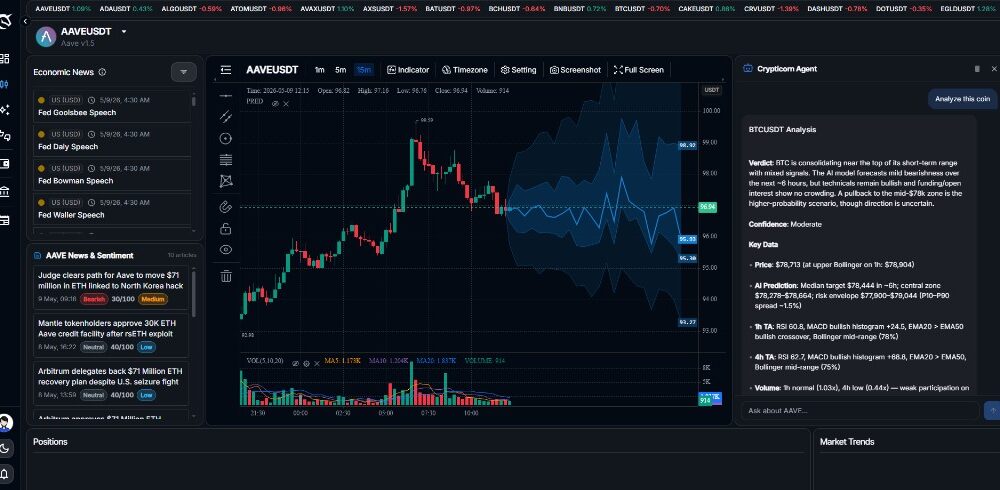
Prediction Dashboard (product page): live candles plus a forward probability cone for roughly the next six hours (about 24 fifteen-minute steps). You get a P10–P90 band and median path, not one target price. The on-chart Crypticorn Agent summarizes TA, news, and funding context. Updates land about every 15–30 minutes depending on load, per our FAQ.
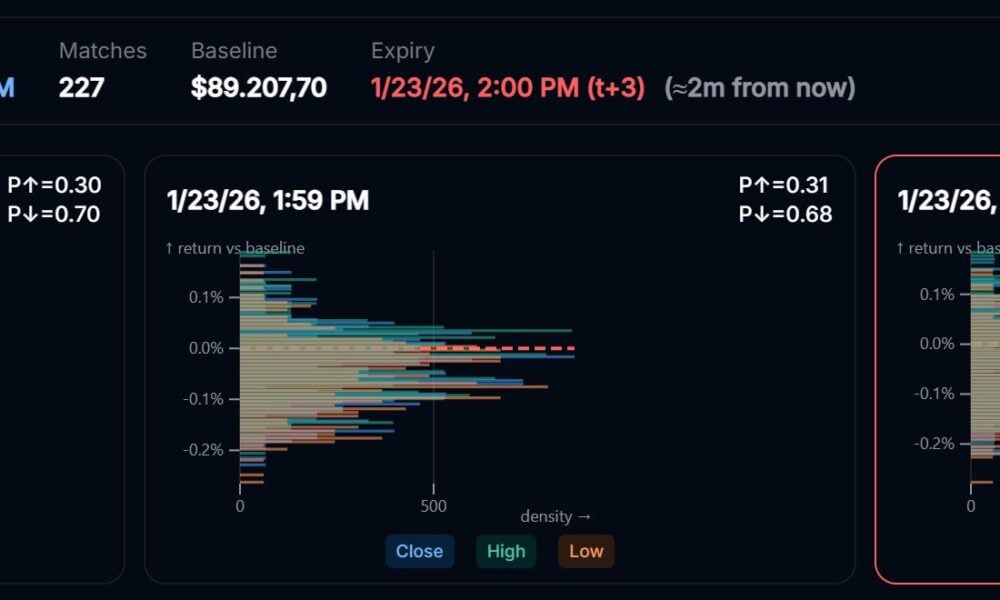
Up/Down predictions (product page): directional strength scores on 15-minute, 1-hour, 4-hour, and daily windows, aimed at Polymarket and Kalshi crypto up/down traders. Scores run from about -10 (down pressure) to +10 (up pressure). That is a different product shape than a year-end price page.
ChatGPT app (MCP): same analytics through chat for subscribers who prefer that UI. Details: Crypticorn ChatGPT app.
Strengths: Uncertainty-first outputs, short horizons you can actually score, workflow built for active crypto traders.
Limitations: Paid ($59/mo entry for Up/Down, $249/mo for full Dashboard per our pricing page). Not a prediction market. Not a promise of accuracy. Smaller-cap coins are harder because whale games break pattern models. We do not sell autonomous trading agents as a live commercial product today.
Santiment
Santiment is the tool I reach for when the question is “what are whales and social channels doing?” not “where is price in six hours?” On-chain flows, developer activity, and social volume help you build context. It is not a cone forecaster. Pair it with a probabilistic spot tool if you want both context and forward bands.
CoinPrediction.ai, WalletInvestor, DigitalCoinPrice-style sites
These dominate long-tail SEO. CoinPrediction.ai at least states predictions are unreliable on its own site. WalletInvestor documents that its models use historical price only and ignore news. That honesty helps, but the output shape is still often a point path or year target, which traders over-weight.
I mention them so you recognize the category, not because I recommend building a risk system on free 2030 targets.
Prediction-market analytics (aggregators)
Search “prediction market aggregator” and you should land here, not on a spot cone dashboard. These tools analyze event contracts (yes/no prices, wallets, resolution history).
HashDive focuses on Polymarket wallet quality, Smart Scores, and market charts. Polymarket Analytics indexes trader leaderboards and historical market data (third-party, not official Polymarket). Polysights spans Polymarket and Kalshi with screener columns and a trading terminal in beta.
I use this layer to ask “who is profitable on which market type?” and “how did similar markets resolve?” It does not replace spot cones when you are trading perp or spot charts. For how crowd odds relate to AI spot forecasts, see Polymarket crypto price predictions: crowd odds vs AI.
Charting and AI assistants
TradingView remains the default execution chart for most crypto traders. Its AI Chart Copilot (Chrome extension, public beta as of 2026) reads open charts and summarizes RSI, MACD, and support/resistance. That is descriptive TA assistance, not a calibrated forward distribution.
Crypticorn integrates with TradingView-style workflows in our marketing because the jobs stack: chart for execution, cone for forward uncertainty. Copilot usage limits scale with your TradingView plan during beta.
Crowd forecasting (different product again)
Metaculus aggregates human probability estimates on research questions. It is explicitly not a prediction market. Useful macro and tech context when a question exists, but sparse for “BTC next hour.” Treat it as research culture, not a trading feed.
What to avoid treating as an oracle
- Single year-end prices with no band and no calibration history.
- “80% confidence” labels without defining the metric or showing out-of-sample tests.
- Free trade cards with entry, take-profit, and stop without a verifiable track record.
- Confusing Polymarket yes-price (crowd-implied probability) with a spot ML forecast. Different inputs, different failure modes.
For the accuracy question in plain language, read how accurate AI crypto price predictions really are. For using cones in a workflow, see how to use AI crypto predictions for trading.
A practical stack (what I actually run)
- Spot bias: probabilistic dashboard or up/down scores for the next window I intend to trade.
- Context: on-chain/social analytics when the move looks positioning-driven.
- Execution chart: TradingView (or your broker UI) for entries and risk lines.
- Event odds: Polymarket analytics when the trade is a contract, not a perp.
That stack respects what each tool is good at. None of it removes fees, spread, or the need to size positions sanely.
Final takeaway
- Pick the category first: spot ML, market analytics, charting, or crowd research.
- Demand uncertainty: bands, cones, or calibrated probabilities.
- Match horizon to product: intraday tools for intraday decisions.
- Keep venues separate: tools compared here are not substitutes for our prediction markets comparison.
If you want to see how we implement probabilistic spot forecasting, start with the Prediction Dashboard or Up/Down predictions. Soft mention, same honesty rule as the rest of this site: probabilities, not prophecies.
FAQ
What is the best crypto prediction platform in 2026?
There is no universal winner. TradingView is best for charting. Santiment is strong for on-chain and social context. HashDive and Polymarket Analytics lead for Polymarket research. Crypticorn targets traders who want short-horizon probabilistic spot forecasts and up/down scores. Match the tool to the question you are asking.
What is a crypto forecasting tool?
Software that outputs forward-looking price or direction estimates from data (prices, on-chain flows, order books, or crowd odds). Honest tools show ranges or probabilities. Weak tools publish single targets without uncertainty.
What is a prediction market aggregator?
A dashboard that indexes prediction-market data: odds history, open interest, wallet performance, or cross-market screens. It analyzes event contracts, not spot candle cones. Examples include HashDive, Polymarket Analytics, and Polysights.
Are free crypto price prediction sites accurate?
Some disclose limits clearly; many do not. Even transparent ML extrapolation sites ignore news shocks by design. Treat free long-range targets as scenarios, not trade signals, unless the site publishes calibration you can audit.
How is Crypticorn different from Polymarket?
Polymarket is a venue where you trade event contracts. Crypticorn is forecasting software for spot crypto paths and up/down directional scores. We also publish Polymarket strategy content and compare venues, but we are not an exchange.
Does Crypticorn guarantee profitable trades?
No. We sell decision support with explicit uncertainty bands. Fees, sizing, and discipline still decide outcomes. Anyone promising guaranteed profits from AI predictions is not being honest about the problem.
Should I use AI predictions or prediction markets?
Often both, for different layers. Markets aggregate crowd beliefs about events. ML spot tools estimate price distributions from historical patterns. Compare them explicitly, as in our Polymarket vs AI forecasts article, instead of treating one yes-price as the other’s ground truth.