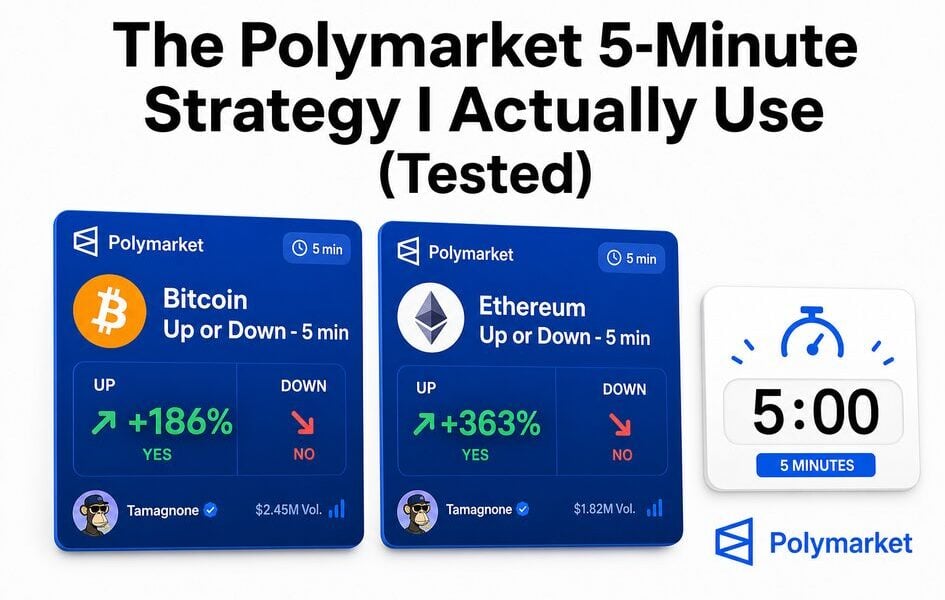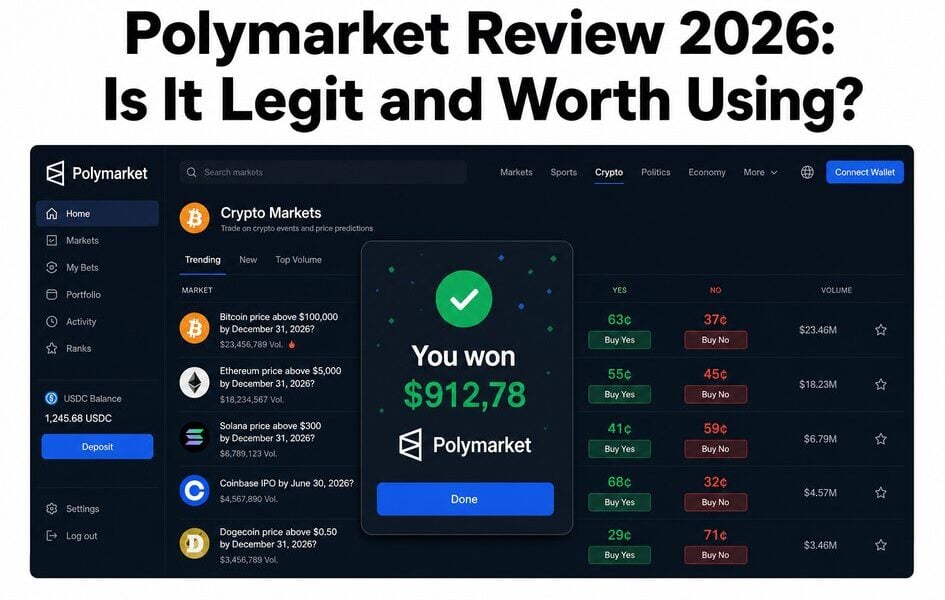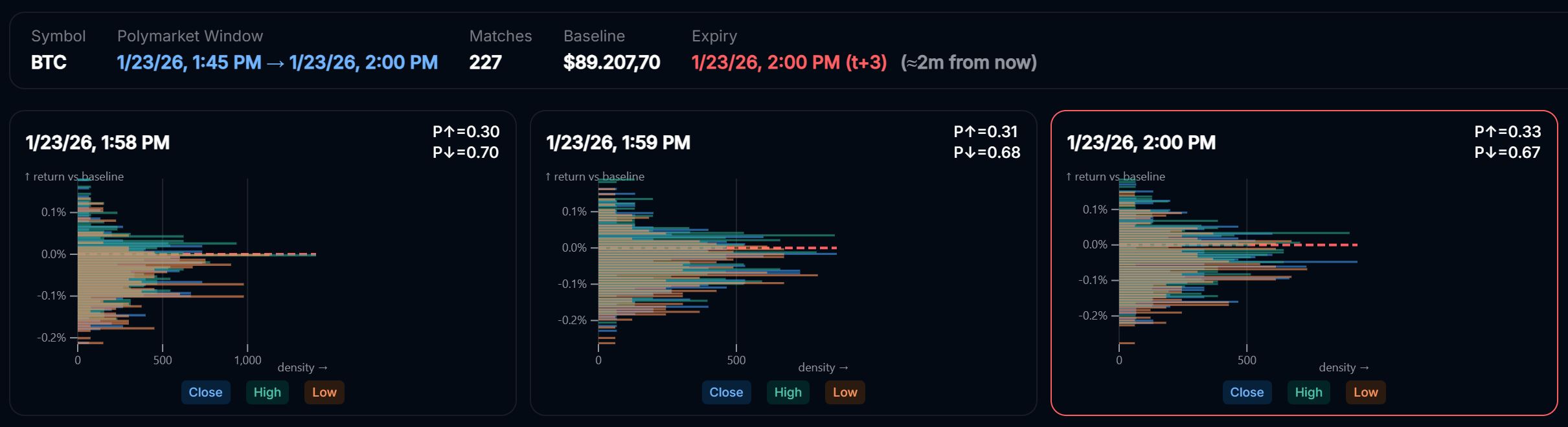
Search for “Polymarket crypto price predictions” and you get two different things mashed together: the crowd-implied odds on Polymarket’s Bitcoin and Ethereum UP/DOWN markets, and AI model forecasts that try to estimate direction before you trade. I do both daily. I trade Polymarket 15-minute and 1-hour crypto markets, and I build the probability tools at Crypticorn. This page separates the products, shows when each one helps, and where people waste time treating market prices like prophecies. Last updated: August 2026. Not financial advice.
Direct answer
Polymarket crypto price predictions usually means the implied probabilities on short-horizon BTC/ETH UP/DOWN contracts (15-minute, 1-hour, 4-hour, daily), where a 65¢ UP share means the crowd prices roughly a 65% chance BTC finishes above the strike in that window. That is not the same as an AI price forecast: AI tools output model-based direction scores and probability bands (for example P10–P90 cones) from features like order flow, funding, and sentiment. Use Polymarket odds to see where money already sits and what you pay to disagree; use AI predictions to form an independent view and decide when the market looks mispriced enough to trade after fees and spread.
Key takeaways
- Polymarket odds = crowd positioning, not a neutral forecast. High UP prices after a fast rally often mean you are late, not that UP is “more likely” in any objective sense.
- AI crypto predictions estimate probabilities from data. Honest systems show uncertainty (bands, calibration), not a single magic target price.
- The two tools complement each other: AI for a prior, Polymarket for executable price and liquidity.
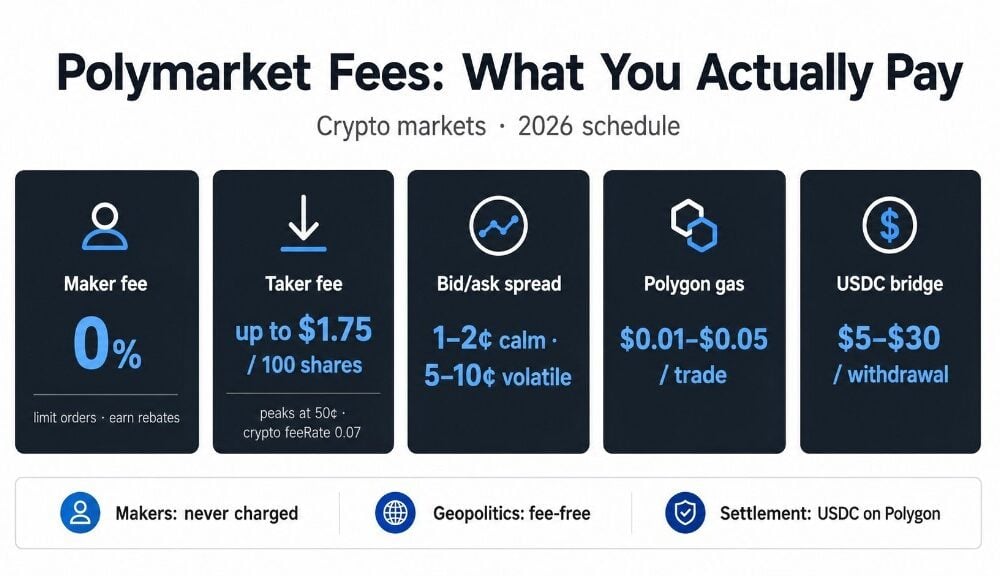
- 2026 taker fees on Polymarket crypto markets (feeRate 0.07, up to ~$1.75 per 100 shares near 50¢) mean your edge must clear spread and fees.
- Neither replaces sizing discipline. A small statistical edge dies fast without skip rules and fractional Kelly-style caps.
- Deeper context lives in the Polymarket trading guide, AI prediction guide, and best prediction markets comparison.
What people mean by “Polymarket crypto price predictions”
Three queries hide inside the same phrase:
- Market-implied probabilities on live UP/DOWN contracts (“BTC UP is 62¢ right now”).
- Whether Polymarket is a good place to bet on crypto direction (liquidity, fees, resolution).
- Whether AI can predict crypto prices well enough to trade those markets.
This article covers all three, but keeps the categories separate. Mixing them is how beginners buy 78¢ UP after a spike and call it “following the prediction.”
A Polymarket price tells you what it costs to agree with the crowd. It does not tell you the crowd is right.
How Polymarket crypto UP/DOWN markets work
Polymarket lists binary contracts on whether Bitcoin or Ethereum finishes above or below a reference price at the end of a fixed window. You buy UP or DOWN shares between $0.01 and $0.99. Winning shares pay $1.00; losers go to $0.
The headline numbers people call “predictions” are just live order-book prices. If UP trades at 65¢, the market implies ~65% before fees. That math is simple; the hard part is interpretation. After a sharp move, odds often reprice instantly. The “prediction” embedded in the price is mostly where traders already moved, plus whoever is still willing to provide liquidity on the other side.
For the full mechanics (resolution, strikes, market types), start with the ultimate Polymarket crypto guide. For odds specifically, read how Polymarket Bitcoin odds work. For entries, I use the 5-minute confirmation rule on 15-minute BTC markets and the broader playbook in how to win on Bitcoin UP/DOWN.
How AI crypto price prediction differs
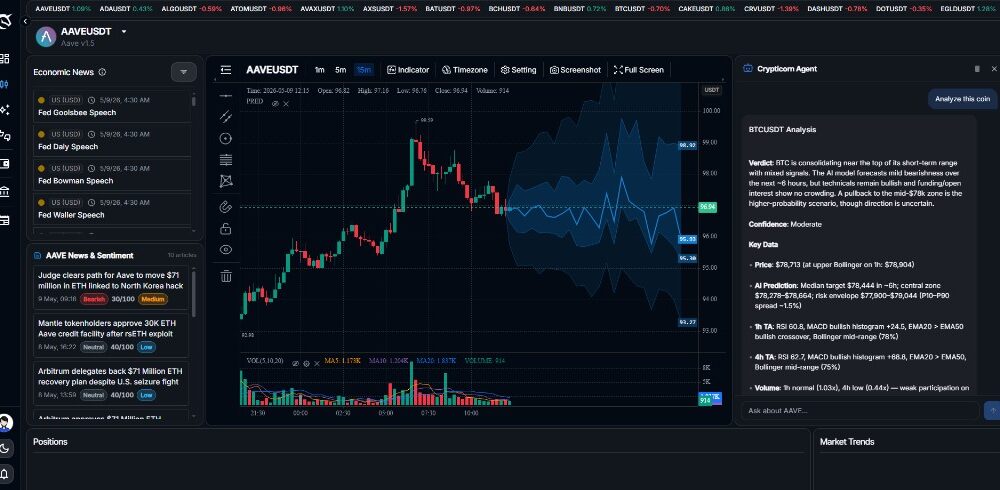
AI crypto price prediction, the way we build it at Crypticorn, is a different product category. Models ingest market microstructure, derivatives data, sentiment, and macro context, then output:
- Direction probabilities for short windows (15m, 1h, 4h, daily).
- Uncertainty bands (P10–P90 style ranges), not one exact future print.
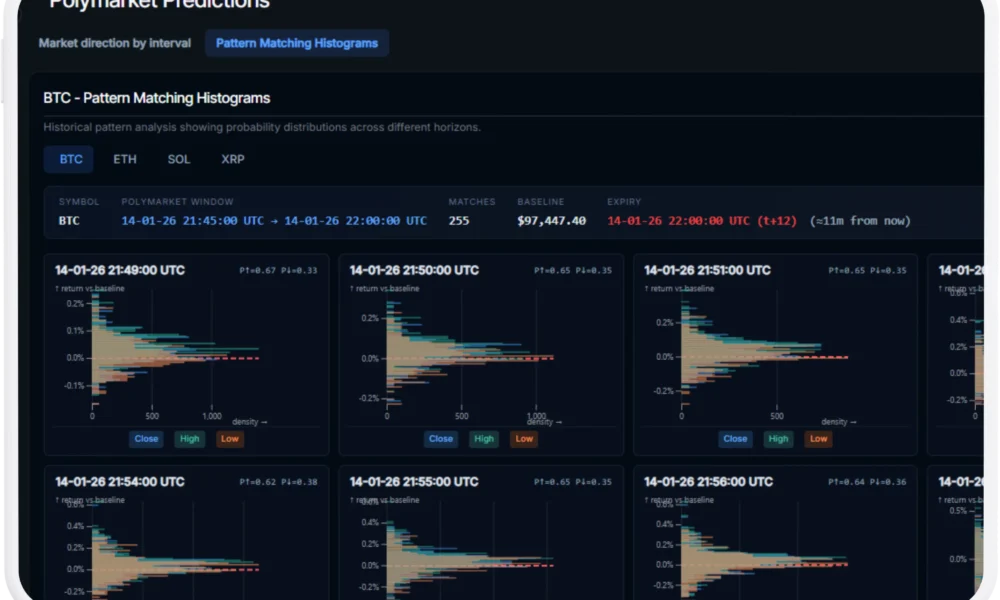
- Calibration targets: if the model says 60% UP often enough, outcomes should cluster near 60% over a large sample.
That is fundamentally unlike a single Polymarket mid-price. The model tries to estimate an underlying probability; Polymarket shows you the price to trade against other humans (and bots) right now.
If you need definitional depth, read what AI crypto price prediction is, how the models work, and how accurate they really are. Spoiler from someone who ships these tools: short-horizon edges are usually small. The value is honest uncertainty, not a 90% win-rate poster.
Polymarket odds vs AI forecasts (comparison)
| Dimension | Polymarket crypto UP/DOWN | AI crypto price prediction |
|---|---|---|
| What you get | Tradable share price (0–99¢) = crowd-implied probability | Model probability + range bands; not a live order book |
| Horizon | Fixed contract windows (15m, 1h, 4h, daily) | Same horizons, but as analytics you apply before trading |
| Costs to use | Spread (often 1–2¢ calm, wider in volatility) + 2026 taker fees on crypto + gas/bridge | Tool subscription; no direct market spread |
| Best for | Execution when you think the crowd is wrong by enough margin | Forming a prior, filtering bad setups, skip discipline |
| Main failure mode | Chasing repriced odds; ignoring all-in costs | Treating bands as certainty; overtrading tiny edges |
| Honest accuracy frame | “Did my trade beat fees at this entry?” | “Is the model calibrated out-of-sample?” |
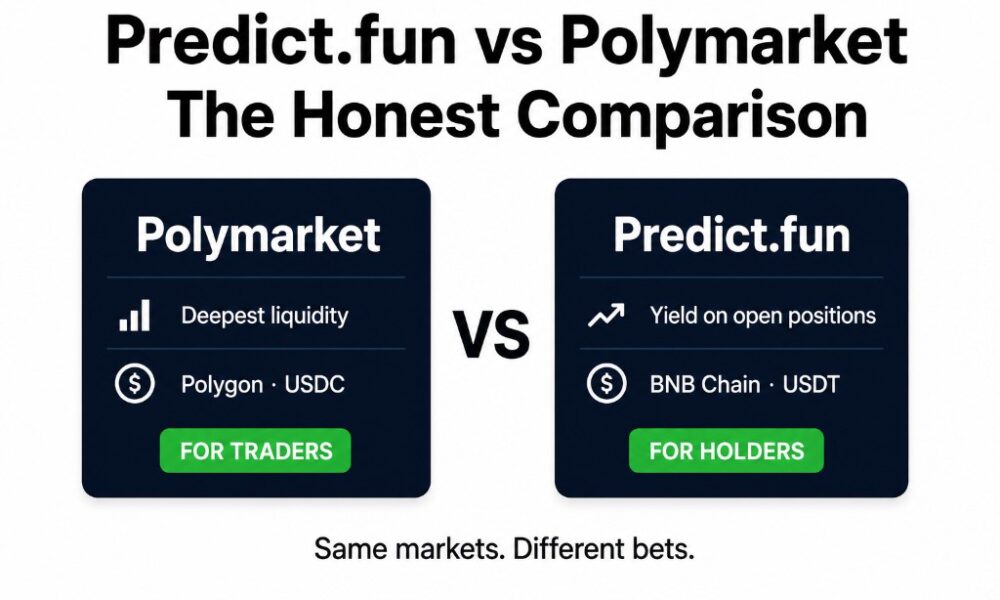
Polymarket also competes with other venues. Platform choice matters for fill quality. See the 2026 prediction markets comparison for Polymarket vs Kalshi vs Predict.fun on liquidity and fees.
When to use Polymarket odds vs AI tools
Use Polymarket market prices when you need executable information
You want to know:
- What it costs to buy UP or DOWN right now.
- Whether liquidity is tight enough to enter and exit without donating spread.
- How much the crowd already moved after news (sometimes the trade is “too expensive to disagree”).
Example I see weekly: BTC rips 0.8% in three minutes on a 15-minute market. UP jumps from 52¢ to 74¢. The “prediction” changed because positioning changed. Unless you had a view before the move, 74¢ is often a tax, not an edge.
Use AI predictions when you need an independent prior
AI helps when you want a structured estimate before you look at the ticket price:
- Direction score vs 50/50 with context (funding, vol regime, sentiment).
- Wide vs narrow P10–P90 band as a skip signal (wide band = sit out).
- Cross-check after the market reprices (“model still likes UP at 58% but market shows 71¢ UP: maybe pass”).
Our product pages for this lane: up/down crypto predictions and the Prediction Dashboard. Workflow write-up: trade Polymarket UP/DOWN with AI.
How I combine them in practice
My live loop on Polymarket BTC 15-minute markets looks boring on purpose:
- Check AI prior for the window (direction + band width). If the band is wide and the score sits near 50/50, I skip. No hero trades.
- Open Polymarket and read UP/DOWN prices after the first five minutes on 15-minute markets (see the 5-minute strategy).
- Compare model probability to market price. I need a gap that survives ~2–4% all-in costs (spread + taker fee + slippage). On a 50¢ entry, Polymarket’s 2026 crypto taker fee peaks around $1.75 per 100 shares per their fee docs. That is real math, not decoration.
- Size small with a hard cap per market. Edge estimates are noisy; streaks happen. See position sizing and skip rules in the win guide.
- Log outcomes against model bins. Calibration beats storytelling.
Some days I take zero trades. That is a feature. Polymarket publishes new windows constantly; AI tools do not obligate you to click.
Common mistakes (both sides)
- Treating 70¢ UP as “70% truth.” It is 70% priced. The crowd can be wrong, and often is after momentum spikes.
- Using AI like a signal service. A 54% UP estimate is not a mandate to buy UP at any price.
- Ignoring fees post-2026. Makers still free; takers pay on crypto markets. Backtests that assume zero fees lie.
- Confusing prediction markets with spot trading. You are buying event contracts, not BTC itself. Different risk, different resolution.
- Chasing accuracy marketing. If a vendor shows 90%+ “accuracy” without defining labels and horizons, walk away. Same standard as our accuracy article.
FAQ
Does Polymarket predict crypto prices?
Polymarket does not publish an official forecast. Traders price UP/DOWN contracts, and those prices imply probabilities. Treat them as market consensus for trading, not as vetted research. For platform context, see the Polymarket hub.
What is the difference between Polymarket odds and AI crypto predictions?
Polymarket odds are live, tradable crowd prices on binary contracts. AI crypto predictions are model estimates (direction probabilities and bands) built from data features. You trade against Polymarket prices; you use AI outputs to decide if those prices look wrong enough to bet.
Can AI predict Polymarket outcomes?
AI can estimate short-window direction probabilities for the same assets Polymarket lists, which helps you compare your view to market prices. It cannot guarantee wins, and it does not replace fee and spread math. Accuracy is about calibration and small edges, not certainty.
Which Polymarket markets are best for crypto price predictions?
For active trading, the short-horizon Bitcoin and Ethereum UP/DOWN books (15-minute and 1-hour) usually have the tightest spreads and most volume. Daily markets behave differently: more time for news, wider paths, different fee sensitivity. Match horizon to your process.
Are Polymarket crypto predictions free to use?
Reading odds is free. Trading is not: you pay spread, and takers pay fees on crypto markets since 2026. AI analytics may carry a separate subscription. Compare all-in costs before you count an edge.
Should I trust Polymarket or AI more?
Trust neither blindly. Use AI for an independent, uncertainty-aware prior. Use Polymarket for execution price and liquidity. When they disagree by a lot, ask why (news, thin book, model stale?) before you size up.
Where do I start if I am new to both?
Read AI crypto predictions: the complete guide for model basics, then the Polymarket pillar for market mechanics. Paper-log comparisons for a few sessions before sizing real USDC.
Final takeaway
- Polymarket crypto price predictions = crowd-implied odds on UP/DOWN contracts, best read as positioning and execution cost.
- AI crypto price prediction = model-based probabilities and bands for an independent prior.
- Combine them: AI to filter and form a view, Polymarket to trade only when price leaves enough margin after fees.
- Skip most windows. Small edges and tight costs beat constant clicking.
Explore the Prediction Dashboard and up/down predictions for the AI side, and keep the Polymarket guide open for fees, odds, and sizing when you execute.
Written by Johannes Thüroff, M.Eng.
Not financial advice. See Disclaimer.