
Crypto Trading
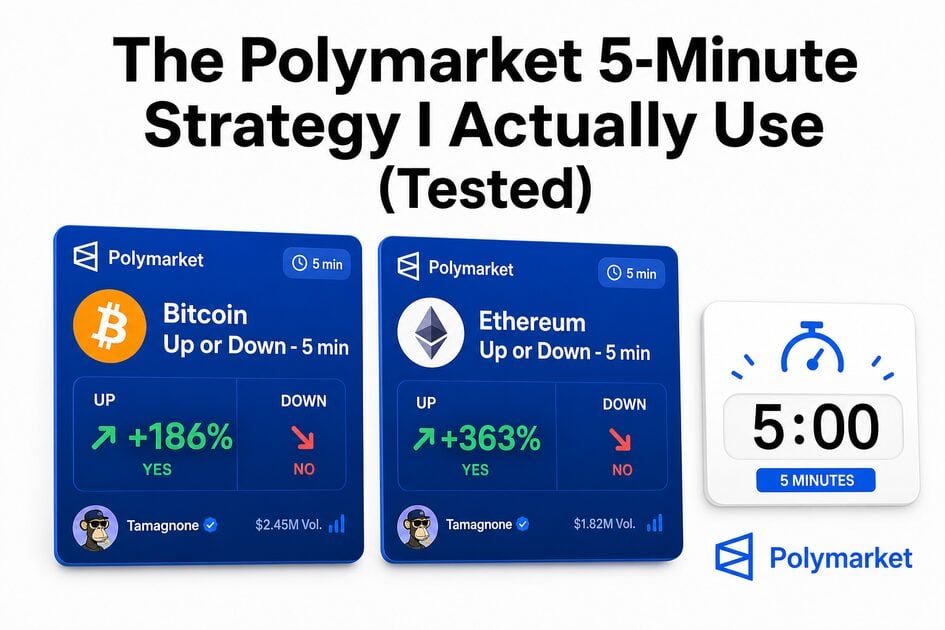
If you trade Polymarket Bitcoin up/down markets, the first 5 minutes are where most of the money is made or lost. Most beginners enter immediately, get caught in the shakeout, and lose. The strategy I use - and the one I'll walk through here - does the opposite: it waits for the first 5 minutes to tell you whether the move is real or a trap, then enters only on confirmed edges.
I'm Johannes Thüroff, M.Eng., and I trade Polymarket 15-minute and 1-hour Bitcoin UP/DOWN markets daily. This is the 5-minute strategy I actually use, with the entry rules, exit rules, real trade examples, and the sizing logic that keeps it from blowing up. Last updated: June 2026. Not financial advice.
This page is the timing rule only. The rest of how I think about winning - which market, size, skip-rate, no martingale - is in how to win on Polymarket Bitcoin UP/DOWN. For the full hub (setup, fees, sizing, bots, AI), see the Ultimate Guide to Polymarket Crypto Trading.
Direct Answer
The Polymarket 5-minute strategy is to wait for the first 5 minutes of a 15-minute BTC UP/DOWN market to reveal the true move, then enter only when the early shakeout has exhausted itself and price has confirmed a direction. The edge comes from trading against the late emotional money - the traders who entered in the first 60 seconds on adrenaline and are now stuck. The strategy fails when you trade it during low-volatility grind sessions or when you size positions by streak instead of by edge.
Key Takeaways
- The 5-minute strategy = wait for the first 5 minutes of a 15-minute BTC UP/DOWN market to settle, then enter on confirmed direction.
- The edge comes from trading against late emotional money - beginners who entered in the first 60 seconds and are now trapped.
- The entry rule: no entry in the first 5 minutes. After minute 5, enter UP/DOWN only if price has held a direction for ≥60 seconds and odds are still mispriced relative to the move.
- The exit rule: close at ~85–90¢ if the market confirms your direction. Hold to resolution only if odds reached your entry threshold cleanly.
- Don't trade this in low-volatility grind sessions, around major scheduled news, or when BTC is in a tight chop.
- Size by edge using fractional Kelly - never by streak. (See position sizing on Polymarket.)
What "5-minute Strategy" Means on Polymarket
Two interpretations show up in search queries, and both point to the same underlying skill:
- The 5-minute window inside a 15-minute market - using the first 5 minutes of a 15-minute BTC UP/DOWN market as an observation period before entering. This is what I do daily and what this article covers in detail.
- A dedicated 5-minute market - Polymarket has at times offered ultra-short crypto UP/DOWN markets. If and when those are available, the same principles apply at higher intensity: the shakeout pattern is even faster, the edge is thinner, and position sizing matters even more.
Both versions share the same core insight: in ultra-short crypto markets, the first chunk of time is noise, and the real edge is in waiting for the noise to resolve before committing capital.
If you haven't already, read the 5-minute mistake that kills Polymarket trades first - it covers the failure mode this strategy avoids. This article is the positive counterpart: what to do instead.
Why the First 5 Minutes Matter
The first 5 minutes of a 15-minute BTC UP/DOWN market are chaotic by design. Here's what's actually happening:
- Minute 0–1: the market opens. Bots reposition. Stop hunts trigger. Emotional traders rush in based on the candle that just closed on the underlying.
- Minute 1–3: the early move (often a fakeout) draws in late emotional money. DOWN odds might spike to 70–80% based on a 30-second BTC drop that doesn't actually continue.
- Minute 3–5: the shakeout exhausts. If the move was fake, price reverts. If the move was real, price continues but with cleaner structure.
- Minute 5+: the real direction (if any) is visible. Odds have often over-corrected, creating the entry opportunity.
The pattern I see over and over:
- Market opens
- BTC drops sharply for 30–60 seconds
- DOWN odds spike to 75–85¢
- Late sellers pile in at those odds
- BTC stabilizes
- BTC drifts back up over the next 8–10 minutes
- Market resolves UP
The traders who bought DOWN at 80¢ in minute 2 are stuck. The traders who waited until minute 5–6 and bought UP at 30¢ (when the shakeout was clearly exhausted) are the ones who win. Same market, opposite outcome, decided entirely by timing.
The Entry Rule (my Actual Rules)
Here's the specific entry logic I use. This isn't theoretical - it's what I run almost every day on Polymarket 15-minute BTC UP/DOWN markets.
No entry in the first 5 minutes
Hard rule. No exceptions. Even if the move looks obvious, even if odds look like free money. The first 5 minutes are for observation, not for trading.
After minute 5: the 3 conditions
After the 5-minute mark, I enter only if all three conditions are met:
- Direction held for ≥60 seconds. The post-shakeout direction (UP or DOWN) has to be sustained for at least 60 seconds. If price is still oscillating, no entry.
- Odds are still mispriced. The market odds lag the actual move. If BTC has clearly been trending up for 90 seconds but UP odds are still at 40¢ (implying 40% probability when the real probability is closer to 65%), that's the entry. If odds have already corrected to 70¢, the edge is gone.
- No major scheduled news in the next 10 minutes. If there's a Fed speaker, CPI print, or similar scheduled event before market resolution, I sit out. These events invalidate any technical edge.
When all three conditions are met, I enter with a position sized by edge (see the sizing section below). When any one of them fails, I sit on my hands.
What "mispriced" actually means
This is the part most articles gloss over. A 5-minute strategy isn't "buy UP when BTC is going up." That's not an edge - that's a description. The edge is in the gap between the market's current odds and the real probability.
I cover this in detail in how Polymarket Bitcoin odds actually work, but the short version: Polymarket odds reflect crowd positioning, not true probability. When the crowd is panicking (selling UP at 30¢ after a 60-second BTC drop), the true probability is often higher than 30%. That gap - between 30¢ market price and ~50% true probability - is the edge.
How do I estimate "true probability" faster than the market? That's what Crypticorn's UP/DOWN predictions are built for - AI-based probability estimates that don't get emotional.
The Exit Rule (when to Close Vs Hold to Resolution)
Once I'm in a 5-minute-strategy trade, the exit logic is mechanical:
| Scenario | Action | Why |
|---|---|---|
| Odds reach 85–90¢ in my favor | Sell and lock profit | The remaining 10–15¢ isn't worth the resolution risk. |
| Odds stall at 60–70¢ for 3+ minutes | Sell and exit | Momentum has faded - the edge is gone. |
| Odds reverse below my entry | Hold (don't panic) | If the entry conditions were valid, the thesis is still intact. |
| Odds reverse to 20¢ against me | Accept the loss at resolution | Selling at 20¢ locks a 30¢ loss; holding gives the thesis a chance. |
| Major news hits mid-trade | Sell immediately | News invalidates the technical edge - exit and reassess. |
The key insight: in a 15-minute market, you usually don't have time to "wait and see" if the thesis breaks. Decide your exits before you enter, and execute mechanically.
Real Trade Example (win)
This is a composite of a pattern I see roughly 2–4 times per week on Polymarket 15-minute BTC UP/DOWN markets:
- Market opens at 14:00. BTC is at $67,400.
- 14:00–14:01: BTC drops to $67,150 in 40 seconds. DOWN odds spike to 78¢.
- 14:01–14:03: Late sellers pile in. DOWN odds hit 82¢. UP at 18¢.
- 14:03–14:05: BTC stabilizes around $67,150. No further drop. DOWN odds drift to 75¢.
- 14:06: BTC starts recovering. $67,250. Sustained direction for 60+ seconds.
- 14:07: I check the 3 conditions. Direction held? Yes. Odds mispriced? UP at 28¢ when real probability is closer to 55%. No scheduled news? Correct. Entry: buy UP at 28¢.
- 14:08–14:11: BTC continues up to $67,500. UP odds climb to 88¢.
- 14:11: I sell UP at 85¢ (slightly below the 88¢ quote to ensure fill). Profit: 57¢ per share, ~200% return on the position.
- Market resolves UP at 14:15.
This is the trade the 5-minute strategy is built for. The traders who bought DOWN at 80¢ in minute 2 lost everything. The traders who waited and bought UP at 28¢ in minute 7 made 3x.
Real Trade Example (loss)
For honesty, here's a losing trade from the same pattern:
- Market opens at 10:00. BTC at $68,100.
- 10:00–10:02: BTC drops to $67,900. DOWN odds to 72¢.
- 10:02–10:05: BTC stabilizes. I'm watching for the recovery.
- 10:06: BTC starts recovering. $67,950. Direction held 60+ seconds. I enter UP at 35¢.
- 10:08: BTC rolls over and drops to $67,750. UP odds fall to 18¢.
- 10:11: BTC continues down. UP odds at 8¢. I hold (per the exit rule - selling at 8¢ locks a 27¢ loss; holding gives the thesis a chance).
- 10:15: Market resolves DOWN. Loss: 35¢ per share, full position lost.
What went wrong? The "stabilization" at 10:05 was a fake - BTC was in a sustained downtrend that day, and the bounce I read as a recovery was just a brief pause. The 5-minute strategy doesn't win every trade; it wins more than it loses when applied consistently, and the wins are larger than the losses when sized correctly.
This is why fractional Kelly sizing matters. One loss should not destroy your week.
When Not to Trade the 5-minute Window
The strategy stops working in three scenarios. Recognize them and sit out:
1. Low-volatility grind sessions
If BTC has moved less than 0.3% in the last hour, the 5-minute window won't produce a clear shakeout pattern. There's no emotional money to trade against. Sit out, do something else, come back when volatility returns.
2. Around major scheduled news
Fed speakers, CPI prints, FOMC minutes, major ETF flows - these invalidate any technical edge. The market will gap on the news and your "confirmed direction" from minute 6 becomes meaningless. I block out 15 minutes before and after scheduled news events.
3. Tight chop
If BTC is oscillating in a $50 range with no clear trend, the 5-minute window will produce false signals in both directions. The "direction held for 60 seconds" condition will pass, but the move will reverse immediately after entry. If you've lost two 5-minute-strategy trades in a row in chop, stop for the day.
Common Mistakes (beyond the Entry-timing One)
The biggest mistake is covered in the 5-minute mistake article - entering in the first 5 minutes. But even if you wait, these other mistakes will kill you:
- Chasing the move. If BTC has already moved 0.5% in your direction by minute 6, odds have probably already corrected. The edge is gone. Don't enter.
- Doubling down after a loss. The martingale trap. See why martingale fails on Polymarket - the math is brutal.
- Trading every market. Most 15-minute markets don't produce a clear 5-minute-strategy setup. I trade maybe 3–6 markets per day, out of 96 available.
- Ignoring the spread. If the bid/ask is 5¢ wide, you're starting 5¢ in the hole. Only trade when the spread is ≤2¢.
- Sizing by streak instead of by edge. The single most destructive habit. Position size should reflect your edge on this trade, not your need to recover the last loss.
Sizing for 5-minute-window Trades
The 5-minute strategy produces a higher win rate than entering at random, but it's not a high-win-rate system in absolute terms - maybe 55–65% of trades win, with the wins being 2–3x the size of the losses when exits are managed well. That profile calls for fractional Kelly position sizing:
- Bankroll = total USDC you've allocated to Polymarket trading.
- Edge per trade = your estimated true probability minus the market's implied probability (from the odds you're buying at).
- Full Kelly = (b × p − q) / b, where b is net odds, p is your probability, q is 1 − p.
- Fractional Kelly = ¼ or ½ of full Kelly. I use ¼ for 5-minute-strategy trades because the variance is higher than on longer horizons.
For the full math and a worked example with a $1,000 bankroll, see position sizing on Polymarket and Kalshi.
The short version: if your bankroll is $1,000, your average 5-minute-strategy position should be in the $30–$80 range - not $200, and definitely not $500. If you're sizing bigger than that, you're gambling, not trading.
Faq: Polymarket 5-minute Strategy
Does the 5-minute strategy work on Polymarket?
Yes, when applied with discipline. The strategy - waiting for the first 5 minutes of a 15-minute BTC UP/DOWN market to reveal the true direction, then entering only on confirmed edges - produces a 55–65% win rate in my experience, with wins typically 2–3x the size of losses. It fails when traders enter in the first 5 minutes (the shakeout), chase already-corrected odds, or size positions by streak instead of by edge.
What is the Polymarket 5-minute strategy?
The Polymarket 5-minute strategy is to use the first 5 minutes of a 15-minute BTC UP/DOWN market as an observation period, then enter only after minute 5 when (a) the post-shakeout direction has held for at least 60 seconds, (b) odds are still mispriced relative to the actual move, and (c) no major scheduled news is due before market resolution. The edge comes from trading against late emotional money trapped in the first 60 seconds.
When should I not trade the 5-minute strategy on Polymarket?
Sit out in three scenarios: low-volatility grind sessions where BTC has moved less than 0.3% in the last hour (no shakeout pattern to trade against), 15-minute windows around major scheduled news like Fed speakers or CPI prints (news invalidates the technical edge), and tight chop where BTC oscillates in a narrow range with no trend (the "direction held" condition will pass but the move will reverse immediately after entry).
What's the exit rule for the Polymarket 5-minute strategy?
Sell and lock profit when odds reach 85–90¢ in your favor. Sell if odds stall at 60–70¢ for 3+ minutes (momentum has faded). Hold if odds reverse slightly below entry but the thesis is intact. Accept the loss at resolution if odds reverse to 20¢ against you - selling at 20¢ locks the loss, holding gives the thesis a chance. Sell immediately if major news hits mid-trade.
How is the 5-minute strategy different from the 5-minute mistake?
The 5-minute mistake is entering in the first 5 minutes of a market - getting caught in the shakeout. The 5-minute strategy is the positive counterpart: waiting through the first 5 minutes, reading the post-shakeout direction, and entering only on confirmed edges after minute 5. Same 5-minute window, opposite action. The mistake article explains what not to do; this strategy explains what to do instead.
How should I size positions for the Polymarket 5-minute strategy?
Use fractional Kelly position sizing - typically ¼ Kelly for 5-minute-strategy trades because the variance is higher than on longer horizons. With a $1,000 bankroll, your average position should be in the $30–$80 range. Size by your edge on each trade, never by your need to recover a prior loss. The full math is in position sizing on Polymarket and Kalshi.
Can I run the 5-minute strategy as an automated bot?
Partially. The observation period (waiting 5 minutes) and the mechanical exit rules can be automated. The hard part to automate is the "odds are still mispriced" condition - that requires estimating the true probability faster than the market, which is exactly what AI-based prediction systems like Crypticorn's are built for. A pure rule-based bot without a probability edge will not be profitable long-term.
Final Takeaway
The Polymarket 5-minute strategy in one sentence:
Wait for the first 5 minutes to tell you what the move actually is, then enter only when the edge is real.
- Wait through the shakeout (minutes 0–5).
- Observe whether the post-shakeout direction holds for 60+ seconds.
- Enter only when odds are still mispriced and no scheduled news is due.
- Exit mechanically - lock profit at 85–90¢, exit stalled trades, hold reversals if the thesis is intact.
- Size by edge (¼ Kelly), never by streak.
- Sit out in low-volatility grind, around major news, and in tight chop.
If you want a probability edge to power the "odds are still mispriced" check, that's what we build at Crypticorn - our AI-based UP/DOWN predictions are here. Not to guarantee wins, but to skip the trades where there's no edge.
Author: Johannes Thüroff, M.Eng. | Last updated: June 2026
Not financial advice. See Disclaimer.
Further reading
Crypto Price Prediction
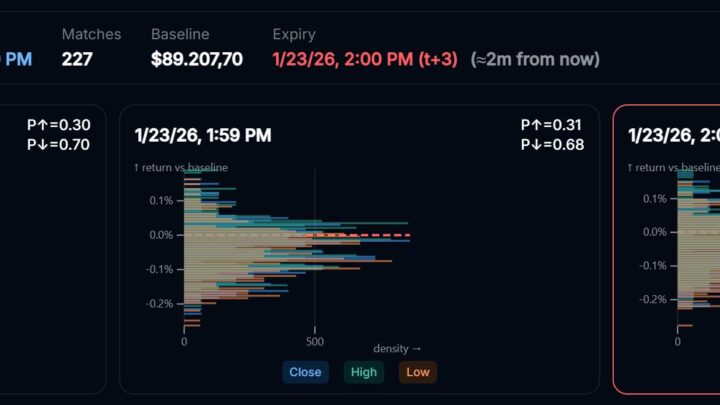
Polymarket Crypto Price Predictions: Crowd Odds vs AI Forecasts (2026)

Crypto Price Prediction
How Accurate Are AI Crypto Price Predictions? (2026)

Crypto Trading
Predict.fun vs Polymarket: The Honest Comparison (2026)
Crypto Trading
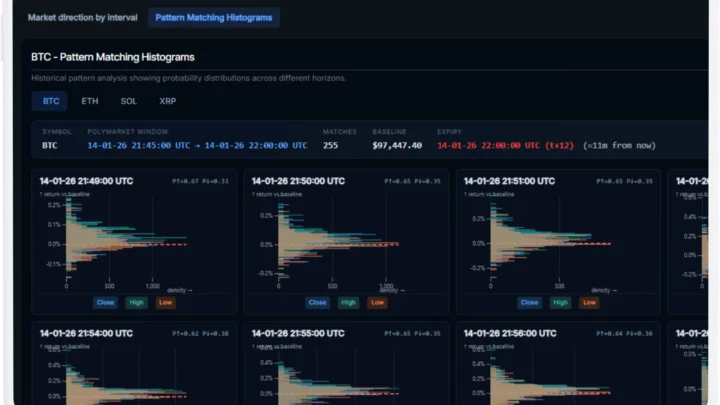
Ultimate Guide to Polymarket Crypto Trading (2026)
Crypto Trading
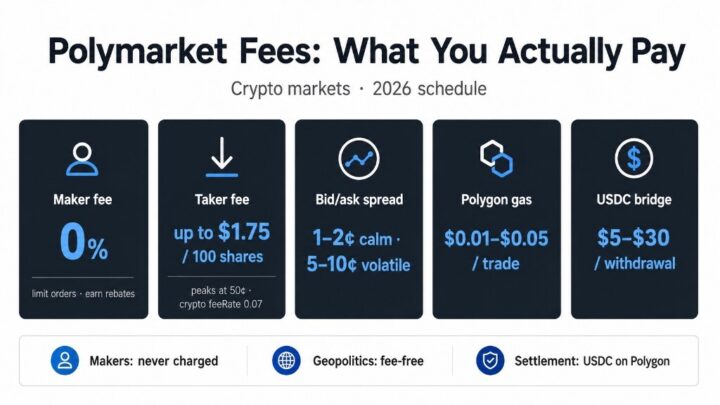
Polymarket Fees 2026: Taker Fees, Spread & Real Costs

Crypto Trading