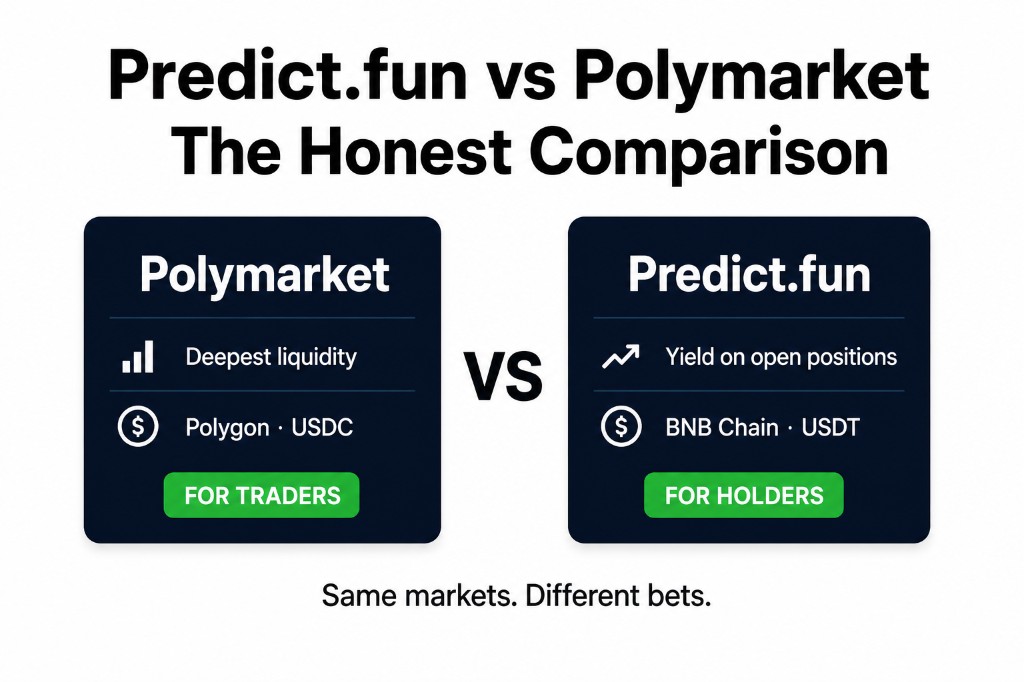
Predict.fun is the first prediction market to make Polymarket look expensive to hold positions on — because on Predict.fun, your collateral earns yield while your bet is open. That single design choice, plus a Binance-ecosystem pedigree, has made “predict.fun vs Polymarket” one of the fastest-growing comparison questions in prediction markets. Here’s the honest answer, from the perspective that matters to us: short-horizon crypto trading.
I trade Polymarket crypto up/down markets daily and build AI tooling for prediction markets at Crypticorn, so this comparison focuses on what actually affects traders — liquidity, fees, market structure — not marketing pages. Last updated: July 2026. Not financial advice.
Direct answer
Polymarket and Predict.fun are structurally similar — on-chain order books, conditional YES/NO tokens, UMA oracle resolution — with three real differences. Predict.fun pays yield on open positions (collateral routed through Venus Protocol on BNB Chain) and offers easier onboarding (email/Google/X login, sponsored gas). Polymarket has far deeper liquidity, especially on short-horizon crypto up/down markets, and a longer track record. Fees are now comparable: both charge takers. For active crypto up/down trading, liquidity wins — Polymarket. For longer-dated positions where idle collateral matters, Predict.fun’s yield model is a genuine edge.
Key takeaways
- Same skeleton: both are on-chain prediction markets with order books, 0–$1 outcome shares, and UMA optimistic-oracle resolution.
- Predict.fun’s differentiator is yield on open positions — USDT collateral earns via Venus Protocol on BNB Chain whether you win or lose.
- Polymarket’s differentiator is liquidity — the deepest books in prediction markets, especially 15-min/1h crypto up/down, where Predict.fun’s thinner books mean wider spreads.
- Chains and stablecoins differ: Polygon + USDC vs BNB Chain + USDT; Predict.fun sponsors gas and offers email login.
- Both charge taker fees in 2026 (Polymarket added them Jan–Mar 2026); makers trade free on both.
- Predict.fun launched December 2025 and has processed $1.7B+ volume — real traction, but still a fraction of Polymarket’s depth.
The comparison at a glance
| Polymarket | Predict.fun | |
|---|---|---|
| Chain / currency | Polygon / USDC | BNB Chain / USDT |
| Yield on open positions | None | Yes — collateral earns via Venus Protocol automatically |
| Liquidity depth | Deepest in the category, tight spreads on crypto up/down | Growing fast ($1.7B+ volume since Dec 2025) but thinner books, wider spreads |
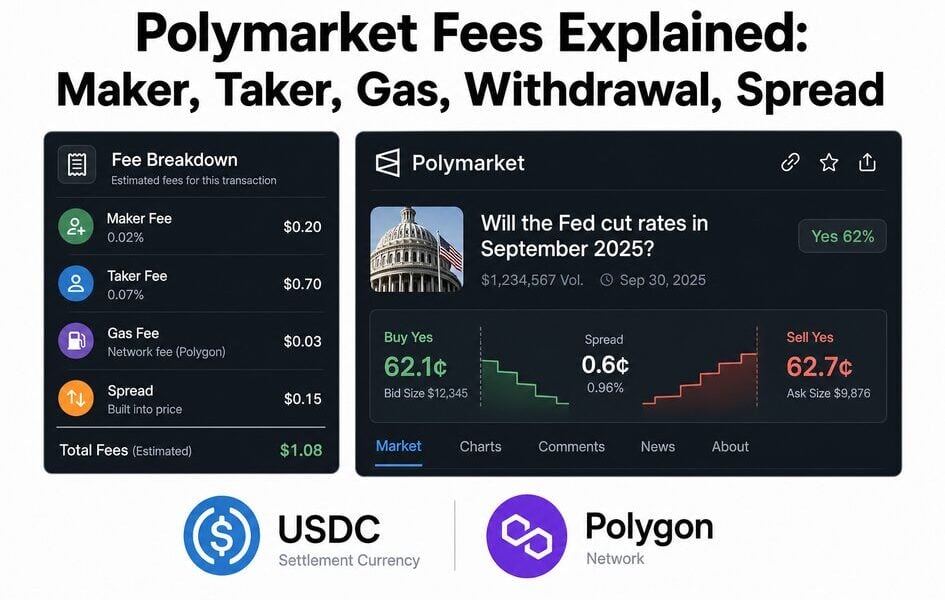
| Fees | Taker fees since 2026 (crypto: up to $1.75/100 shares; makers free + rebates) | Low taker fees, sponsored gas, free deposits/withdrawals |
| Onboarding | Web3 wallet or email login; bridge USDC to Polygon | Email, Google, or X login — smart wallet, no setup |
| Resolution | UMA optimistic oracle | UMA optimistic oracle |
| Market types | Binary + multi-outcome; short-horizon crypto up/down is its strength | Binary + multi-outcome + “bond markets” (near-certain events, ~1–2% returns) |
| Ecosystem | Independent; the category’s reference platform | YZi Labs (ex-Binance Labs) backed; Binance Wallet + Trust Wallet integrations |
Where Predict.fun genuinely wins
Idle capital works. On Polymarket, $1,000 in open positions is $1,000 doing nothing until resolution. On Predict.fun, that collateral is routed through Venus (a BNB Chain lending market) and accrues yield regardless of outcome. For short 15-minute markets this is a rounding error — but for positions held days or weeks, it’s a structural advantage no other major platform offers. Their “bond markets” category leans into this: near-certain outcomes priced for small, low-risk returns on top of the collateral yield.
Onboarding is genuinely easier. Email/Google/X login with a smart wallet, sponsored gas, free deposits and withdrawals — compare that to bridging USDC to Polygon and paying $5–30 to get money out of the Polymarket ecosystem (the full Polymarket cost breakdown). For a first-time prediction market user, Predict.fun is the gentler entry.
The Binance orbit. Backed by YZi Labs, integrated into Binance Wallet and Trust Wallet, and it absorbed PancakeSwap’s Probable in March 2026 — it’s consolidating as BNB Chain’s prediction market. Distribution like that tends to compound.
Where Polymarket still wins (and why I trade there)
Liquidity is the product. Everything I’ve written about reading odds and timing entries depends on books deep enough that your fill resembles the quote. Polymarket’s 15-minute and 1-hour BTC/ETH markets are the deepest short-horizon books in prediction markets. Thinner books — and Predict.fun’s are thinner, as a platform seven months old — mean wider spreads, worse fills, and strategies that stop working at size. In prediction markets, the spread is the fee, and liquidity is what compresses it.
Track record and market structure. Polymarket has run through multiple market cycles, a CFTC settlement, and years of oracle disputes — its failure modes are documented (I covered them in the 2026 review). Predict.fun’s $1.7B in seven months is impressive, but depth of history matters when your money rides on resolution edge cases.
Note on fees: this used to be Predict.fun’s cleaner win, but Polymarket’s 2026 fee rollout made them comparable — both charge takers, both let makers trade free. The bigger cost difference now is spread depth, which favors Polymarket, versus withdrawal friction, which favors Predict.fun.
The verdict by trader type
- Short-horizon crypto up/down traders (my lane): Polymarket. Liquidity decides these markets, and yield on a 15-minute position is irrelevant.
- Longer-dated event traders: genuinely worth splitting — Predict.fun’s collateral yield compounds on positions held for weeks, and its bond markets add a low-risk sleeve.
- Beginners: Predict.fun’s onboarding is easier; just remember easier entry doesn’t make the trading easier.
- US users: neither — both are on-chain platforms with geo-restrictions; the regulated route remains Kalshi (Polymarket vs Kalshi).
- Yield-first users: understand that Venus yield adds smart-contract and protocol risk on top of your prediction risk. Nothing is free.
Whichever venue you trade, the hard part is identical: estimating true probability better than the crowd prices it. That’s the layer we build at Crypticorn — AI up/down probabilities for exactly these markets. The platform choice changes your costs; the probability edge decides your outcomes.
FAQ: Predict.fun vs Polymarket
Is Predict.fun better than Polymarket?
It depends on holding period. Predict.fun wins on capital efficiency (collateral earns yield via Venus Protocol while positions are open) and onboarding (email login, sponsored gas). Polymarket wins on liquidity depth — decisive for short-horizon crypto trading where spreads determine costs — and track record. Active traders generally do better where the books are deepest; longer-dated position holders benefit from Predict.fun’s yield.
What is Predict.fun?
Predict.fun is a decentralized prediction market on BNB Chain, launched December 2025 and backed by YZi Labs (formerly Binance Labs). It uses USDT collateral, an on-chain order book with conditional YES/NO tokens, and UMA oracle resolution — structurally similar to Polymarket — with one distinctive feature: open-position collateral is automatically routed through Venus Protocol to earn yield. It has processed over $1.7 billion in volume across 125,000+ users.
Does Predict.fun really pay yield on open positions?
Yes — collateral backing open positions is deposited into Venus Protocol, a lending market on BNB Chain, and accrues interest until resolution, win or lose. The caveat: that yield carries Venus smart-contract and market risk on top of your prediction exposure. It’s a genuine innovation, not free money.
Which has lower fees, Predict.fun or Polymarket?
They’re closer than they used to be. Predict.fun advertises low taker fees, sponsored gas, and free deposits/withdrawals. Polymarket introduced taker fees across 2026 (crypto markets: up to $1.75 per 100 shares, peaking at 50¢) with makers trading free and earning rebates. For market-order traders the platforms are comparable; the practical cost difference is Polymarket’s deeper books (tighter spreads) versus Predict.fun’s frictionless withdrawals.
Can US users trade on Predict.fun or Polymarket?
Both are on-chain platforms that geo-restrict US users; direct access violates their terms. The regulated US alternative for event contracts is Kalshi. Rules vary by jurisdiction — verify your local status before funding either platform.
Final takeaway
- Same architecture, different bets: Predict.fun bets on capital efficiency, Polymarket on liquidity.
- For 15-minute crypto up/down trading, liquidity wins — Polymarket. For weeks-long positions, Predict.fun’s yield is real money.
- The 2026 fee changes erased Polymarket’s old “0% fees” edge — spread depth is now the real cost battleground.
- Neither platform gives you an edge. The probability estimate does — and it’s portable across both.
Author: Johannes Thüroff, M.Eng. | Last updated: July 2026
Not financial advice. See Disclaimer.