For years, Polymarket’s headline was 0% fees — and for years it was true. That era ended in 2026: crypto markets picked up taker fees in January, and by March 30 the fee schedule covered nearly every category. Makers still trade free. So the real cost of trading Polymarket now has five parts: the new taker fee, the spread, the gas, the bridge, and resolution risk. This article breaks down every cost I actually pay as a daily Polymarket crypto up/down trader, with real numbers — updated for the 2026 fee schedule.
I’m Johannes Thüroff, M.Eng., and I trade Polymarket 15-minute and 1-hour BTC UP/DOWN markets almost every day. I’ve kept rough track of my effective costs for the past year. Here’s the honest breakdown. Last updated: June 2026. Not financial advice.
Direct answer
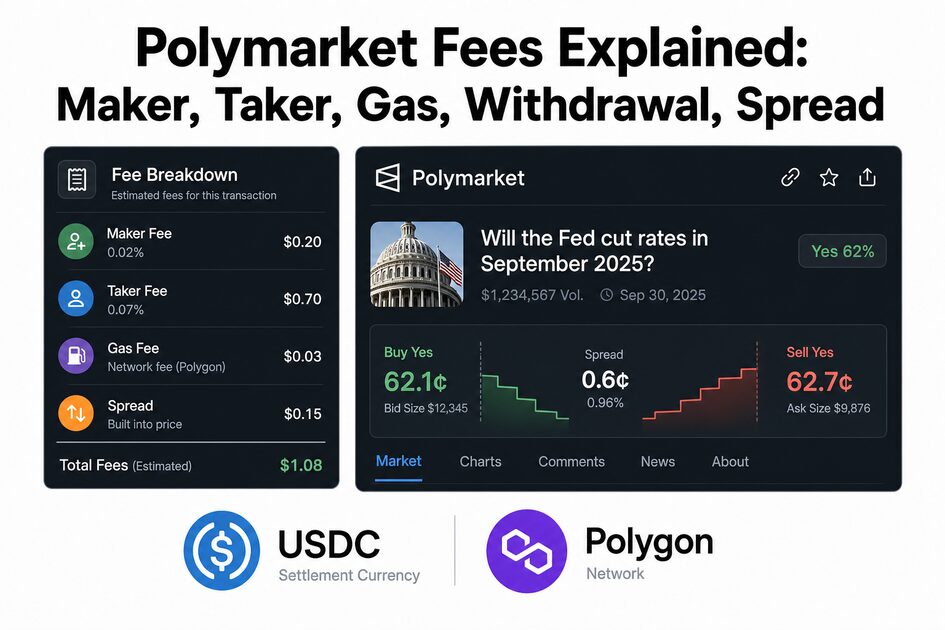
Since 2026, Polymarket charges taker fees on crypto up/down trades: fee = shares × 0.07 × price × (1 − price), peaking at $1.75 per 100 shares on a 50¢ market. Makers still pay 0% and earn 20% of collected taker fees as rebates. On top of that: bid/ask spread (1–2¢ calm, 5–10¢ volatile), Polygon gas ($0.01–0.05/trade), USDC bridge fees ($5–30 per withdrawal), and resolution risk. A market-order round trip at mid prices now runs roughly 8–10% all-in; trading with limit orders (as a maker) keeps it near the old ~2–4%.
Key takeaways
- 2026 update: Polymarket now charges taker fees on crypto markets (feeRate 0.07, up to $1.75 per 100 shares, peaking at 50¢). Makers still pay 0% and earn 20% rebates. Geopolitics markets remain fee-free.
- Real cost 1 — spread: 1–2¢ on liquid 15-min BTC UP/DOWN, 5–10¢ during volatility or on illiquid markets. Crossing the spread is the fee.
- Real cost 2 — Polygon gas: $0.01–0.05 per trade. Tiny but compounds across high-frequency trading.
- Real cost 3 — USDC bridge: $5–30 to withdraw USDC from Polygon back to Ethereum mainnet, depending on gas at the moment.
- Real cost 4 — resolution risk: markets that resolve against you on a technicality. Rare, but a 100% loss when it happens.
- Effective round-trip cost at mid prices: ~8–10% for market orders (taker fees both ways + spread), or ~2–4% via limit orders (makers pay no fee, only spread dynamics and gas).
- How to minimize: use limit orders (don’t cross the spread), batch withdrawals, trade only liquid markets.
From 0% to taker fees: what changed in 2026
Polymarket’s order book still matches buyers and sellers peer-to-peer on Polygon — but the fee model changed in 2026. Crypto markets got taker fees in January; on March 30 the schedule quietly expanded to nearly every category. The current structure, from Polymarket’s own fee documentation:
- Makers are never charged. Limit orders that get filled pay no fee — and makers receive rebates (20% of collected taker fees on crypto markets, paid daily).
- Takers pay per fill: fee = shares × feeRate × price × (1 − price). Crypto’s feeRate is 0.07 — the highest category — peaking at $1.75 per 100 shares at 50¢ and shrinking toward the extremes (a 90¢ fill costs ~$0.63 per 100 shares).
- Geopolitics markets are fee-free; other categories run feeRates of 0.04–0.05.
- A tiered taker-rebate program returns part of the fees to high-volume takers.
Two practical consequences. First, the fee peaks exactly where 15-minute crypto markets live — near 50¢. Second, the maker/taker asymmetry got dramatically more important: crossing the spread now costs the spread plus the taker fee, while resting a limit order costs neither. The rest of the costs below apply either way — and note that fee rates have already been adjusted several times in 2026, so check the market’s fee parameters rather than assuming.
Hidden cost 1: the bid/ask spread
This is the biggest one. On every Polymarket market, there’s a bid (highest price someone will buy at) and an ask (lowest price someone will sell at). The gap between them is the spread.
If you want to buy UP immediately, you pay the ask. If you want to sell UP immediately, you receive the bid. The spread is the difference — and that difference is the effective fee you pay for taking liquidity.
Real spread numbers from my trading
| Market type | Typical spread | Effective round-trip cost |
|---|---|---|
| 15-min BTC UP/DOWN (calm conditions) | 1–2¢ | ~2–4% |
| 15-min BTC UP/DOWN (volatile) | 5–10¢ | ~10–20% |
| 1-hour BTC UP/DOWN | 2–4¢ | ~4–8% |
| 4-hour BTC UP/DOWN | 3–6¢ | ~6–12% |
| Daily BTC UP/DOWN | 2–5¢ | ~4–10% |
| Thin political markets | 5–15¢ | ~10–30% |
| Sports markets | 5–20¢ | ~10–40% |
On a 50¢ entry with a 2¢ spread, you buy at 51¢ and can immediately sell at 49¢. That 2¢ is gone the moment you enter — it’s the cost of taking liquidity. To break even, the market has to move enough to close that gap. On a 15-minute market, that’s a real hurdle.
How to avoid paying the spread
Use limit orders. Instead of clicking “buy UP at market” and paying the ask, place a limit order at the bid (or mid). You become a maker instead of a taker. You don’t pay the spread — you collect it (eventually).
The catch: your limit order might not fill. On a fast-moving 15-minute market, the price can blow past your limit before anyone takes the other side. So there’s a tradeoff: limit orders are free but uncertain; market orders are certain but cost the spread.
My rule: on 15-minute BTC markets with a 1–2¢ spread, I’ll cross it (the cost is small). On markets with a 5¢+ spread, I only use limit orders — the spread is too expensive to pay.
Hidden cost 2: Polygon gas
Every Polymarket trade is an on-chain transaction on Polygon. Polygon gas is cheap — usually $0.01–0.05 per trade — but it’s not zero. If you’re placing 30 trades a day, that’s $0.30–1.50 in gas alone. Over a month of active trading, $10–45.
This is small compared to the spread, but it’s worth knowing because:
- Gas spikes during network congestion. A $0.02 trade can briefly cost $0.50 if Polygon is busy.
- Canceling an open order also costs gas (a small amount, but it adds up if you cancel often).
- Bridging USDC to Polygon before you can trade also costs gas — that’s a separate bridge fee, not just Polygon gas.
For most traders, Polygon gas is a rounding error. For hyper-active traders running bots, it’s a real line item.
Hidden cost 3: USDC withdrawal and bridge fees
This is the cost that surprises people new to Polymarket. The trades themselves are cheap, but getting your money out to a bank account is not free.
Here’s the path from Polymarket winnings to your bank:
- Polymarket deposit address (Polygon) → bridge contract: the bridge takes a small fee, typically $1–5.
- Polygon → Ethereum mainnet bridge: the bridge transaction costs gas on both chains. The Ethereum side is the expensive one — typically $5–25 depending on mainnet congestion.
- USDC on mainnet → exchange (Coinbase, Kraken, etc.): an ERC-20 transfer, typically $2–10 in gas.
- Exchange → bank account (ACH/SEPA): usually free, but some exchanges charge a withdrawal fee ($1–25 depending on method).
Total end-to-end cost to get winnings from Polymarket to your bank: $8–40 per withdrawal, depending on mainnet gas at the moment.
The fix: batch your withdrawals
If you withdraw after every winning trade, you’ll lose 10–50% of your profit to bridge and gas fees. The fix is to batch: leave your winnings on Polymarket (or in USDC on Polygon) until you’ve accumulated a meaningful balance, then withdraw once.
My rule: I withdraw only when my Polygon USDC balance exceeds $500. At that point, the $10–30 bridge fee is 2–6% of the withdrawal — annoying but not catastrophic. Withdrawing $50 of winnings and paying $20 in fees is a 40% effective fee — that’s the trap.
Hidden cost 4: resolution risk
This isn’t a fee in the traditional sense, but it’s a real cost. Polymarket markets resolve based on a specified resolution source — usually a price feed (like Binance or Pyth) or an oracle (like UMA). Sometimes the resolution doesn’t go the way you expect.
Examples I’ve seen or heard about:
- Price feed disagreement: a market resolved based on the BTC price on Binance at exactly 14:15:00, but BTC traded at slightly different prices on different exchanges at that exact second. If your position would have won on Coinbase’s price but lost on Binance’s price, you lose.
- Resolution source changes: if the original resolution source goes down, Polymarket may switch to a backup. The backup might define the outcome slightly differently.
- UMA dispute resolution: for some markets, resolution is proposed by one party and can be disputed. If a dispute goes against you, you lose even if you were “right” by common-sense interpretation.
- Market voided: rarely, a market is voided and all shares are refunded at the entry price. You get your money back but lose any expected profit.
Resolution risk is rare — probably under 1% of markets — but when it hits, it’s a 100% loss of your position. You can’t really minimize it; you just have to be aware it exists and not bet money you can’t afford to lose on a single market.
Effective fee comparison: Polymarket vs Kalshi vs sportsbooks
Here’s how Polymarket’s all-in cost compares to alternatives, for a typical $100 trade:
| Platform | Headline fee | Spread cost | Gas/bridge | Effective cost on $100 trade |
|---|---|---|---|---|
| Polymarket (15-min BTC, calm) | 0% | $2–4 | $0.02 + amortized bridge | ~$2–4 (2–4%) |
| Polymarket (15-min BTC, volatile) | 0% | $10–20 | $0.02 + amortized bridge | ~$10–20 (10–20%) |
| Kalshi (event contracts) | ~$0.10–1.00 per contract | built into quoted prices | none (fiat) | ~$1–5 (1–5%) |
| Sportsbook (vig built into odds) | ~4.5% vig | built into -110 lines | none (fiat) | ~$4.50 (4.5%) |
| Centralized crypto perp exchange (maker) | 0–0.02% | varies | free internal transfers | ~$0–2 (0–2%) |
| Centralized crypto perp exchange (taker) | 0.05–0.07% | varies | free internal transfers | ~$5–7 (5–7%) |
The takeaway: Polymarket is competitive on calm, liquid markets (especially 15-min BTC UP/DOWN during normal conditions), but more expensive than alternatives on volatile or illiquid markets where the spread blows out. Kalshi wins on simplicity and predictability. Sportsbooks have a built-in vig but no surprise costs. Crypto perp exchanges are cheapest of all if you’re already trading there.
How to minimize your Polymarket fees
Five rules I follow:
1. Use limit orders on wide-spread markets
If the spread is 2¢ or less, crossing it is fine. If the spread is 5¢ or more, only use limit orders at the bid or mid. You’ll get filled less often, but when you do, you’ve saved 5–10¢ per share.
2. Trade only liquid markets
The 15-minute and 1-hour BTC UP/DOWN markets have the tightest spreads on Polymarket. Niche political markets, sports markets, and obscure event contracts have wide spreads because there’s less competition for liquidity. If you’re fee-sensitive, stick to the high-volume crypto markets.
3. Batch your withdrawals
Only withdraw when your Polygon USDC balance is large enough that the bridge fee is under 5% of the withdrawal. For me, that means waiting until I have at least $500–1,000 accumulated. Withdrawing $50 of winnings and paying $20 in bridge fees is a 40% effective fee — don’t do it.
4. Don’t cancel orders you don’t have to
Canceling open limit orders costs a small amount of Polygon gas. If you’re going to cancel frequently, batch your cancels or only cancel when necessary. Each cancel is $0.01–0.05 — small individually, but if you’re running a bot that cancels 100 times an hour, it adds up.
5. Trade around volatility, not into it
Spreads widen during volatile moments — and that’s exactly when beginners want to trade because the moves look big. Wait for the spread to compress back to 1–2¢ before entering. You’ll get a worse price on the underlying but a much better all-in cost. (This pairs well with the 5-minute strategy — wait for the shakeout to exhaust, which is also when spreads normalize.)
FAQ: Polymarket fees
Does Polymarket charge fees?
Yes — since 2026. Takers on crypto up/down markets pay fee = shares × 0.07 × price × (1 − price), up to $1.75 per 100 shares at 50¢. Makers pay nothing and earn 20% rebates; geopolitics markets are fee-free. Add the bid/ask spread (1–2¢ calm, 5–10¢ volatile), Polygon gas ($0.01–0.05/trade), and USDC bridging ($5–30 per withdrawal), and a market-order round trip at mid prices runs ~8–10% all-in — versus ~2–4% for patient limit-order traders.
What is the maker fee on Polymarket?
0% — this part survived the 2026 fee changes. Placing a limit order that gets filled costs no maker fee, and makers now earn rebates on top (20% of collected taker fees on crypto markets, distributed daily). The fee for makers is effectively negative: you collect the spread and a rebate. Since takers now pay real fees, the maker route is more valuable than ever.
What is the taker fee on Polymarket?
On crypto markets: fee = shares × 0.07 × price × (1 − price) per fill, introduced in 2026. That peaks at $1.75 per 100 shares on a 50¢ market and falls toward the price extremes. The taker also still pays the spread — so crossing a 2¢ spread at 50¢ costs roughly 3.5% in fees plus 4% round-trip spread. Other categories charge 0.04–0.05 feeRates; geopolitics is free.
How much is Polymarket gas?
Polymarket trades settle on Polygon, where gas typically costs $0.01–0.05 per transaction. Polygon gas is much cheaper than Ethereum mainnet gas, but it’s not zero. Gas spikes during network congestion, and canceling open orders also costs gas. For most traders, Polygon gas is a rounding error compared to the spread cost.
How much does it cost to withdraw from Polymarket?
Withdrawing USDC from Polymarket to a bank account costs $8–40 in total fees, depending on Ethereum mainnet gas at the moment. The breakdown: bridge fee ($1–5), Polygon-to-mainnet bridge gas ($5–25), ERC-20 transfer to exchange ($2–10), and any exchange withdrawal fee. The fix is to batch withdrawals — only withdraw when your Polygon USDC balance exceeds $500, so the bridge fee is under 5% of the withdrawal.
Is Polymarket really 0% fees?
Not anymore. The 0% era ended in 2026: crypto markets charge taker fees (up to $1.75 per 100 shares), and most other categories followed in March. What remains true: makers pay 0% and earn rebates, geopolitics markets are fee-free, and there are still no deposit/withdrawal fees from Polymarket itself. All-in, a market-order round trip at mid prices costs ~8–10% including spread; the limit-order route stays near ~2–4%.
How does Polymarket compare to Kalshi on fees?
Since 2026 both platforms charge takers. Polymarket: crypto taker fees up to $1.75 per 100 shares (makers free, 20% rebate) plus spread and gas/bridge costs. Kalshi: per-contract fees (~$0.10–1.00) with no spread-crossing gas because it’s fiat-native. For market-order traders the gap has narrowed substantially; for limit-order traders Polymarket’s zero maker fee still wins on liquid crypto markets. On volatile markets where spreads blow out, Kalshi is often cheaper all-in.
How do I avoid the spread on Polymarket?
Use limit orders instead of market orders. Place your buy order at the bid (or mid-price) instead of crossing to the ask. You become a maker instead of a taker, and you don’t pay the spread — you collect it. The tradeoff: your limit order may not fill if the market moves away from your price. On wide-spread markets (5¢+), limit orders are strongly recommended; on tight-spread markets (1–2¢), crossing is fine.
Final takeaway on Polymarket fees
Polymarket’s 0% headline is real, but it’s not the whole story:
- Taker fees are real since 2026 — up to $1.75 per 100 shares on crypto; makers still pay 0% and collect rebates.
- Spread is the real fee — 1–2¢ calm, 5–10¢ volatile, on a 50¢ market.
- Polygon gas is tiny but not zero — $0.01–0.05 per trade.
- USDC bridge fees are the big surprise — $5–30 per withdrawal to mainnet.
- Resolution risk is rare but a 100% loss when it hits.
- Effective all-in cost on a typical trade: ~2–4% in calm conditions, ~10–20% during volatility.
Three rules will keep your fees low: use limit orders on wide-spread markets, batch your withdrawals, and trade only the liquid 15-minute and 1-hour crypto UP/DOWN markets. If you do those, Polymarket’s effective cost is competitive with any alternative. If you don’t, the spread and bridge fees will eat your edge.
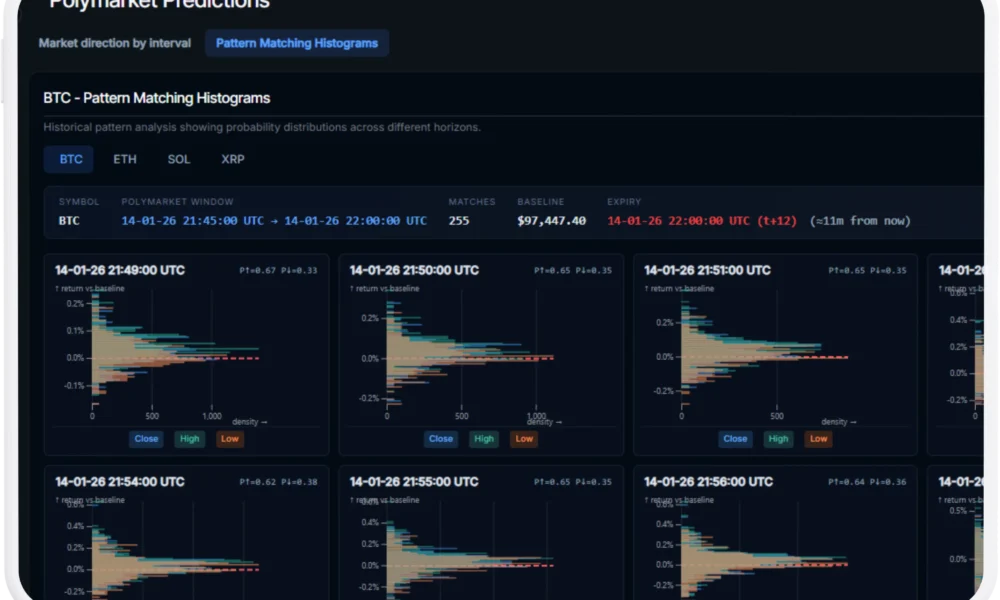
If you want a probability edge to make sure the trades you do place are worth the fees, that’s what we build at Crypticorn — our AI-based UP/DOWN predictions are here. Not to guarantee wins, but to skip the trades where the fee-to-edge ratio is bad.
Author: Johannes Thüroff, M.Eng. | Last updated: June 2026
Not financial advice. See Disclaimer.