If you’ve spent any time trading Polymarket crypto up/down markets, you’ve probably been tempted by the martingale strategy. Double your position size after every loss, the logic goes, and one win wipes out the whole streak. It sounds like a mathematical certainty. In practice, it’s one of the fastest ways to blow up your account on Polymarket — and the math explains exactly why.
I’m Johannes Thüroff, M.Eng., and I trade Polymarket 15-minute and 1-hour Bitcoin up/down markets daily. I’ve watched martingale destroy accounts (including one of my early test accounts). This article breaks down what martingale actually is, why it fails on Polymarket specifically, the real math behind a losing streak, and what I do instead. Last updated: June 2026. Not financial advice.

Direct answer
The martingale strategy on Polymarket is to double your position size after every losing trade so that the first winning trade recovers all prior losses plus the original profit target. It fails on Polymarket because Polymarket’s order book has finite liquidity, so position size is capped in practice; the required bankroll grows exponentially during a losing streak; and Polymarket crypto odds are not 50/50 — they shift with crowd positioning, so “eventually winning” is not guaranteed at the price you need. The fix is fractional Kelly position sizing, which I cover at the end.
Key takeaways
- Martingale means doubling your position size after each loss so the first win recovers all losses plus the original profit target.
- On Polymarket, a 6-loss streak requires a $640 position to recover a $10 profit target — cumulative capital at risk: $1,270.
- A 10-loss streak (0.098% probability, happens to active traders) requires a $10,240 position — cumulative risk $20,470, still to make $10.
- Polymarket is worse than a casino for martingale: finite liquidity, spreads widen during volatility, crypto odds aren’t 50/50, and Polygon gas + USDC withdrawal fees add friction.
- Fractional Kelly position sizing is the fix — size by edge, not by prior losses. Most serious Polymarket traders use ¼ or ½ Kelly.
What is the martingale strategy (and why people try it on Polymarket)
Classic martingale comes from 18th-century casino betting. The rule is simple:
- Bet 1 unit on an even-money outcome (red/black at roulette).
- If you win, pocket the profit and bet 1 unit again.
- If you lose, double your next bet to 2 units.
- Keep doubling after every loss until you win.
- When you finally win, you recover all losses plus 1 unit of profit.
On paper, with infinite money and no betting limit, this is mathematically guaranteed to end in profit. That “on paper” is doing a lot of work.
People try to port this to Polymarket because the structure looks similar:
- Polymarket binary markets resolve to $1 or $0.
- If you buy a side at 50¢, a win pays $1 (double your money).
- Losing trades go to $0, winning trades pay $1 — same as even-money casino bets.
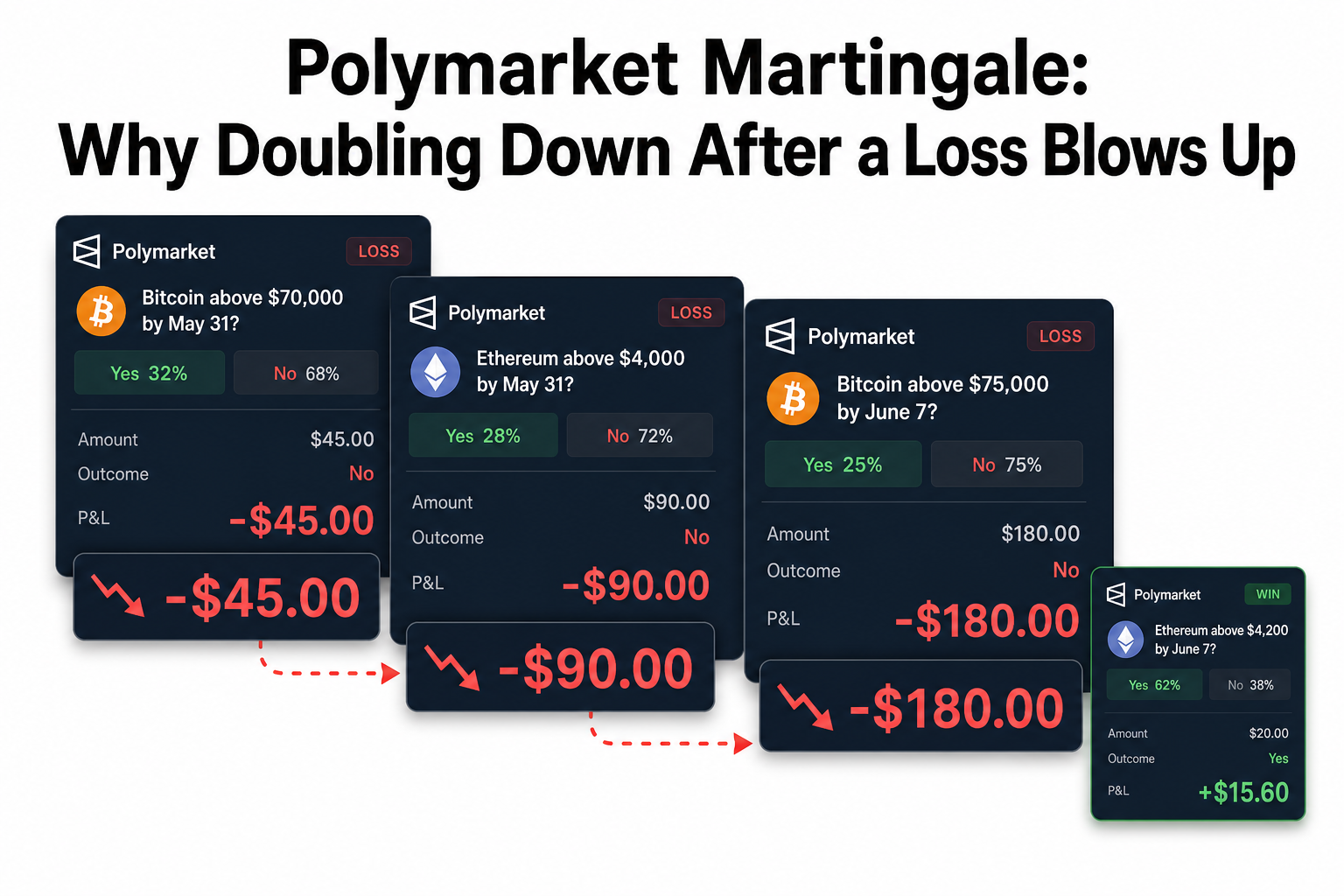
So the temptation is: buy 50¢ UP, lose, double to two 50¢ UP positions, lose, double to four, and so on. The first UP that hits pays out enough to clear the streak.
It fails for the same reason it fails in casinos — plus a few Polymarket-specific reasons that make it worse.
The math: why martingale fails on Polymarket
Let’s run the numbers for a real Polymarket 15-minute Bitcoin UP/DOWN market. Assume you start with a $10 position on UP at 50¢ (so you buy 20 shares at 50¢ each, total cost $10). Each losing trade, you double the position size.
Here’s what a 6-loss streak looks like (1.56% probability at 50/50 — rare but happens multiple times per year if you trade daily):
| Trade # | Position size | Cost per share | Shares bought | Cumulative loss |
|---|---|---|---|---|
| 1 | $10 | 50¢ | 20 | $10 |
| 2 | $20 | 50¢ | 40 | $30 |
| 3 | $40 | 50¢ | 80 | $70 |
| 4 | $80 | 50¢ | 160 | $150 |
| 5 | $160 | 50¢ | 320 | $310 |
| 6 | $320 | 50¢ | 640 | $630 |
| 7 (win) | $640 | 50¢ | 1280 | +$10 net |
To recover a 6-loss streak and pocket the original $10 profit target, you need a $640 position on trade #7. Your cumulative capital at risk is $1,270 — all to make $10. And that’s the best case where trade #7 wins.
Now extend the streak. A 10-loss streak (0.098% probability — happens to active traders eventually) requires a single position of $10,240, with cumulative capital at risk of $20,470. Still to make $10.
This is the first failure mode: exponential bankroll growth against a linear profit target. The expected value of the system is still negative because the rare catastrophic loss exactly cancels the many small wins — and that’s before real-world frictions.
Why Polymarket is worse than a casino for martingale
Casinos actually protect martingale players with table limits. A $10 roulette table might cap bets at $5,000 — meaning your martingale progression dies at trade #10 and you eat the loss. That’s a brutal outcome, but it’s bounded.
Polymarket has no formal position limit. Instead, the order book itself is the limit, and it’s worse for four reasons:
1. Liquidity thins at the top of the book
When you need to drop a $640 order on UP at 50¢, there typically aren’t 1,280 shares sitting at exactly 50¢. The order eats through several price levels, so your average fill price rises to 52¢, 55¢, or worse. The math that assumed a 50¢ entry breaks.
2. Spreads widen during volatility — exactly when martingale needs them tight
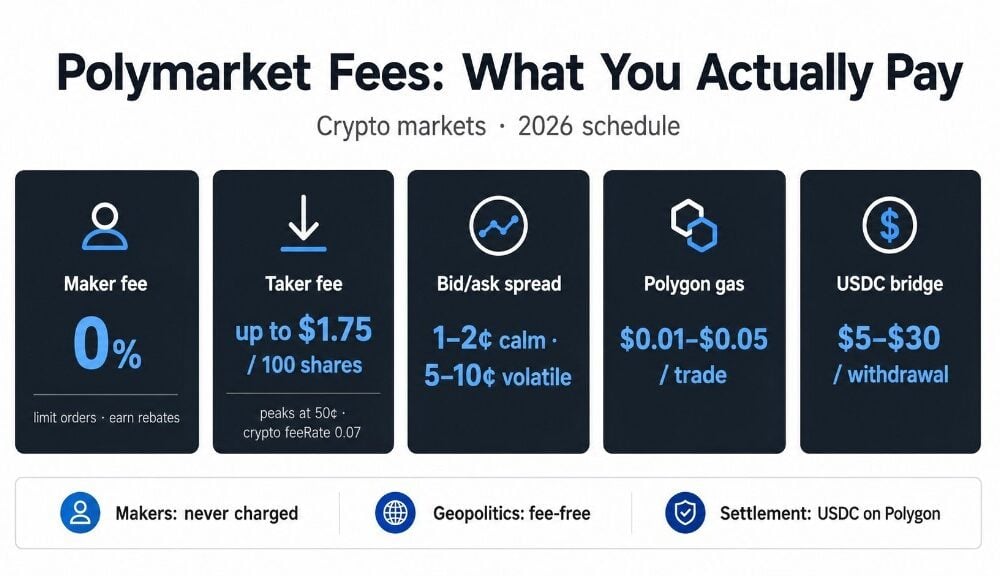
Martingale losses cluster during volatile, trending markets — and that’s exactly when Polymarket spreads blow out from 1–2¢ to 5–10¢. By the time you’re placing the recovery trade, the spread itself can cost more than your $10 profit target.
3. Polymarket crypto odds are not 50/50
Roulette has a fixed 47.4% probability of red/black (with the zero). Polymarket crypto up/down odds drift with crowd positioning. A 50¢ UP price does not mean 50% probability — it means the market currently prices UP at 50%, which often lags the real move. (I cover this in detail in how Polymarket Bitcoin odds actually work.) If you’re doubling into a market where the true probability has shifted to 30%, your “eventually win” assumption is broken.
4. Polygon gas and withdrawal friction add to the bleed
Each Polymarket trade settles on Polygon. Gas is usually tiny ($0.01–0.05) but compounds across a doubling streak. Worse: when you finally want to withdraw your recovered bankroll, bridging USDC from Polygon back to Ethereum mainnet costs $5–30 in gas — which can exceed the $10 profit you “earned” through 7 trades of perfect martingale.
The real-world failure mode (first-hand)
I tested a martingale variant on a small Polymarket test account in early 2025. The progression was capped at 5 doublings (so max position $320 from a $10 base), and I ran it on 15-minute BTC UP/DOWN markets.
For about 6 weeks, the equity curve looked like a stairway to heaven — smooth, gentle, almost no drawdowns. Then a trending BTC session produced 6 consecutive UP losses (BTC ground down for 90 minutes with no meaningful bounce), and the system hit its cap. The 7th trade would have required $640 — past my self-imposed limit. I ate the $310 loss.
Six weeks of small wins (~$80 total) wiped out in one afternoon. Net result: -$230 on what had looked like a profitable system.
This is the universal martingale pattern. The equity curve is not a straight line up — it’s a straight line up with a single vertical cliff somewhere in the future. You don’t know where the cliff is until you’ve already gone over it.
Why martingale still gets promoted
Same reason the “buy both sides” hedging strategy I wrote about earlier keeps getting pushed on X:
- It looks incredible in screenshots for the first few weeks.
- Win rate is high (90%+ for short streaks), so most people who try it briefly become evangelists.
- The people who blow up stop posting — survivorship bias does the marketing.
- It’s mathematically simple, which makes it easy to teach and sell as a “system.”
If someone is selling you a Polymarket bot or strategy with a “high win rate” and smooth backtest equity curve, martingale (or its cousin, the “buy both sides” hedge) is almost always the structure underneath. Both have the same shape: many small wins, one catastrophic loss.
What to do instead: fractional Kelly position sizing
The mathematically sound alternative to martingale is to size each position based on the edge you actually have, not on the loss you’re trying to recover. The Kelly criterion gives the theoretical optimal fraction of your bankroll to bet on a positive-edge opportunity:
f* = (bp − q) / b
where b is the net odds received on the wager (for a 50¢ Polymarket bet that pays $1, b = 1), p is the probability of winning, and q is the probability of losing (q = 1 − p).
In practice, full-Kelly is too volatile for crypto markets, so most serious Polymarket traders use fractional Kelly — typically ¼ or ½ Kelly — which sacrifices a small amount of expected growth for a large reduction in drawdown volatility.
The key difference from martingale: position size scales with your current bankroll and current edge, not with your prior losses. A losing streak reduces your bankroll, which reduces your position size, which means recovery takes longer but cannot blow up. The system is self-correcting rather than self-destroying.
I walk through the exact fractional Kelly math for Polymarket in position sizing on Polymarket and Kalshi crypto up/down predictions, with real numbers for a $1,000 bankroll.
FAQ: Polymarket martingale
Does the martingale strategy work on Polymarket?
No. Martingale on Polymarket produces small wins for weeks or months, then a single catastrophic loss wipes out the entire gain. The expected value is near zero before fees and negative after. Polymarket’s finite liquidity and shifting crypto odds make the strategy worse than in a casino. I tested a capped martingale variant on a Polymarket test account in early 2025 — six weeks of small wins were wiped out in a single 6-loss streak.
Why does martingale fail on Polymarket?
Martingale fails because it requires exponentially growing position sizes to recover a linear profit target. A 6-loss streak needs 64× the original bet; a 10-loss streak needs 1,024×. Polymarket’s order book can’t fill large orders at the assumed price (liquidity slippage), spreads widen during the volatile moments when martingale needs them tight, and crypto up/down odds are not 50/50 — they drift with crowd positioning, so the “eventual win” is not guaranteed at the price the math assumed.
What is the alternative to martingale on Polymarket?
The alternative is fractional Kelly position sizing: bet a fraction of your bankroll proportional to your edge on each trade, independent of prior losses. Losing streaks reduce your bankroll, which reduces your position size — the system self-corrects instead of self-destroying. Most serious Polymarket traders use ¼ or ½ Kelly to reduce drawdown volatility. The formula is f* = (bp − q) / b, where b is net odds, p is win probability, and q is 1 − p.
How is Polymarket martingale different from casino martingale?
Casinos have table limits that cap your martingale progression (a $10 table typically caps at $5,000) — the loss is brutal but bounded. Polymarket has no formal position limit, but order book liquidity acts as a soft cap that’s worse: large orders slip through price levels, so the assumed entry price breaks. Casino odds are fixed at 47.4% for red/black; Polymarket crypto odds drift with market sentiment and are never exactly 50/50.
Can you recover losses on Polymarket by doubling down?
Not reliably. Doubling down only recovers losses if (a) you have infinite capital, (b) the order book has infinite liquidity at your price, and (c) the true probability stays at 50%. None of these hold on Polymarket. A long enough losing streak will either exhaust your bankroll or hit the liquidity ceiling before recovery. The expected value is negative after fees, gas, and spread costs.
What is fractional Kelly position sizing on Polymarket?
Fractional Kelly sizes each Polymarket position as a fraction of your current bankroll, proportional to your edge on that trade. Full Kelly is f* = (bp − q) / b, where b is net odds received, p is win probability, and q is 1 − p. Most Polymarket traders use ¼ or ½ Kelly, which sacrifices some expected growth for much smaller drawdowns. Position size scales with bankroll and edge — never with prior losses, which is what makes it self-correcting rather than self-destroying like martingale.
Final takeaway on Polymarket martingale
Martingale on Polymarket:
- produces smooth, profitable-looking equity curves for weeks or months
- has a single catastrophic loss hidden in the future
- is bounded by Polymarket liquidity and spread, not by a friendly table limit
- has expected value near zero before fees, negative after
The fix is not a better doubling rule. The fix is to abandon the “recover losses” framing entirely and size positions by edge, not by streak. Fractional Kelly is the boring, correct answer.
If you’re trading Polymarket crypto up/down markets and want a probability edge instead of a doubling trick, that’s what we build at Crypticorn — our AI-based UP/DOWN predictions are here. Not to guarantee wins, but to skip the trades where there’s no edge in the first place.
Author: Johannes Thüroff, M.Eng. | Last updated: June 2026
Not financial advice. See Disclaimer.