I build on-chain analytics at Crypticorn. This is the hub I use when someone asks how to trade on DEXs without treating every new pair like a CEX altcoin. It covers wallets, liquidity, safety, holders, bots, signals, venue choice, tools, and where AI actually helps (filtering, not magic pumps).
Last updated: August 2026. By Johannes Thüroff, M.Eng. Not financial advice. See our disclaimer.
Direct answer
DEX trading with AI in 2026 means self-custody swaps on automated market makers (Uniswap, Raydium, PancakeSwap, and others), plus a due-diligence stack before you sign: contract safety, liquidity depth, holder concentration, deployer history, and social noise. AI is useful when it compresses that checklist into seconds. It is not a substitute for small size, revoked approvals, or skepticism toward Telegram alpha. Most retail losses happen on token selection and signing, not on chart indicators.
Key takeaways
- DEX risk is what you sign. CEX risk is who holds your coins. Many traders use both; see DEX vs CEX (2026).
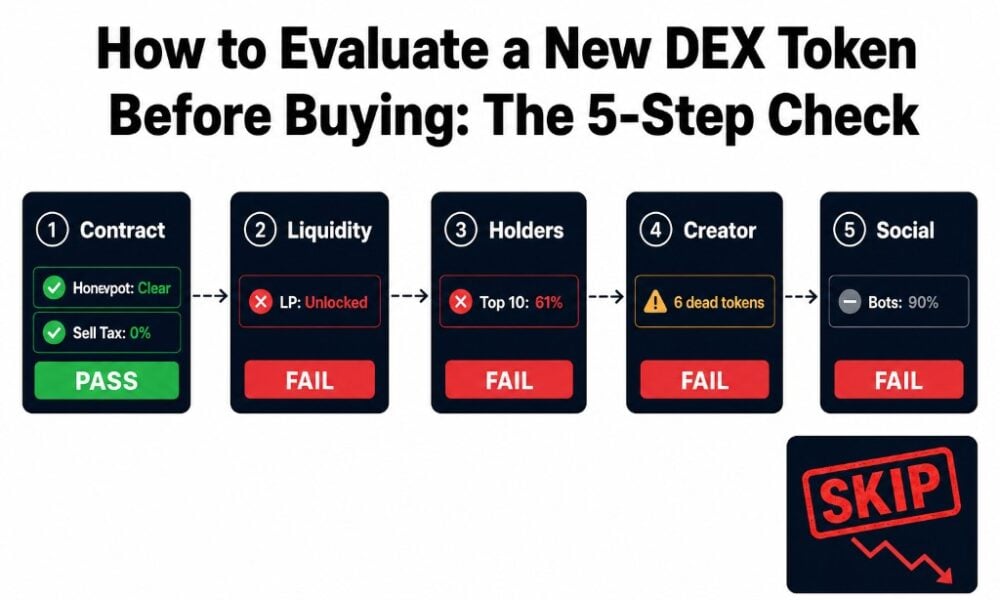
- New pairs need a checklist, not RSI. Full funnel: 5-step token evaluation.
- Holder tables decide launches. Deep dive: holder analysis guide.
- Screeners find; scanners vet. Tool stack: best DEX tools (2026).
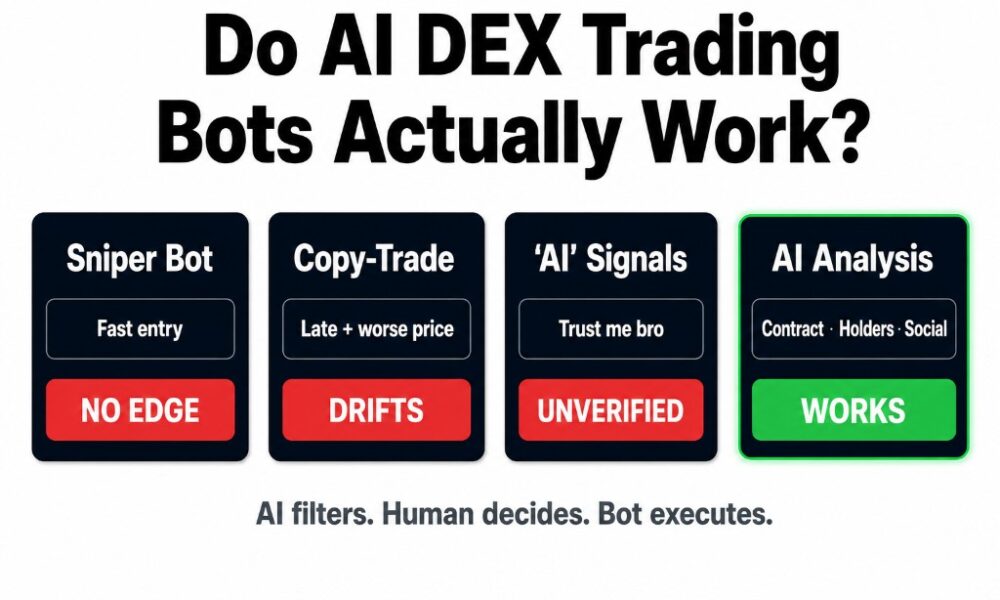
- Sniper bots sell speed, not edge. Reality check: do AI DEX bots actually work and sniper bot comparison.
- MEV and scams are signing problems. Read MEV scams and who pays MEV bots.
- Telegram signal groups often make you the product. Ethics and mechanics: DEX trading signals.
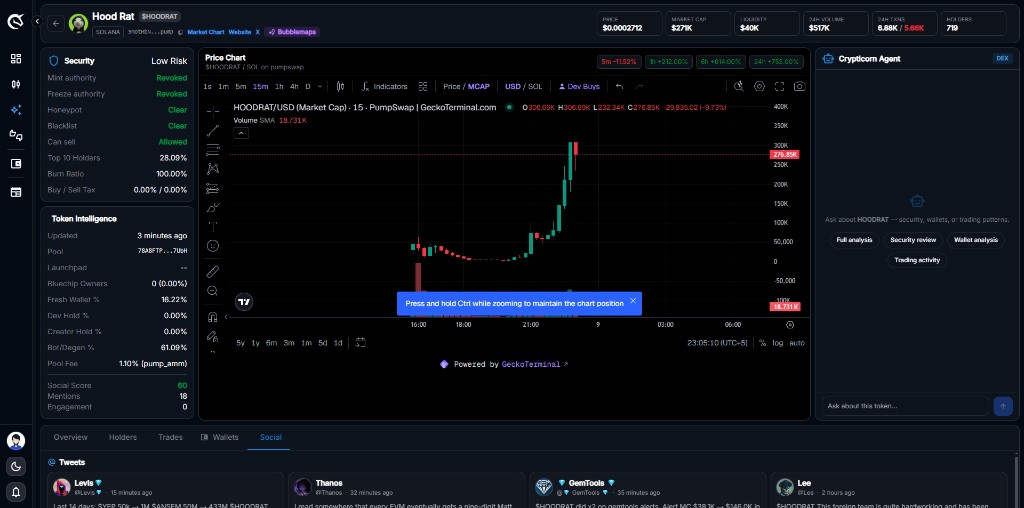
- Crypticorn DEX AI is a decision layer on supported tokens (security, holders, social). Not a sniper, not a guarantee. Product: DEX AI Trading.
1. What DEX trading actually is
A decentralized exchange routes trades through smart contracts and liquidity pools instead of a company order book. You connect a wallet, approve token spending, and swap against a pool curve. Nobody custody-holds your balance between trades, but you pay gas, pool fees, and often slippage. Anyone can list a token by creating a pool, which is why scam density is higher than on curated CEX listings.
DEX trading is not one activity. It spans deep pairs on Ethereum (ETH/USDC), Solana memecoin launches, and everything between. The workflow differs by chain, but the safety funnel is the same: contract → liquidity → holders → creator → social.
For definitional framing on AI in this context, read what decentralized AI trading is (and what it is not).
2. Wallets, chains, and setup hygiene
Minimum setup before first swap:
- Hot wallet for experiments. Never route life savings through the same wallet you use for new pairs.
- Chain-native gas token. ETH on Ethereum L1, SOL on Solana, etc. Running out of gas mid-approval is an expensive lesson.
- Bookmark official interfaces. Phishing sites mimic Uniswap and Raydium UIs to steal approvals.
- Exact approvals when possible. Unlimited ERC-20 approvals are convenient and dangerous. Revoke after sessions via Revoke.cash.
- Hardware or cold storage for savings. DEX degen wallets should assume compromise.
AI does not replace wallet discipline. A perfect token read still fails if you sign on a fake site or leave standing approvals open.
3. Reading pairs, liquidity, and charts on DEXs
On a screener (DexScreener, DEXTools, Birdeye, GMGN), start with mechanics, not hype:
- Pool age and liquidity USD: sub-$10k liquidity on a micro cap means exit slippage can eat you alive.
- Volume vs liquidity: huge volume on thin liquidity often means churn, bots, or wash patterns.
- Price impact on your ticket size: simulate the swap size you actually plan to use.
- LP lock / burn claims: verify on-chain, not from a screenshot in Telegram.
CEX-style indicators on a two-hour-old token are mostly noise. Candles built from a handful of trades are not “support and resistance.” For automated liquidity context (ALM, LP strategies), see automated liquidity management in DeFi.
4. Token safety: the five-step funnel
Every new DEX token should pass five checks in order. Any failure is a skip:
- Contract safety: can you sell? taxes? owner functions? honeypot patterns?
- Liquidity: depth, LP ownership, lock status.
- Holders: concentration, fresh-wallet clusters, dev allocation.
- Creator history: what did the deployer launch before?
- Social signal: real accounts vs bot farms.
Full walkthrough with red-flag table: how to evaluate a new DEX token before buying. Holders get their own chapter in holder analysis for crypto trading.
5. MEV, sandwiches, and scam surface
Public mempool swaps can be sandwiched: searchers trade around your order for worse fills. That is adversarial market structure, not always a “scam,” but it costs money. Mitigations: tight slippage, smaller clips, protected RPC routes where available.
Separate category: fake bots, approval honeypots, and drainer sites. Those target your keys and allowances. June 2026’s JaredFromSubway incident (~$7.5M) showed even automated MEV bots lose to approval traps.
- Mechanics: what MEV bots are
- Scam taxonomy: MEV scams in DeFi
6. Bots, snipers, and automation reality
Execution bots (Trojan, Banana Gun, Maestro, BONKbot, GMGN, and others) compete on milliseconds and chain coverage. Typical trade fees run ~0.5-1%. They do not fix bad token selection.
The honest order of operations:
- Filter tokens (contract, holders, creator, social)
- Size small on survivors only
- Then worry about sniper speed if you still need it
Read what sniper bots are, top sniper bots compared, and do AI DEX trading bots actually work. Crypticorn does not sell mempool sniping software.
7. DEX trading signals (and Telegram traps)
“DEX signals” usually means one of three things: on-chain data alerts, screener watchlists, or Telegram packages with entry/TP/SL. Only the first two are inspectable. Paid groups often front-run followers.
A useful on-chain signal stack combines price/volume, holder data, contract safety, and social sentiment. CEX indicator playbooks break on fresh pairs. Full explainer: DEX trading signals that actually work.
8. DEX vs CEX: when to use which
Use a CEX when you need fiat ramps, deep majors, simple UX, and exportable history. Use a DEX when you need permissionless access to new tokens and accept self-custody plus scam overhead. Hybrid workflows are normal: CEX for core exposure, hot wallet + DEX for on-chain experiments.
Comparison tables and fee examples: DEX vs CEX crypto trading (2026).
9. Tool stack in 2026
No single app covers discovery, safety, holders, portfolio, and execution. A practical stack:
- Discovery: DexScreener or GeckoTerminal (free)
- Depth / scores: DEXTools (EVM), Birdeye or GMGN (Solana-heavy)
- Scanners: RugCheck (Solana), Token Sniffer (EVM), explorers (always)
- Hygiene: Revoke.cash
- AI pass (optional): Crypticorn DEX AI on supported tokens
Honest comparison of nine tools: best DEX tools for crypto traders.
10. Solana vs EVM: what actually changes
The safety funnel is chain-agnostic. The tooling and failure modes are not.
Solana memecoin culture runs on Raydium and Pump.fun-style launches with sub-second blocks. Screeners like Birdeye and GMGN dominate discovery. RugCheck is the default quick scan. Holder labels (sniper, bundler, fresh wallet) matter more because launches compress into minutes. Gas is cheap enough that bots spam transactions; your edge is rarely raw speed unless you run infrastructure.
EVM chains (Ethereum L1, Base, BSC, Arbitrum) use Uniswap-style pools and ERC-20 approvals. Token Sniffer and Etherscan/Basescan reads are mandatory. Gas spikes on Ethereum L1 can make small tickets uneconomic. MEV sandwiches show up more visibly on public mempools. DEXTools remains the workhorse for pair depth on EVM.
Do not copy a Solana Telegram playbook onto Base, or vice versa. Match screener, scanner, and bot (if any) to the chain you actually trade.
11. Position sizing and exits on thin pools
DEX sizing is liquidity-bound, not account-bound. A rule I use on experimental wallets:
- Max single entry: roughly 1-2% of pool liquidity at the time of entry, or less if holders are concentrated.
- Scale out in clips: assume 5-15% slippage on exit if liquidity thins after your buy.
- Predefine invalidation: creator wallet movement, LP pull, or holder cluster dumping beats any chart line on new tokens.
- Time stop: if narrative dies and volume collapses for 24-48 hours, treat illiquidity as the exit signal.
Prediction-style take-profit ladders from CEX TA rarely map cleanly to a pool with $40k liquidity and three bot wallets. For hybrid traders, keep DEX degen size separate from CEX core books. The DEX vs CEX guide covers when to route size through each venue.
12. Where Crypticorn fits (honest product tie-in)
We built DEX AI Trading for the decision layer on supported chains (see product page for current coverage, with Solana emphasis in our DEX AI messaging):
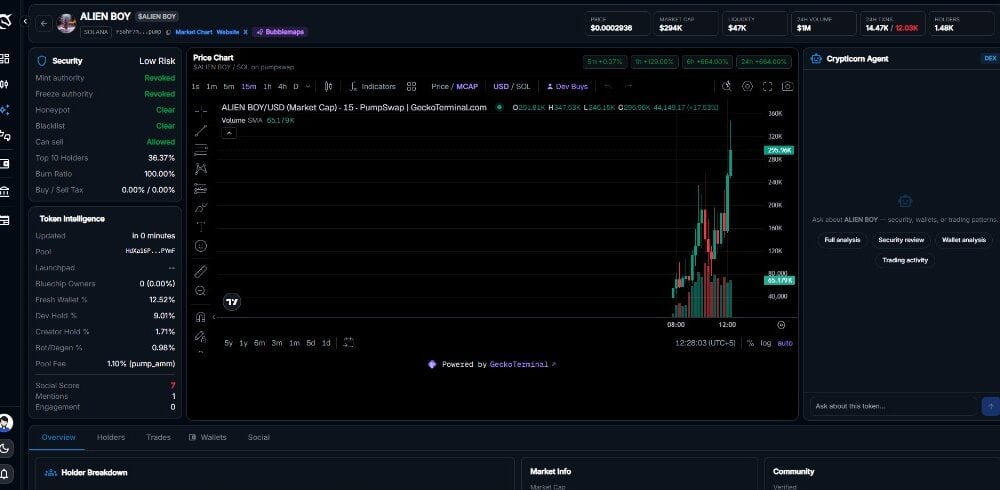
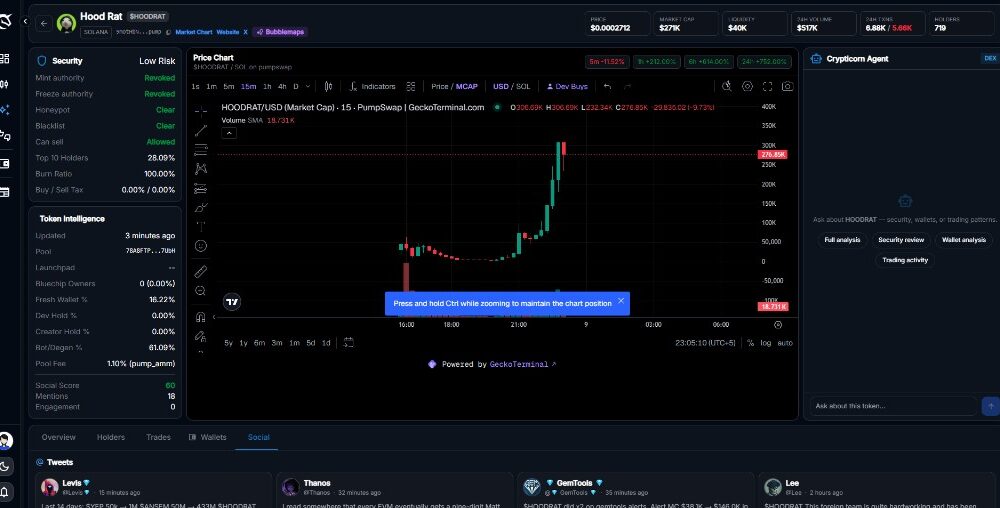
- Crypticorn Agent quick actions (full analysis, security review, holder/wallet read)
- Holder breakdown with wallet labels (smart money, snipers, fresh wallets, bundlers, where data exists)
- Live X / social sentiment context
- Security risk pill with specific flags (not a single green checkmark)
Pricing is on Crypticorn pricing (dynamic tiers). The product pattern we aim for: flag more tokens than it clears. If a tool clears everything, it is probably selling speed, not safety.
We also ship Prediction Dashboard for probabilistic cones on liquid chart markets. That is a separate product from on-chain memecoin launches. Do not mix the two workflows.
Optional: connect analytics via our ChatGPT MCP app for the same read-only token and chart tools in chat.
Common mistakes (account killers)
| Mistake | Why it hurts | Spoke to read |
|---|---|---|
| Buying from a green contract scan alone | Rugs hide in liquidity and holders | 5-step checklist |
| RSI on a 1-hour-old chart | No meaningful history | DEX signals |
| Telegram VIP without track record | Exit liquidity mechanic | signal ethics |
| Sniper bot before filter | Fast losses | bots reality |
| Unlimited approvals left open | Latent drain risk | MEV scams |
| Life savings on a hot wallet | Single signature failure | DEX vs CEX |
Further reading (by topic)
Foundations
Safety and holders
Signals and automation
- DEX trading signals
- What are sniper bots?
- Top sniper bots compared
- Do AI DEX bots work?
- MEV bots explained
Liquidity
Final takeaway
DEX trading with AI is not “let the bot print.” It is self-custody market access plus a repeatable funnel: read the pool, vet the contract, read the holders, check the deployer, sanity-check social, size small, revoke approvals. AI earns its fee when it shortens that funnel without hiding uncertainty. Everything else in this cluster exists to support that one sentence.
FAQ
What is DEX trading with AI?
DEX trading is swapping tokens via on-chain liquidity pools with a self-custody wallet. AI adds value by compressing safety checks (contract, holders, social) before you sign swaps. It does not remove rug risk or guarantee profits.
Is DEX trading better than CEX trading?
Neither is universally better. DEXs offer permissionless token access and self-custody with higher scam and execution complexity. CEXs offer fiat ramps and deep majors with platform custody risk. Many traders use both.
Do I need a sniper bot to trade memecoins?
No. Snipers optimize execution speed on competitive launches. Most losses come from bad token selection, not slow clicks. Filter first; automate execution only if you still have a edge after filtering.
What is the minimum safety checklist for a new DEX token?
Contract safety, liquidity depth and LP status, holder concentration, deployer history, and social authenticity. Any single failed check should be a skip. See the 5-step evaluation guide linked above.
Can AI predict which DEX token will pump?
Honest AI on DEX tokens focuses on filtering high-risk contracts and suspicious holder patterns, not predicting pumps. Treat pump predictions as marketing unless backed by public calibration data.
What tools do I need to start on DEXs?
At minimum: a screener (DexScreener), a block explorer, a chain-specific scanner (RugCheck or Token Sniffer), and Revoke.cash. Add DEXTools, Birdeye, or GMGN for depth depending on chain. See the best DEX tools comparison for stacks.
How does Crypticorn DEX AI differ from DexScreener?
DexScreener is discovery and charting. Crypticorn DEX AI is an agent-led due-diligence pass on supported tokens: security cues, holder labels, creator context, and social signal. We complement screeners; we do not replace them.
Is decentralized AI trading the same as automated trading bots?
No. Decentralized AI trading usually means AI-assisted analysis for on-chain decisions. Automated bots execute swaps on triggers. Crypticorn sells analysis speed on DEX AI; we do not position autonomous trading agents as a live retail product on exchanges.