DEX vs CEX Crypto Trading (2026): Honest Comparison
Compare DEX vs CEX trading: custody, fees, slippage, token access, MEV exposure, and who should use which venue in 2026.
Compare DEX vs CEX trading: custody, fees, slippage, token access, MEV exposure, and who should use which venue in 2026.
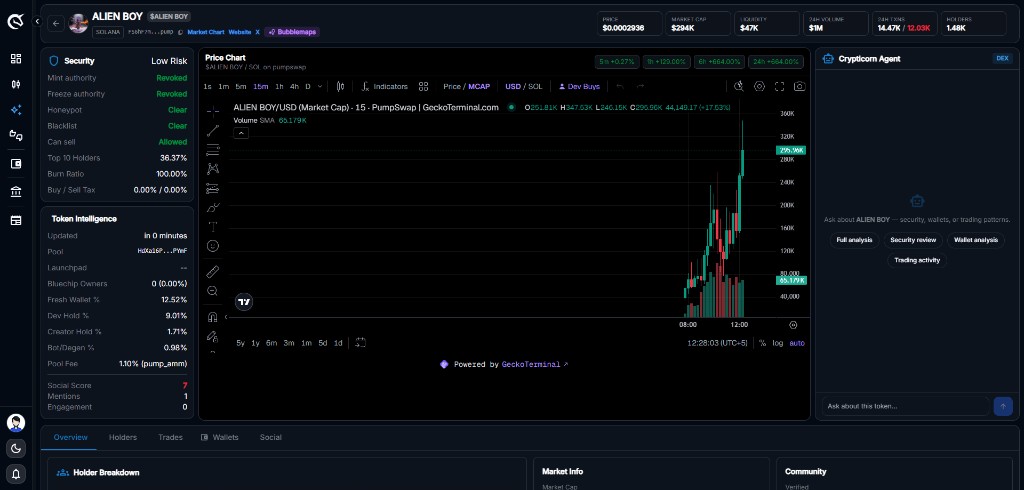
I trade short-horizon crypto on centralized venues and build on-chain analytics at Crypticorn. The DEX vs CEX debate online is usually tribal. In practice, the split is boring: custody, fees, what you are allowed to trade, and who can front-run you.
For DeFi mechanics, start with what decentralized AI trading is. For on-chain signals once you are on a DEX, read DEX trading signals that actually work.
Last updated: August 2026. Not financial advice. See our disclaimer.
DEX vs CEX crypto trading comes down to who holds your keys and who sets execution. A centralized exchange (CEX) like Binance or Coinbase matches orders on internal books, holds custody (you trust their wallet infrastructure), and lists vetted markets with familiar fees. A decentralized exchange (DEX) like Uniswap or Raydium runs smart-contract swaps from your wallet: self-custody, permissionless token access, gas costs, and public-mempool MEV risk. Neither is universally better. CEXs win on fiat ramps, deep majors, and simplicity. DEXs win on new token access and custody control, at the cost of scam surface and execution complexity.
Cluster hub: This article is part of our Ultimate Guide to DEX Trading with AI (2026).
| Factor | CEX (centralized) | DEX (decentralized) |
|---|---|---|
| Custody | Exchange holds assets in omnibus wallets; you have an account balance | Self-custody; you sign transactions from your wallet |
| Access / KYC | Account signup, often ID verification, jurisdiction gates | Wallet-only; permissionless swaps (local law still applies) |
| Trading fees | Published maker/taker tiers (e.g. 0.1% retail spot on major venues) | LP fee per pool + network gas (Ethereum L1 gas can dominate small tickets) |
| Slippage | Tighter on listed majors with deep books | AMM curve + pool depth; can be extreme on new memecoins |
| Token universe | Curated listings, slower new assets | Anyone can create a pool; honeypots and rugs are common |
| MEV / ordering | Internal matching engine; different trust model | Public mempool exposure on many routes; see MEV scams guide |
| Recovery if hacked | Support tickets, insurance funds (varies by venue, not guaranteed) | No undo button; approvals and drainer signatures are final |
| Best fit | Fiat on-ramps, BTC/ETH/SOL size, simple spot/perps UX | Early on-chain pairs, self-custody, composable DeFi workflows |
I still use centralized venues when the job is operational, not exploratory:
CEX failure modes are well publicized: exchange insolvency, withdrawal freezes, account flags. Those are platform credit risks, not smart-contract risks. You are choosing regulated-ish convenience versus on-chain sharp edges.
DEXs earn their keep when the asset does not exist on your CEX yet, or you refuse to custody on a third party:
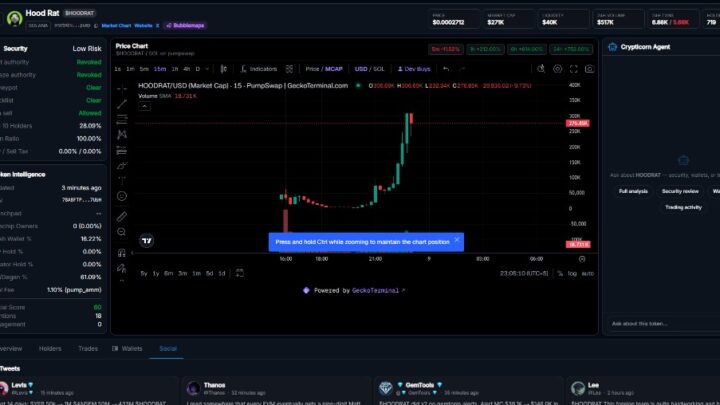
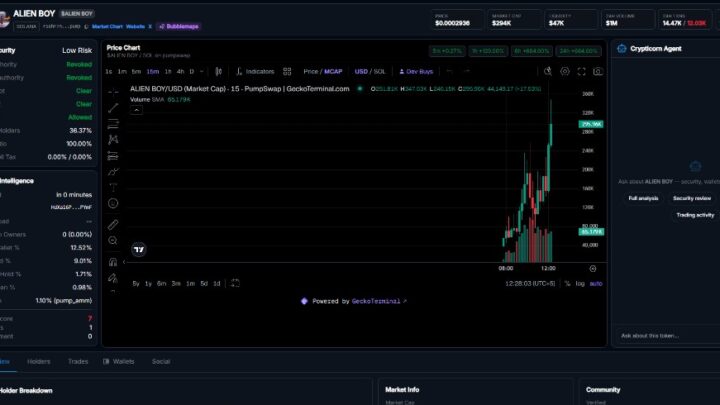
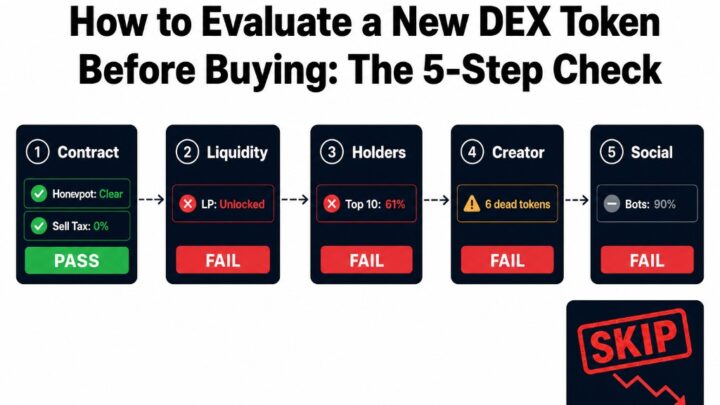
The DEX tax is diligence. Price candles on a two-hour-old pair are mostly noise. Contract safety, holder concentration, and creator wallets matter more than RSI. Our 5-step token checklist is the minimum bar I use before first buy.
Illustrative $1,000 BTC spot buy (actual costs vary by tier, route, and volatility):
| Cost layer | Typical CEX majors | Typical DEX (liquid pool) | Typical DEX (thin/new pool) |
|---|---|---|---|
| Explicit fee | ~$1 (0.1% taker example) | ~$3 (0.3% pool fee example) | 0.3%-1%+ pool fee |
| Gas / network | Often $0 on internal ledger | $0.50-$20+ depending on chain/load | Same, but failed txs still burn gas |
| Slippage | Low on deep books | Low on deep ETH/USDC-style pools | Can exceed 5%-20% on micro caps |
| Hidden MEV | Mostly N/A (platform matching) | Sandwich risk on public routes | Often worse on volatile launches |
On small DEX tickets, gas can be the entire edge. That is why "cheaper fees" marketing for DEX trading is incomplete without chain context.
On many Ethereum routes, pending swaps sit in a public mempool where searchers can sandwich you. You lose via worse fill price, not necessarily via a hacked CEX account. Mitigations include tight slippage, smaller clips, protected RPC endpoints (e.g. Flashbots Protect), and simply avoiding oversized market buys in illiquid pools.
Full scam taxonomy (fake bots vs sandwiches): MEV scams in DeFi. Mechanism primer: what MEV bots are.
For a tool-by-tool stack (screeners, scanners, AI layers), see best DEX tools for crypto traders (2026).
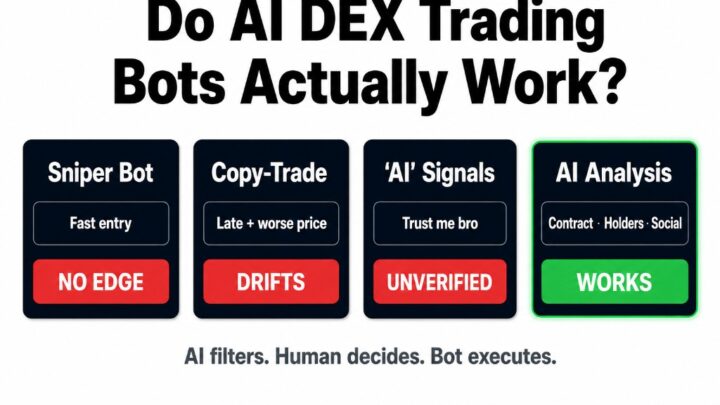
Crypticorn does not replace a CEX account or a wallet. We build decision support: probabilistic forecasts for liquid chart markets and fast token due diligence on-chain. See do AI DEX trading bots actually work for why we do not sell blind automation.
| Mistake | Where | Why it hurts |
|---|---|---|
| Leaving life savings on exchange balance | CEX | Platform risk concentrates |
| Chasing leverage on illiquid alts | CEX | Liquidations on wicks |
| Applying CEX indicator playbooks to 1-hour-old tokens | DEX | Charts lie when history is empty |
| Unlimited token approvals | DEX | Latent drain risk |
| Telegram "alpha" without contract review | DEX | You are exit liquidity |
DEX vs CEX is not a religion. CEXs optimize convenience and depth on listed markets. DEXs optimize permissionless access and self-custody, with scam and MEV overhead. Pick the venue to match the ticket, then use the right checklist on each side. If you only remember one line: CEX risk is who holds your coins; DEX risk is what you sign.
Neither is universally better. CEXs are usually better for fiat access, deep major pairs, and simple UX. DEXs are better for early token access and self-custody, with higher scam and execution complexity. Many traders use both.
Pool fees on liquid DEX pairs can be competitive, but network gas and slippage often make small or L1 Ethereum swaps more expensive all-in than a CEX taker fee on majors. Always compare total cost, not headline pool fee alone.
Yes, both. CEX risks include platform insolvency, account freezes, and phishing login pages. DEX risks include malicious tokens, drainer approvals, and MEV sandwich losses. The failure modes differ.
Most DEX interfaces only require a wallet, but fiat on-ramps, bridges, and local regulations may still impose identity checks. KYC policy depends on the service you use to fund the wallet, not the swap contract alone.
MEV (maximal extractable value) is profit from transaction ordering. On public DEX routes, searchers can sandwich your swap for worse execution. CEX internal matching changes the attack surface but introduces platform trust instead.
Most beginners should learn spot basics on a reputable CEX with fiat support, small size, and no leverage. Treat DEX experimentation as a separate skill: wallets, gas, approvals, and token scams.
Crypticorn provides AI-assisted chart forecasting for liquid markets (Prediction Dashboard) and on-chain token due diligence (DEX AI). We are not a centralized exchange and not an on-chain router. We help you decide; you choose the venue and execute elsewhere.