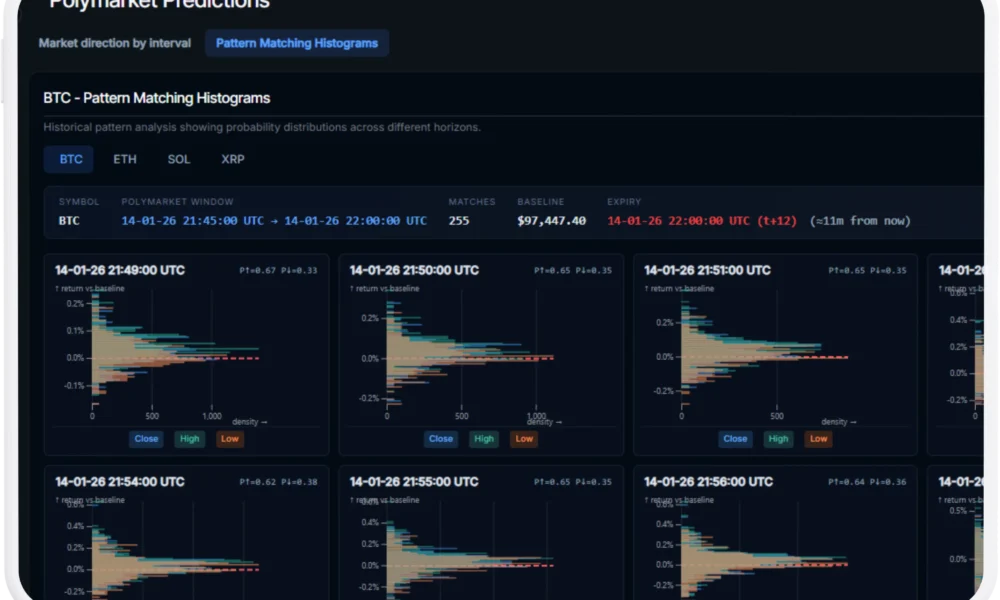
The Accumulation/Distribution (A/D) line blends price location inside a bar with volume to show whether aggression is pressing higher or lower. We use it alongside other flow metrics in our AI prediction dashboard. Here is how to read it, how it differs from on-balance volume, and where it lies to you.

What the A/D line measures
Think of A/D as a running score of whether closes finish high or low in each bar’s range, weighted by volume. “Accumulation” hints at buyers absorbing supply; “distribution” hints at sellers leaning on rallies.
Building the indicator
First compute the money flow multiplier (MFM), which scores where price settled between the bar’s high and low:
MFM = ((Close − Low) − (High − Close)) / (High − Low)Then multiply MFM by the bar’s volume to get money flow volume (MFV). The A/D line is cumulative: add each period’s MFV to the prior A/D reading. Empty ranges (high equals low) need a manual guard—most platforms handle that for you.
How to interpret it
When price falls but A/D rises, buyers may be absorbing prints—watch for a bounce if spot confirms. When price rises while A/D sags, distribution may be hiding under the surface.
Slope matters: a steeply rising A/D line backing a rally shows broad participation; a drifting lower line while price hangs high is the warning version.

You can add A/D inside TradingView and pair it with support and resistance to see whether volume confirms a level.
A/D versus on-balance volume
OBV adds or subtracts the whole bar’s volume based on whether close is above or below the previous close. A/D scales volume by where close sits inside the current range. They often agree; when they diverge, trust the chart and order flow more than either line alone.
Limitations
Gaps confuse A/D: a massive gap down with an upper-range close can lift the line even though holders are underwater. Divergences can persist for weeks—use them as yellow flags, not standalone triggers.
We pair A/D with volatility filters and liquidation context before treating it as actionable—for crypto, tape quirks happen daily.
Final takeaway
A/D is a workhorse volume proxy, not a crystal ball. Add it to your intraday checklist, compare against OBV when signals clash, and always re-check with price structure before sizing.
Co-author: Xilam