
Sin categoría
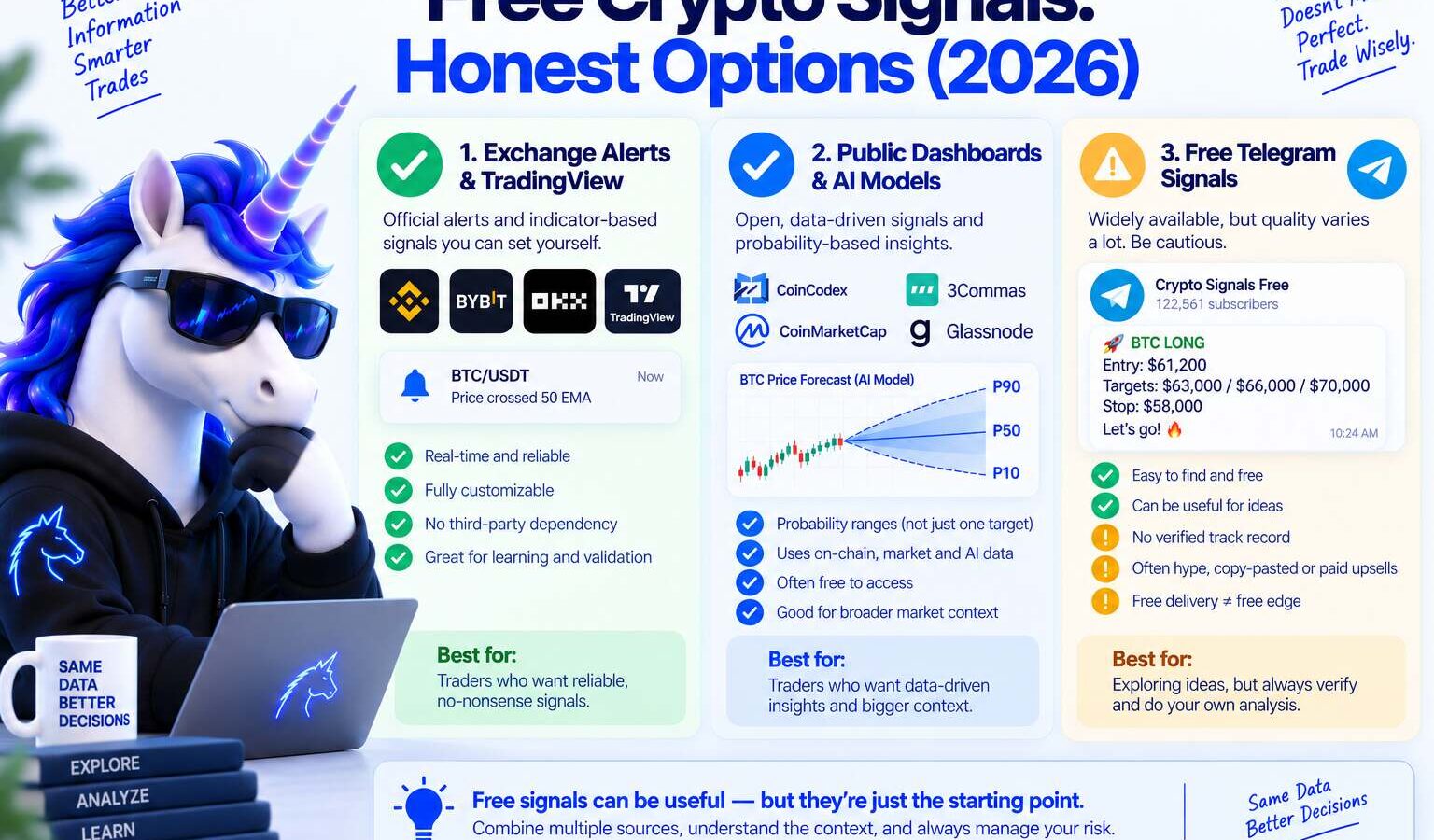
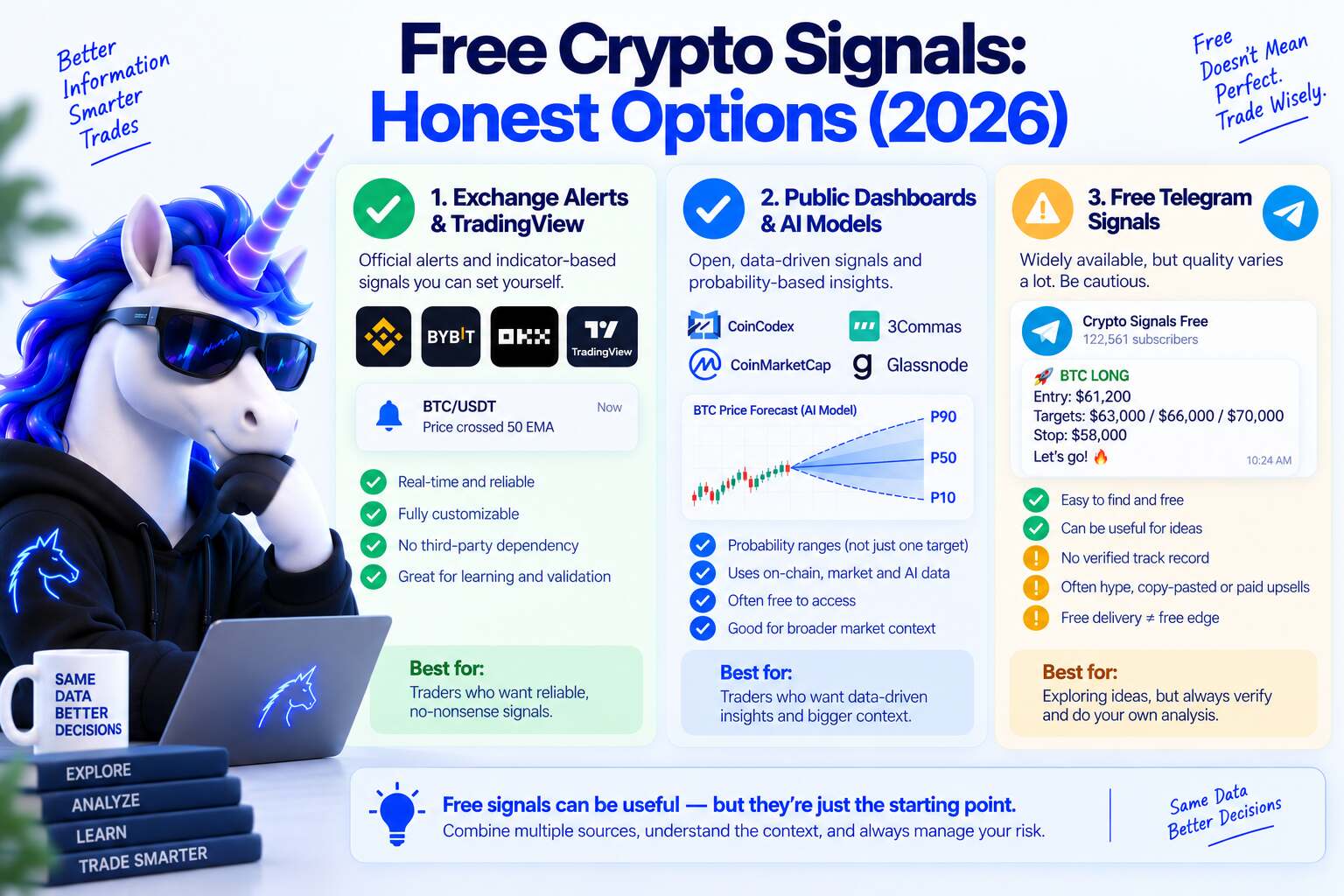
I build AI forecasting tools at Crypticorn and still test alert stacks on liquid pairs before I size real trades. This page ranks free crypto signal options honestly: what you actually get at zero cost, where the catches are, and how to verify anything before you copy it.
Cluster hub: For how to read AI outputs (cones, direction scores), start with AI crypto signals: how to read them honestly. For signal types and provider red flags, see crypto signals explained.
Last updated: August 2026. By Johannes Thüroff, M.Eng. Not financial advice. See our disclaimer.
Direct Answer
The best free crypto signals for trading in 2026 are usually infrastructure alerts you control: exchange price alerts, TradingView indicator alerts (free tier limits apply), funding-rate or liquidation watches, and screener watchlists (DexScreener, GeckoTerminal). Free Telegram "VIP preview" channels are abundant but high-risk: delayed entries, deleted losses, and upsells. Treat them as research only until you log outcomes yourself. Paid probabilistic dashboards (including Crypticorn) are not free; they trade subscription cost for uncertainty bands instead of hype screenshots.
Related: Telegram signal providers: red flags and testing.
Key Takeaways
- Free ≠ verified. Zero price does not mean zero cost. Slippage, fees, and bad sizing still apply.
- Best free stack: exchange alert + one indicator rule + funding context on majors you already trade.
- Telegram free channels are marketing funnels. Paper-trade or skip.
- Log before you trust. Track timestamp, entry, exit, fees for 30+ calls before sizing up.
- Match venue to alert. A Binance spot call does not map cleanly to a thin alt on another book.
- Crypticorn: membership product with probabilistic dashboard and up/down views. Not a free Telegram bot. See pricing.
What Counts as a "free Crypto Signal"?
People use the phrase for four different things:
- Price alerts (app or exchange pings when BTC crosses $X).
- Indicator alerts (RSI cross, MA break) from charting tools.
- Social broadcasts (Telegram/Discord entries with TP/SL).
- Analytics pings (funding extremes, liquidation clusters, whale transfers).
Only the first two are truly self-directed. Social broadcasts outsource judgment to someone who may trade against you. Analytics pings need context before they become entries.
Free Options Compared (honest Table)
| Option | Cost | What you get | Main limit |
|---|---|---|---|
| Exchange price alerts | Free | Push/email when price crosses a level | No direction model; you define levels |
| TradingView alerts (free tier) | Free (capped) | Indicator condition triggers | Alert count limits; easy to overfit indicators |
| CoinGecko / CMC alerts | Free | Price and % move notifications | Coarse; no execution context |
| Funding / liquidation monitors | Free tier on several tools | Extreme funding, liq cluster maps | Lagging narrative; false positives in chop |
| DEX screener watchlists | Free | New pair, volume spike pings | No safety filter; scam density high |
| Free Telegram channels | Free | Entry/TP/SL packages, hype screenshots | Accountability near zero; VIP upsell |
| Crypticorn dashboard | Paid membership | Probabilistic cones, up/down scores, agent Q&A | Not free; not copy-trade automation |
Exchange Alerts (binance, Okx, Coinbase, Kraken, and Others)
If you already trade on a major venue, native alerts are the cleanest free layer. Set levels at structure you would trade anyway (prior day high, weekly open, liquidation cluster), not random round numbers.
Practical tips:
- Use spot book alerts if you spot trade; perp alerts if you hedge with futures.
- On Binance USDT-M, set alerts at liquidation-relevant levels, not every wick.
- Enable anti-spam thresholds (e.g. 0.5% move) on volatile alts.
- Log alert time vs your fill time. Free alerts often fire after the move started.
This replaces zero research Telegram calls for majors. It does not replace risk limits.
Tradingview and Indicator Alerts
TradingView's free plan allows a limited number of active alerts. Use them sparingly: one trend filter plus one momentum trigger beats ten redundant oscillators.
Common setups traders automate for free:
- 200-period MA slope or price cross on 4h for bias.
- RSI or MACD cross on 1h for timing (on liquid pairs only).
- Volume spike vs 20-bar average (confirm breaks, not predict them).
Failure mode: curve-fitting a public script that looked brilliant in backtest screenshots. If you did not write the rule, paper-trade it first.
Free Telegram and Discord Signal Channels
Free crypto signal Telegram groups are everywhere. Most follow the same funnel: free channel with cherry-picked wins → paid VIP with "guaranteed" leverage calls → referral links.
Red flags I treat as automatic skips:
- Win-rate screenshots without losing streak data.
- Entries posted after price already moved.
- Deleted messages after dumps.
- Pressure to use a specific referral exchange.
- Leverage suggestions on illiquid alts.
If you still want to learn from free channels, treat every call as a paper-trade hypothesis. Full evaluation checklist: crypto signals explained.
We do not recommend blind copy-trading from Telegram packages. Crypticorn does not ship a free auto-trading Telegram bot.
On-chain and DEX "free Signals"
Free on-chain alerts (whale transfers, new pools, holder spikes) can be useful on liquid tokens when combined with safety checks. On fresh DEX pairs they are noise without contract and holder context.
Workflow: screener watchlist → safety funnel → size small. See DEX trading signals and the DEX trading guide.
Suggested Free Stacks (by Style)
Spot swing on majors
- Exchange alert at weekly structure level.
- One TradingView confirmation (volume or MA).
- Manual journal (timestamp, fees, outcome).
Perp intraday
- Funding extreme monitor (free tier).
- Exchange alert on BTC/ETH bias level.
- Hard daily loss cap (not an app feature; a rule).
DEX experiments (small wallet only)
- DexScreener watchlist + RugCheck/Token Sniffer pass.
- No Telegram entries without holder read.
How to Test Any Free Signal for 30 Days
- Define horizon (scalp vs swing) before first alert.
- Record every ping with UTC timestamp and asset.
- Simulate fill with realistic fee/slippage (0.05-0.15% on majors, worse on alts).
- Track max drawdown, not just win count.
- Compare to hold on the same asset/period (many signals lose to buy-and-hold after costs).
If the free source cannot survive that log, paying for VIP is unlikely to fix it.
Where Crypticorn Fits (honest Product Tie-in)
Crypticorn is a paid analytics product, not a free signal Telegram channel. What we ship:
- Prediction Dashboard with probabilistic cones and in-chart AI Agent Q&A.
- Up/Down predictions for short-horizon direction scores.
- DEX AI for token safety and holder context (separate workflow from CEX alerts).
- ChatGPT MCP app for read-only access in chat (plan-dependent).
We show uncertainty bands instead of fixed TP/SL packages. We do not promise win rates or sell autonomous trading agents as live retail execution. Plans: Crypticorn pricing.
Final Takeaway
The best free crypto signals are the ones you can audit: exchange and chart alerts you configured, logged, and paid realistic costs on. Free Telegram hype fails that test often enough that I default skeptical. Use free tools to learn format and discipline; use probabilistic dashboards when you are ready to pay for uncertainty modeling instead of screenshots. Start with the AI crypto signals hub when you move from alerts to forecasts.
Faq
What is the best free crypto signals app?
There is no universal winner. Exchange native alerts plus one charting tool (TradingView free tier) cover most spot traders. On-chain traders add a screener watchlist with safety scanners. Avoid apps that promise guaranteed profits.
Are free crypto Telegram signals legit?
Some channels teach market vocabulary; few publish verifiable long-term logs. Treat free Telegram calls as unverified marketing until you paper-trade and record outcomes yourself.
Does Crypticorn offer free crypto signals?
Crypticorn is a membership analytics product (dashboard, up/down views, DEX AI). It is not a free Telegram signal service and does not auto-execute trades on your exchange.
How many TradingView alerts can I use for free?
TradingView caps active alerts on free plans (limits change by plan; check their pricing page). Use few, robust rules instead of many redundant ones.
Can free signals work for futures trading?
Alerts can notify you of levels, but futures add funding and liquidation risk. Free leverage calls from Telegram are especially dangerous. Size and stops matter more than alert source.
What is better: free signals or AI predictions?
They solve different problems. Free alerts tell you a condition triggered. AI predictions (when honest) estimate a distribution over a horizon. Combine alerts for timing context with probabilistic forecasts for conviction checks.
How do I avoid scam free signal groups?
Skip guaranteed-return language, referral pressure, leverage prompts on thin alts, and channels that delete losing calls. Demand a public timestamped log or walk away.
Further reading
Crypto Signals
What Are Discord Trading Signals?: The Best Types and Examples
Crypto Signals
How to Trade Crypto Signals - Easy Crypto AI Trading 101 by Crypticorn
Centralized Exchanges
What are Crypto Exchanges?: Easy Beginner’s Guide to Trading Ecosystems
Crypto Futures
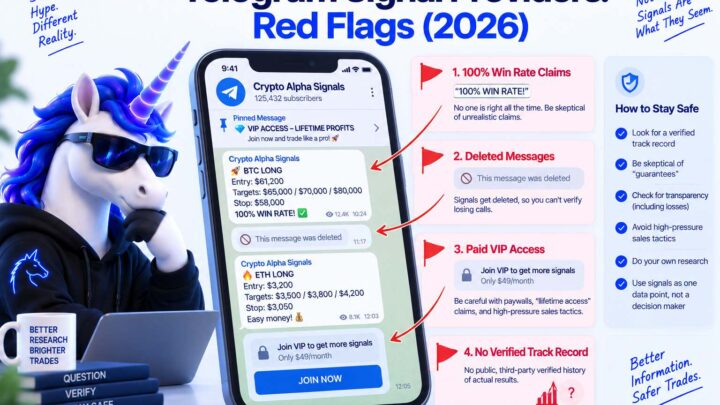
Telegram Crypto Signal Providers: Red Flags and How to Test Them (2026)
Crypto Signals
Crypto News Trading Signals | High Profits from News Sources
Crypto Futures