Liquidity is the least glamorous thing in DeFi and it decides almost everything: the price you actually get on a swap, whether you can exit a position at all, how hard MEV bots can hit you, and whether a token is a market or a trap. “Automated liquidity management” promises to handle this layer with software — and increasingly with AI. Some of that promise is real, and some of it is the usual DeFi marketing wearing a lab coat.
I work with on-chain liquidity data every week building Crypticorn’s DEX tooling. This is the honest guide: what liquidity management actually means, what automation genuinely does well, what no algorithm can remove, and how to read liquidity as a trading signal. Last updated: July 2026. Not financial advice.
Direct answer
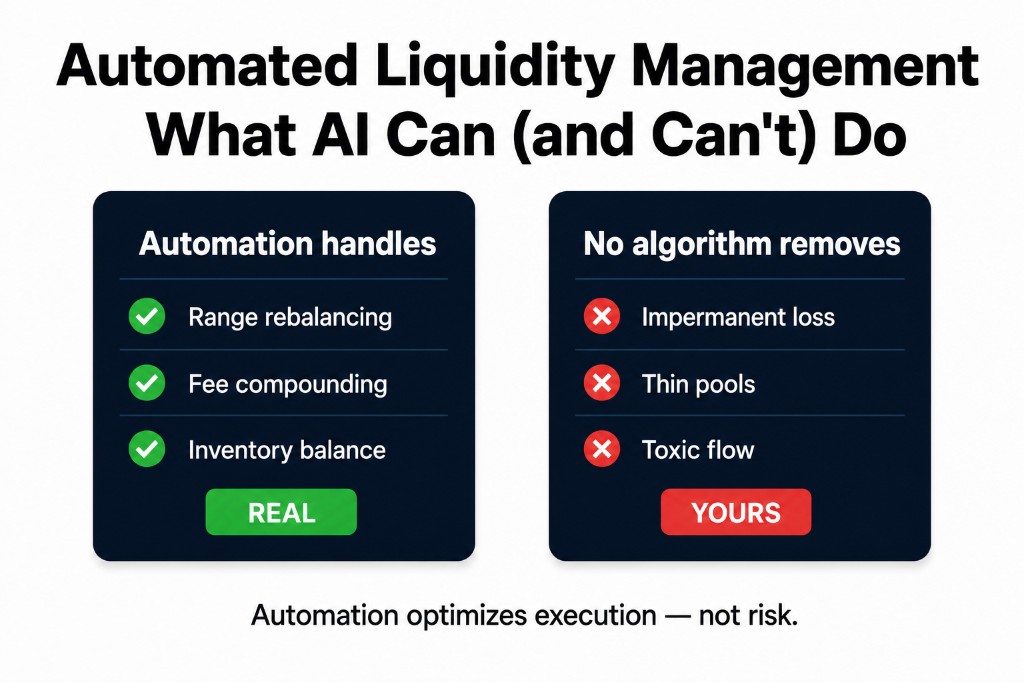
Automated liquidity management is software that allocates and rebalances liquidity in DeFi — most commonly managing concentrated liquidity positions (price ranges) on DEXes, rebalancing as price moves, and compounding fees. It genuinely improves on manual LP management, which requires constant attention. What it cannot do: eliminate impermanent loss, make a thin pool safe, or turn liquidity provision into risk-free yield. The automation optimizes execution of a strategy — the risks of the strategy remain yours.
Key takeaways
- Liquidity = exit quality. Pool depth determines your slippage, your MEV exposure, and whether an exit exists when you need one.
- Modern DEX liquidity is a job, not a deposit: concentrated positions earn nothing when price leaves their range — which is why automation exists.
- Automated managers handle range rebalancing, fee compounding, and inventory balance — real, mechanical value.
- Impermanent loss survives every algorithm. Rebalancing changes when losses are realized, not whether the risk exists.
- AI’s honest role is forecasting inputs (volatility, ranges) and risk filtering (which pools and tokens to touch at all) — not “AI yield”.
- For traders, liquidity is a signal to read before entering: a token with a $3k pool is an exit problem, whatever its chart says.
What liquidity management means in DeFi
On a DEX, liquidity isn’t provided by a market-making desk — it’s pooled from users who deposit token pairs and earn trading fees. Managing that liquidity means deciding where to deploy it, at what price ranges, and when to move it.
The reason this became a real discipline: modern DEXes use concentrated liquidity. Instead of spreading your deposit across every possible price, you commit it to a range — say, ETH between $3,000 and $3,400. Inside the range you earn a share of every trade; the moment price leaves it, you earn nothing and sit fully converted into the weaker side of the pair. Tight ranges earn more and break faster; wide ranges are safer and dilute returns.
That trade-off is a full-time job when managed by hand — which is exactly the gap automated liquidity management fills.
What automated liquidity managers actually do
| Function | What it does | The honest caveat |
|---|---|---|
| Range rebalancing | Moves your position when price approaches or exits the range | Every rebalance realizes impermanent loss and pays gas — frequent rebalancing can cost more than it earns |
| Fee compounding | Harvests and redeposits earned fees automatically | Real but modest — compounding can’t rescue a badly chosen pool |
| Inventory management | Keeps the token ratio balanced as price drifts | Balancing means selling the appreciating asset — by design, not by bug |
| Vault strategies (ALMs) | Pool many users’ liquidity under one managed strategy | You inherit the vault’s strategy risk, contract risk, and fees — read what the strategy actually is |
All of this is genuinely useful in the same way a dishwasher is useful: it automates labor, not judgment. The judgment — which pair, which pool, which risk — is still the part that decides outcomes.
Where AI genuinely helps (and where it’s branding)
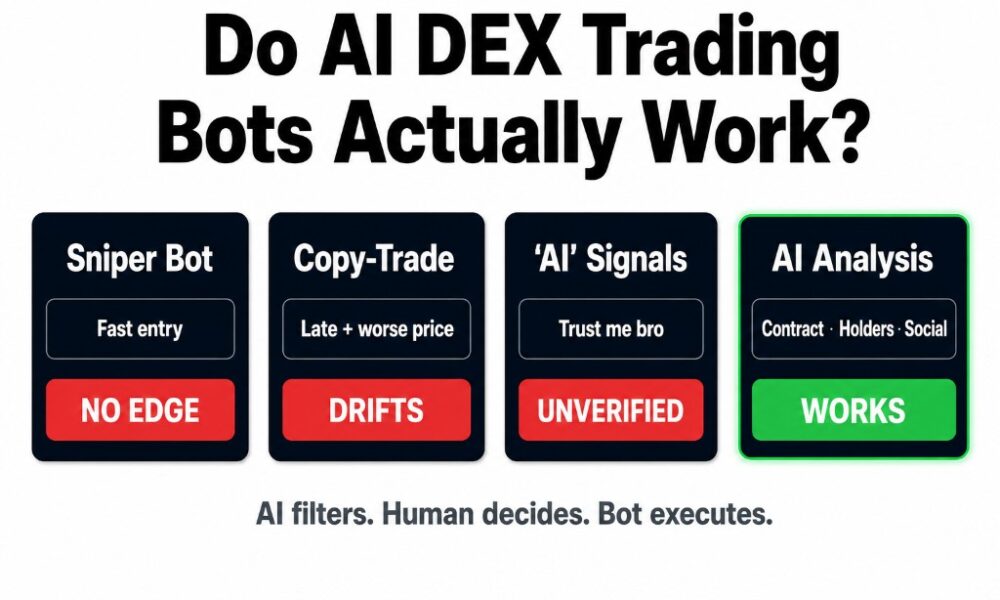
The AI-washing pattern I described in do AI DEX trading bots actually work applies here with full force. The honest split:
Genuinely useful:
- Volatility forecasting for range width — the core input to every range decision is “how far is price likely to move?” That’s a probability estimation problem, the kind models are actually good at.
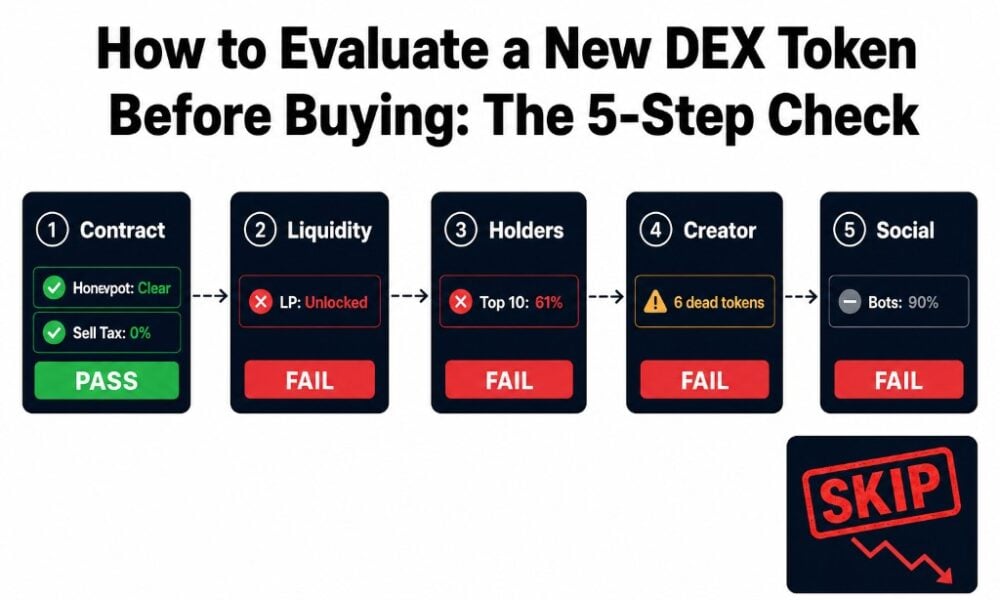
- Risk filtering before deployment — contract safety, holder concentration, and liquidity stability of the pool you’re about to enter. Providing liquidity to a token whose deployer holds half the supply isn’t yield farming, it’s exit-liquidity provision. (The full checklist: how to evaluate a new DEX token.)
- Flow and toxicity analysis — distinguishing pools where fees come from organic volume versus pools farmed by arbitrage and MEV extraction, where LPs systematically lose to informed flow.
Branding: “AI-optimized yield” with no visible model inputs, guaranteed APY numbers, and strategies that can’t explain what they’d do in a drawdown. The test is the same as always: what data does it read, and can you see its reasoning before your money moves?
What no automation removes
- Impermanent loss. If one asset in your pair moves hard, you end up holding more of the loser — that’s the mathematics of pooled liquidity, not an engineering problem. Automation decides when the loss is realized; it can’t decide whether.
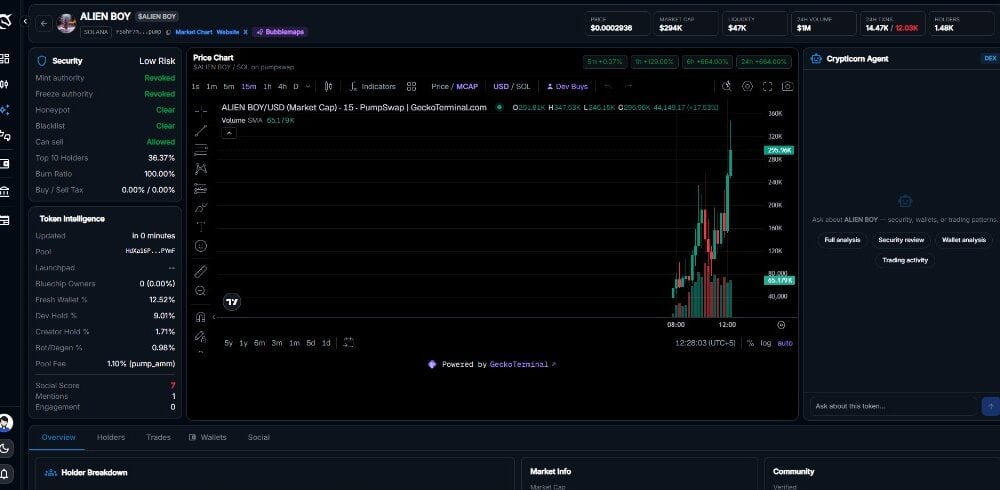
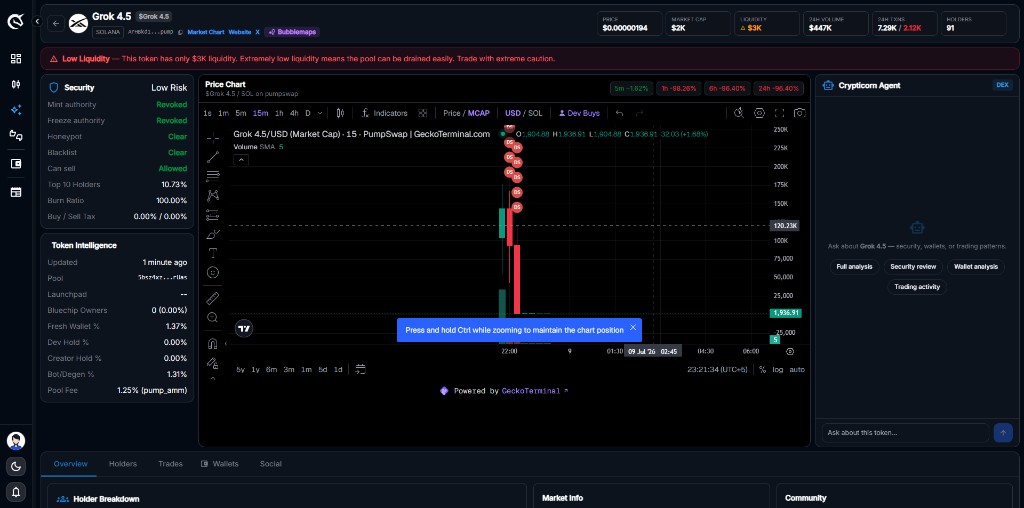
- Thin-market risk. A small pool is fragile no matter who manages it. A $3,000 pool can be drained or manipulated by a single wallet — when our DEX AI flags a token with a low-liquidity warning, no management strategy makes that pool safe.
- Contract and counterparty risk. Vaults are smart contracts; strategies have admins; tokens have deployers. Automation stacks a new contract on top of the risks you already had.
- Toxic flow. In pools dominated by arbitrage, LPs are structurally the counterparty to better-informed traders. More frequent rebalancing doesn’t fix an adversarial pool.
Liquidity as a trading signal (the other direction)
Everything above is the LP’s perspective. For traders, liquidity management matters in reverse: the pool’s state is information about your trade before you make it.
- Depth vs your size: a position that’s 5% of the pool moves the price against you on entry and exit — you pay the spread twice.
- Liquidity stability: locked or burned LP is a commitment; deployer-held LP is a countdown. This single check separates most rugs from most markets.
- Liquidity trend: a pool that’s draining while price holds is the chart lying to you — someone is leaving quietly.
This is why liquidity gets its own tile (and its own warning banner) in Crypticorn’s DEX AI token analysis: it’s the difference between a token you can trade and a token you can only enter. The screenshot at the top of this article is a real flag from that check — a token whose entire pool was $3k, down 96% in a day.
FAQ: automated liquidity management
What is automated liquidity management?
Automated liquidity management is software that handles DeFi liquidity positions on your behalf: setting and rebalancing concentrated-liquidity price ranges, compounding earned fees, and maintaining token-ratio balance. It’s offered as standalone tools and as pooled vault strategies (automated liquidity managers, or ALMs). It automates the labor of liquidity provision — the strategy risk, impermanent loss, and pool quality remain the user’s problem.
Can AI eliminate impermanent loss?
No. Impermanent loss is a structural property of pooled liquidity: when one asset outperforms, the pool mechanically leaves you holding more of the underperformer. AI can forecast volatility to set smarter ranges and time rebalances better — changing when and how losses are realized — but no model removes the exposure itself. Any product claiming to eliminate impermanent loss is describing something mathematically impossible for standard pools.
Are automated liquidity vaults (ALMs) worth it?
They can be, for liquid, established pairs where the vault’s strategy is transparent and the labor savings are real. They’re worst on volatile or thin pairs, where rebalancing costs compound with impermanent loss and the vault adds contract risk on top. Evaluate a vault like a fund: what’s the actual strategy, what were the drawdowns, what are the fees, and who controls the contract.
What counts as good liquidity for a DEX token?
Relative to your trade size, not an absolute number. As working rules: your position should be well under 1% of pool depth for tolerable slippage; pools under ~$10k are fragile enough that our tooling flags them with an explicit warning; and locked or burned LP matters as much as the depth number — deployer-held liquidity can vanish in one transaction.
What tools exist for DeFi liquidity management?
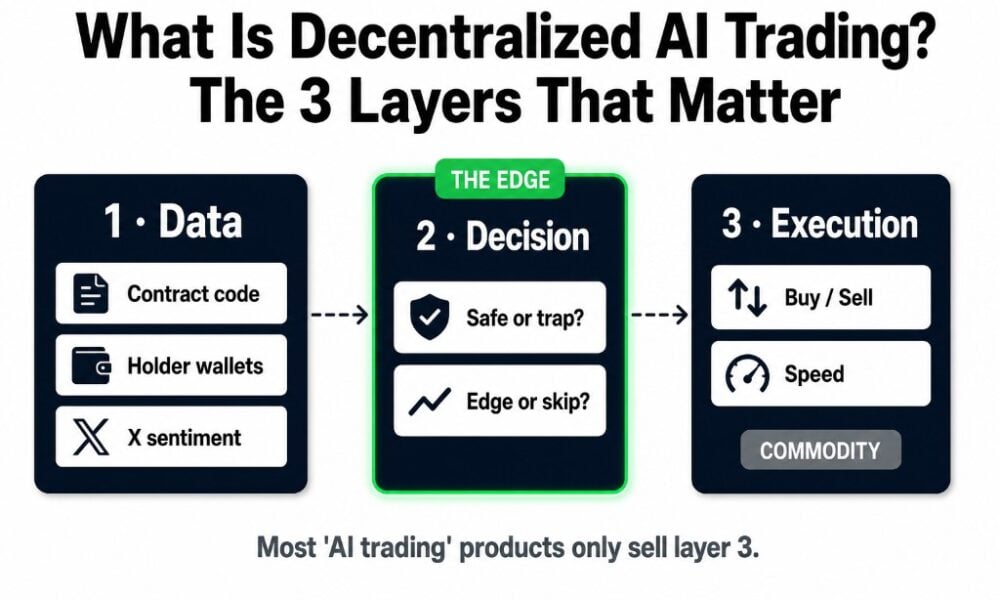
Three layers: analytics (pool depth, volume, fee APR data), position managers (automated range rebalancing and compounding for your own liquidity), and vaults/ALMs (pooled managed strategies). Before any of them, run token-level risk checks — contract safety and holder concentration — because no liquidity tool fixes providing liquidity to a scam. Our DEX AI covers that risk layer, including explicit low-liquidity warnings.
Final takeaway
- Automated liquidity management is real automation of real labor — ranges, rebalancing, compounding.
- It optimizes execution, not risk: impermanent loss, thin pools, and toxic flow survive every algorithm.
- AI’s honest contribution is better inputs (volatility, ranges) and better filters (which pools deserve your capital at all).
- Whether you’re providing liquidity or trading against it: read the pool before you commit. Depth, lock status, and trend tell you more than the chart.
If you want the risk layer handled — liquidity depth and warnings, contract safety, holder concentration on any on-chain token in seconds — that’s what we build at Crypticorn: our DEX AI is here. Not to promise yield, but to keep you out of the pools designed to take your deposit.
Author: Johannes Thüroff, M.Eng. | Last updated: July 2026
Not financial advice. See Disclaimer.