Somebody sold you the dream, or is about to: an AI bot that trades DEX tokens for you while you sleep, catching launches, riding pumps, exiting before the dumps. The question everyone asks before paying for it — do these things actually work? — has an honest answer, and it’s more useful than a plain yes or no.
I build AI tooling for on-chain trading at Crypticorn, which means I spend my weeks looking at the exact data these bots trade on. Here’s what each type of “AI DEX bot” actually does, where each one fails, and the narrow places where AI genuinely earns its keep on-chain. Last updated: July 2026. Not financial advice.
Direct answer
Mostly no — not as sold. AI DEX trading bots that promise autonomous profits fail for structural reasons: execution speed is a commodity, most new tokens are traps that no execution logic avoids, and costs (0.5–1% fees, gas, slippage, MEV) eat thin edges. What does work is AI in the analysis layer — contract security, holder intelligence, sentiment classification — feeding disciplined, human-sized execution. The bot isn’t the edge. The filter is.
Key takeaways
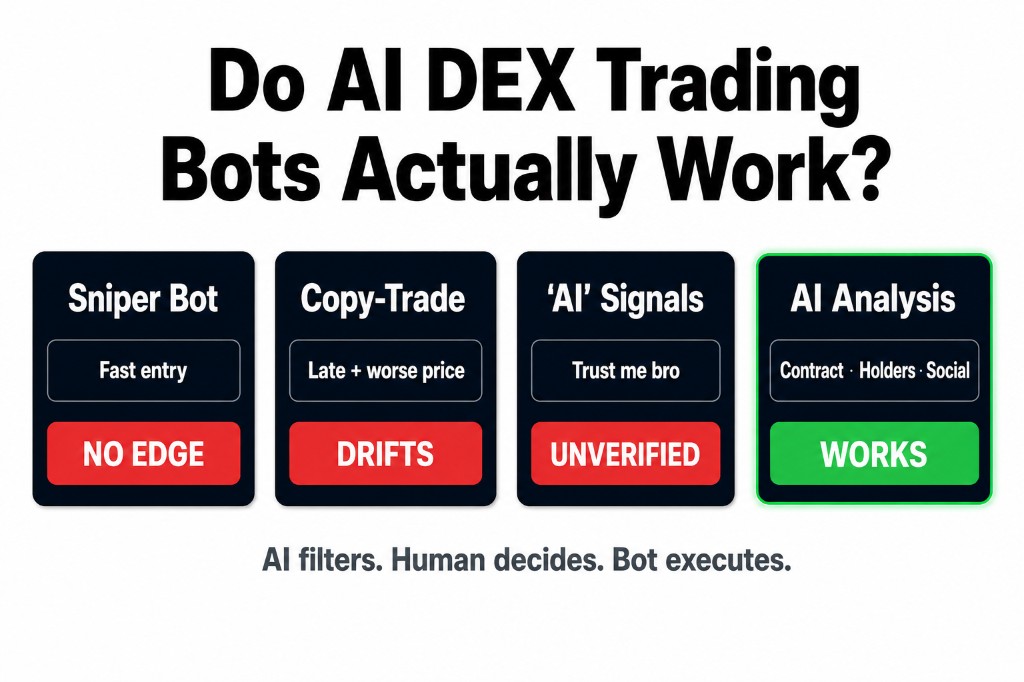
- “AI DEX bot” covers four different products: execution/sniper bots, copy-trade bots, “AI signal” bots, and AI analysis tools. Only the last category consistently delivers what it promises.
- Execution bots fail on token quality: a faster entry into a honeypot is a faster total loss.
- Copy-trade bots fail on drift: you enter later, at worse prices, with different sizing than the wallet you mirror.
- “AI-powered” on a sales page is a claim, not a feature — if you can’t see what data the model reads, assume it’s branding.
- Costs stack before any edge: ~1–2% per round trip in fees, plus gas, slippage, and MEV exposure.
- The measurable value of AI on-chain is the fast no — filtering the majority of tokens that fail basic checks before a bot ever fires.
What people actually mean by “AI DEX trading bot”
Four products get sold under one label, and they fail differently:
| Type | The promise | The reality |
|---|---|---|
| Execution / sniper bots | “Catch launches before everyone else” | Speed is real; edge isn’t. The token decides the outcome, and the bot doesn’t evaluate tokens |
| Copy-trade bots | “Mirror profitable wallets automatically” | You get their trades later, at worse prices, without their exits — the returns don’t copy |
| “AI signal” bots | “Our model calls the pumps” | Unverifiable models, curated track records, and incentives that pay on your volume, not your profit |
| AI analysis tools | “Know what you’re buying in seconds” | The one category that does what it says: contract, holder, and sentiment analysis at machine speed |
Why execution bots don’t produce profits
The fastest fill in the world is worth nothing if the token is designed to take your money — and on permissionless exchanges, a large share of new tokens are exactly that. I covered the mechanics in depth in what are crypto sniper bots and the honest comparison of the top bots, but the short version:
- Honeypots and taxed contracts don’t care about your entry speed — the loss is written in the code before launch.
- Professional snipers with dedicated infrastructure win the speed auction; retail bots buy later and higher.
- Costs compound: 0.5–1% bot fees each way, gas, priority tips, slippage on thin pools, and MEV bots sandwiching visible swaps. Each trade starts 2%+ underwater.
- No stop-losses save you when liquidity vanishes — a rug isn’t a drawdown, it’s an exit that no longer exists.
Why copy-trading doesn’t copy the profits
Copy-trading sounds like the loophole: find a wallet that wins, mirror it. Three things break in practice. Latency — you buy after them, on a thin pool, which means at a meaningfully worse price; on memecoin-sized liquidity, seconds cost percent. Sizing — their $200 probe on a $50k bankroll becomes your meaningful position, so their risk profile doesn’t transfer. Exits — the wallets worth copying are often early insiders whose “strategy” is information you don’t have; when the exit comes, you’re the counterparty. The result: same trades on paper, different outcomes in the account.
The “AI” test: what data does it read?
Here’s the one question that separates AI substance from AI branding: what inputs does the model actually analyze, and can you see its output before you trade?
A real AI layer reads things that predict outcomes on-chain — contract bytecode, holder graphs, deployer history, liquidity state, social authenticity — and shows you its findings. A marketing “AI” reads a price feed, applies a threshold rule from 2019, and shows you rocket emojis. If the pitch can’t answer what the model reads, or the “track record” is screenshots in a Telegram channel, you’re not buying intelligence — you’re buying someone’s exit liquidity coordination with extra steps.
Anything promising autonomous AI profits is describing something AI cannot do on-chain. Anything offering AI analysis before you trade is describing something it does extremely well.
What actually works: the boring stack
The combination that holds up — the same conclusion our four-month live bot test on prediction markets reached from a different direction:
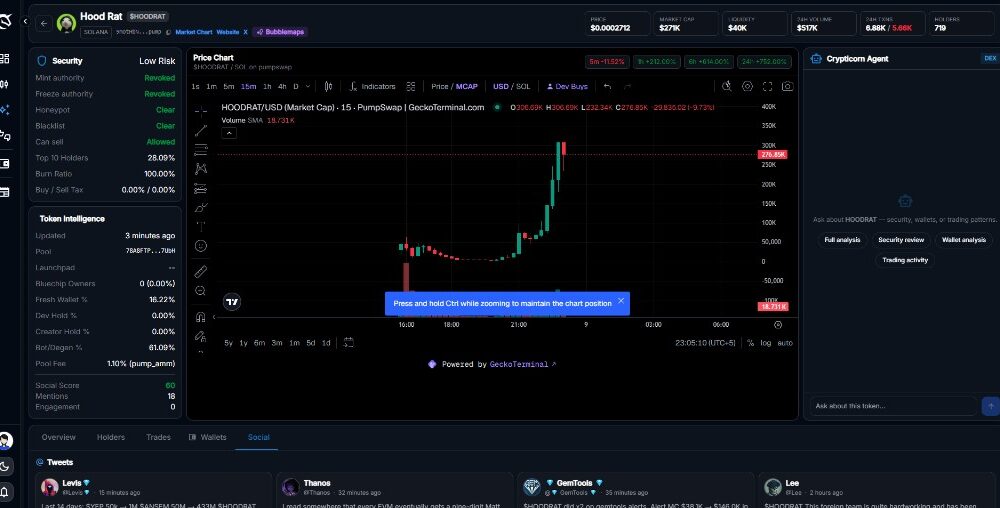
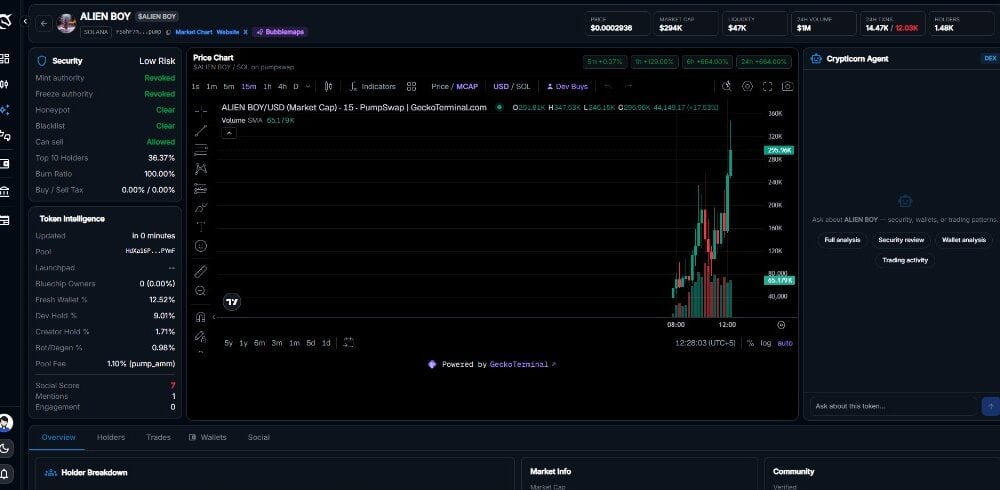
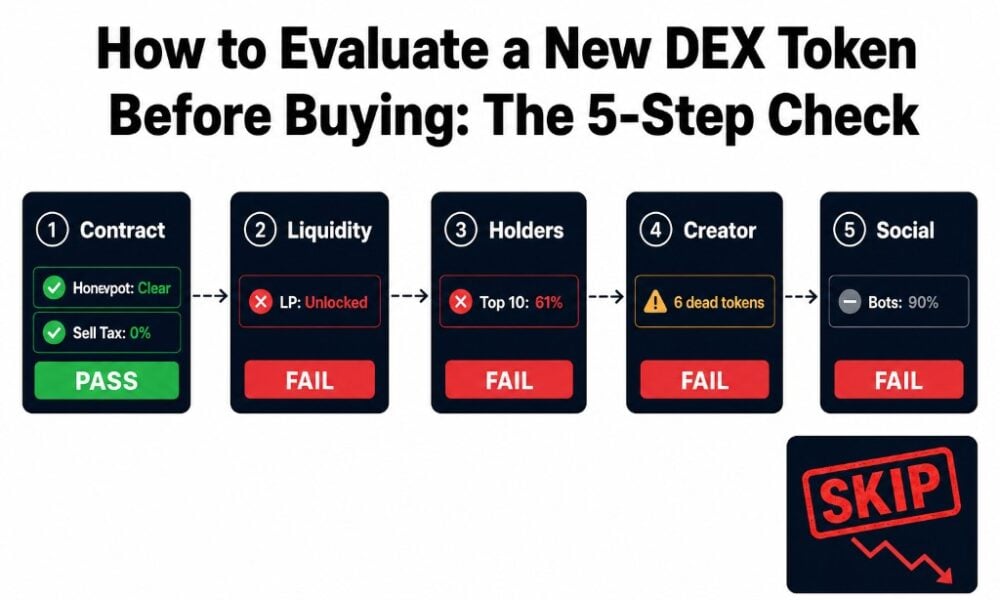
- AI analysis before the trade: the five-step token check — contract, liquidity, holders, creator, social — automated to seconds. This is where most losses are prevented.
- Human judgment on the trade decision: whether the setup has an edge, informed by data instead of Telegram urgency.
- Disciplined execution — a bot is fine here, with MEV protection enabled, tight slippage, and a burner wallet.
- Small, edge-based sizing: volatile tokens with total-loss potential get sized like it.
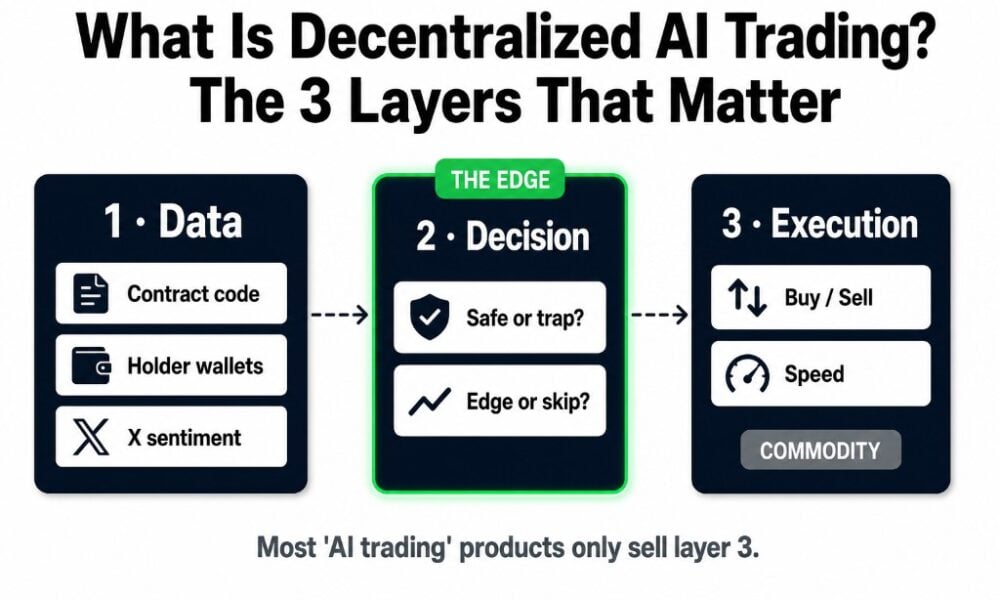
Notice the division of labor: the AI filters, the human decides, the bot executes. Every disappointing “AI bot” story I’ve seen collapses those three roles into one product that only actually does the third. That’s the framework from what is decentralized AI trading — data, decision, execution — and the edge lives in the middle layer.
Red flags before you pay for any “AI DEX bot”
- Profit promises or “up to X% daily” — no honest system on adversarial markets promises returns.
- Deposit-based models — anything holding your funds “to trade for you” is custody risk at best, an exit scam at worst.
- Unverifiable track record — wins as screenshots, losses as silence.
- No visible analysis — if you can’t see what the AI concluded before the trade, there’s nothing to see.
- Referral-heavy marketing — when promoters earn on your sign-up, the reviews are ads.
- “Source code” downloads — the free AI bot on GitHub/YouTube is a wallet drainer often enough to treat the category as hostile.
FAQ: AI DEX trading bots
Do AI DEX trading bots actually work?
As autonomous profit machines, no — execution speed is a commodity, most new tokens fail safety checks regardless of entry quality, and fees plus MEV eat thin edges. As analysis tools, yes: AI reliably automates contract security review, holder analysis, and sentiment classification, which prevents the losses that kill most DEX traders. The working setup is AI analysis feeding disciplined, human-decided execution.
Are DEX trading bots profitable?
For most retail users, no. Costs stack before any edge: 0.5–1% bot fees per side, gas and priority tips, slippage on thin pools, and sandwich attacks on visible swaps — roughly 2%+ per round trip. Profitability requires an edge larger than that hurdle, which comes from token selection and timing, not from the bot itself.
Can AI bots detect rug pulls?
AI tools detect most rug setups before entry: unlocked liquidity held by the deployer, extreme holder concentration, fresh-wallet buying clusters, and deployers with dead tokens behind them. What no tool guarantees is catching every rug — clean-looking launches can still turn. Detection shifts the odds substantially; it doesn’t eliminate the risk, which is why sizing still matters.
What’s the best AI bot for DEX trading?
Split the question: for execution, the established bots (Trojan, Banana Gun, Maestro, BONKbot, GMGN) differ on chains and features, not profitability — the comparison is in our top-5 sniper bots guide. For the AI layer that actually decides outcomes, use analysis tools that show their findings — contract safety, holder breakdown, sentiment — before you trade. No product combining both honestly promises profits.
Are crypto trading bots legal?
Using trading bots on DEXes is legal in most jurisdictions — it’s automated trading on public infrastructure. The legal risk in the category sits elsewhere: fake bots that are investment fraud, drainers disguised as bot software, and deposit schemes. Rules vary by country; nothing here is legal advice.
Final takeaway
- “Do AI DEX bots work?” — as sold, no; as analysis, yes.
- The bot executes. It doesn’t know whether the token is a trap. The filter is the edge.
- Costs (~2%+ per round trip) set the bar every trade must clear before “profit” means anything.
- AI filters → human decides → bot executes. Products collapsing all three into “autonomous profits” are selling the weakest layer with the strongest words.
If you want the filter layer that makes any execution worth doing — security review, holder breakdown, creator context, live X sentiment on any token in seconds — that’s what we build at Crypticorn: our DEX AI is here. Not to trade for you, but to keep you out of the tokens designed to take your money.
Author: Johannes Thüroff, M.Eng. | Last updated: July 2026
Not financial advice. See Disclaimer.