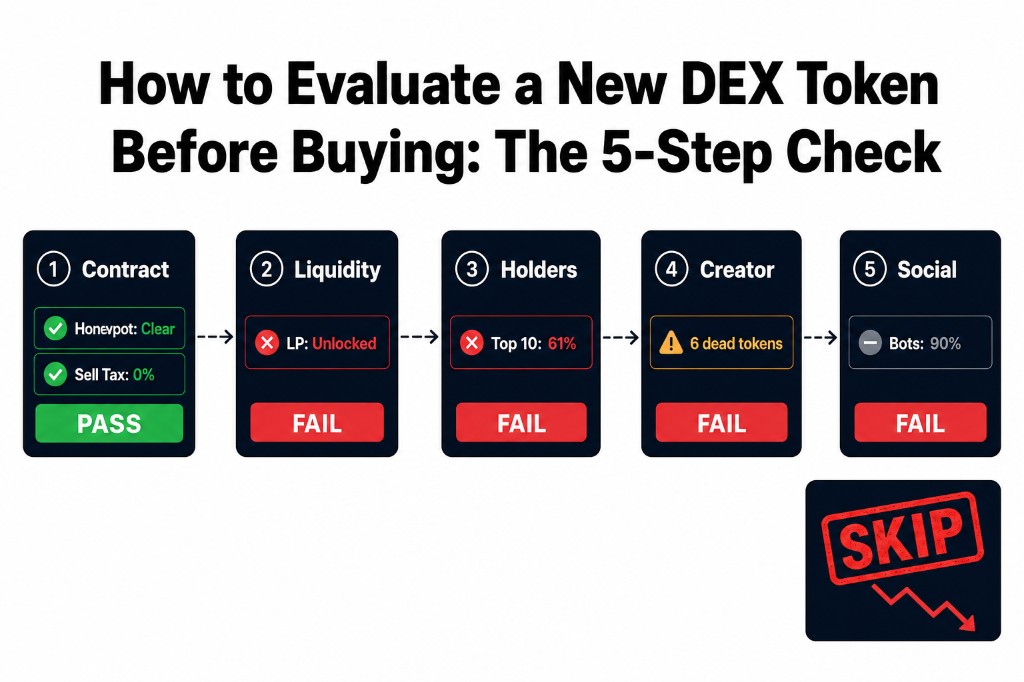
Every rug pull, honeypot, and abandoned memecoin had buyers on day one — and almost none of those buyers had spent even five minutes checking what they were buying. The uncomfortable truth about new DEX tokens is that most of them fail basic safety checks, and the failures are visible on-chain before you buy, to anyone who looks.
I look at launch-day tokens every week building Crypticorn’s DEX tooling, and this is the exact five-step evaluation I’d run before putting a single dollar into any new token. It takes 15–30 minutes manually, or seconds with the right tools — either way, it’s the highest-ROI habit in on-chain trading. Last updated: July 2026. Not financial advice.
For a venue-by-venue comparison (custody, fees, MEV, token access), see our DEX vs CEX trading guide (2026).
Direct answer
To evaluate a new DEX token before buying, run five checks in order: (1) contract safety — can the token actually be sold, and can the owner change the rules; (2) liquidity — how deep is the pool and is the LP locked or burned; (3) holder breakdown — how much supply sits with insiders and fresh wallets; (4) creator history — what the deployer wallet did before this token; and (5) social signal — whether real people or bot farms are talking about it. Most new tokens fail at least one check. Any single failure is a skip.
Key takeaways
- The loss usually happens before the trade: honeypots and rugs are written into the contract and the holder table, not the chart.
- Check order matters — contract safety first, because if you can’t sell, nothing else is relevant.
- Concentration is the countdown: when a few connected wallets control a large share of supply, the trade ends whenever they decide.
- Deployer wallets have memories: serial ruggers redeploy on a schedule, and their history is public.
- The full manual check takes 15–30 minutes per token — the real reason most people skip it and buy someone’s Telegram call instead.
- One failed check = skip. There are thousands of tokens; there’s only one of your bankroll.
Step 1: Contract safety — can this token be sold?
Start where the scams start. A token contract is code, and code can be written so that you can buy but never sell (a honeypot), so that sells are taxed at 50–99%, or so that the owner can change those rules after launch. Check for:
- Sell simulation: automated scanners simulate a sell — if it fails or returns a fraction of value, walk away. This single check catches the most brazen scams.
- Transfer taxes: small taxes (1–5%) are common in memecoins; anything higher, or asymmetric buy/sell taxes, is a red flag.
- Owner functions: can the deployer mint new supply, pause trading, blacklist wallets, or edit taxes? “Renounced” ownership removes this risk — unless the contract is upgradeable through a proxy, which quietly puts it back.
- Verified source code: unverified contracts aren’t automatically scams, but you’re trusting code nobody can read.
A perfect chart on a honeypot is still a 100% loss. This is why contract safety is step one and not step five.
Step 2: Liquidity — how easily can you get out?
Liquidity decides your real entry and exit prices, and whether an exit exists at all:
- Pool depth: in a $30k pool, a $2k swap moves the price severely — and makes you a target for the MEV bots that feed on high-slippage trades. Thin pools also mean the “price” is whatever the last small trade said it was.
- LP locked or burned: if the deployer holds the liquidity tokens, they can pull the pool — the literal rug pull — at any moment. Locked-for-weeks is weaker than burned; check the duration, not just the badge.
- Who added the liquidity: one wallet providing all of it is a single point of failure and usually a single decision-maker for the exit.
Deep dive on reading holder tables, wallet labels, and concentration: holder analysis for crypto trading (2026).
Step 3: Holder breakdown — who owns this thing?
The holder table is where launch outcomes are usually decided. Any block explorer (e.g., Etherscan and its equivalents) shows it free; the work is interpretation:
- Top-holder concentration: if the top 10 wallets (excluding the pool and burn addresses) hold a large share of supply — as a rough rule, anything beyond 20–30% combined deserves suspicion — the price is theirs, not the market’s.
- Fresh-wallet clusters: a batch of new wallets funded from the same source minutes before launch, all buying early, is the classic pre-rug signature. Organic buyers don’t arrive pre-coordinated.
- Dev allocation: what the team kept, and whether it’s moving toward exchanges or splitting across wallets (a common pre-dump pattern).
- Sniper share: if launch snipers took a big slice of early supply, expect their exits to define the first hours of the chart.
Step 4: Creator context — what did this deployer do last month?
Every token has a deployer wallet, and deployer wallets have public histories. Five minutes here regularly saves entire positions:
- Previous deployments: a wallet that has launched six tokens in three months, all now at zero, is telling you its business model. Serial ruggers iterate; the history is the tell.
- Funding trail: where did the deployer’s gas money come from? Fresh wallets funded through mixers or exchange hops are anonymity by design.
- Connection to “early buyers”: if the deployer funded the wallets that bought first, the launch is choreography, not a market.
Step 5: Social signal — is anyone real actually here?
Last because it’s the most fakeable, but still worth the look: a token with zero organic conversation is a token whose only buyers will be the ones already in — and a token with only bot-farm hype is worse. Check whether the accounts posting about it existed before last week, whether engagement is real replies or copy-paste rockets, and whether the “community” answers a single substantive question. Narrative timing matters too: attention on-chain is the fuel, and it burns fast — a point I covered from the signals side in DEX trading signals.
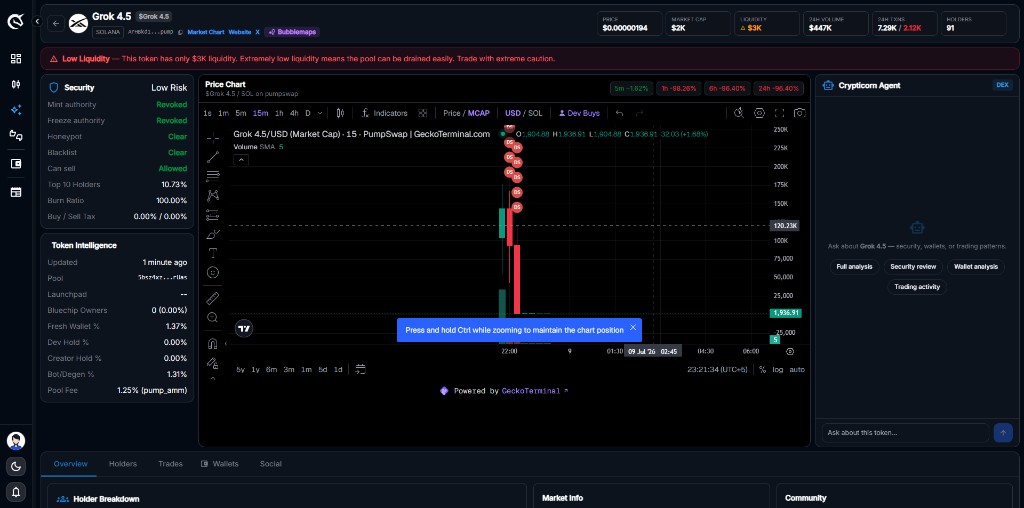
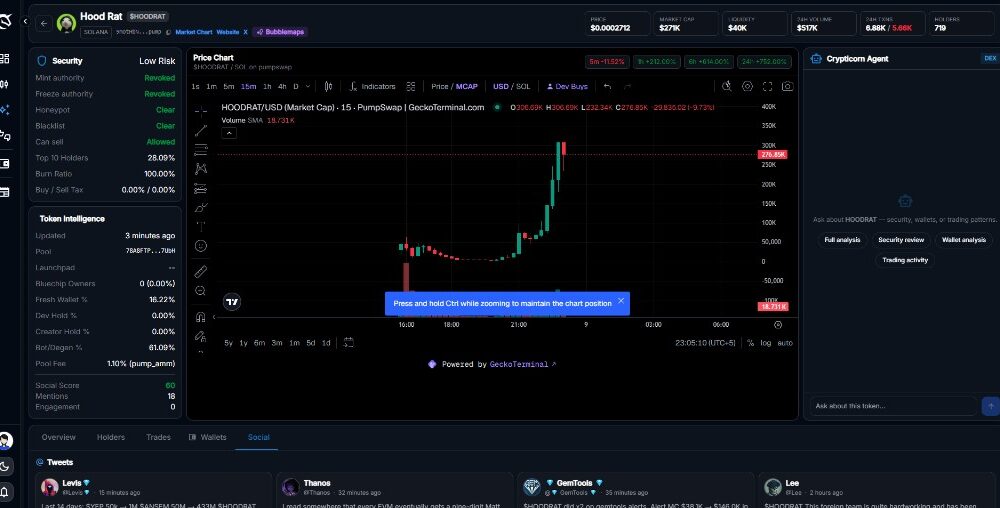
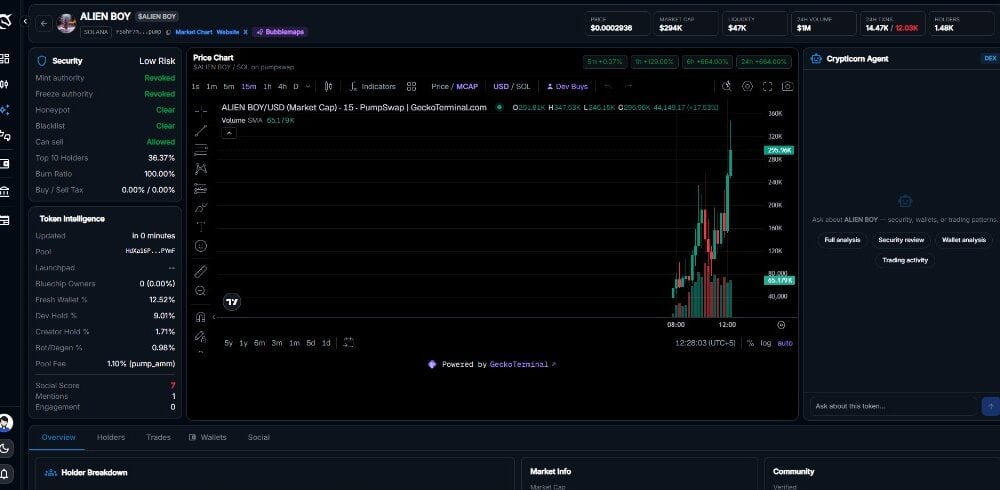
This is what a flagged token looks like in practice: the contract itself scans clean — mint revoked, honeypot clear, sells allowed — but the pool holds $3,000, and the chart is down 96% in a day. A contract-only check would have cleared it. Step 2 catches it.
The instant-no table
| Red flag | What it means | Decision |
|---|---|---|
| Sell simulation fails | Honeypot — you can buy, you can’t leave | Skip, always |
| Sell tax >10% or editable | Your exit is being farmed | Skip |
| LP unlocked and held by deployer | Rug pull is one transaction away | Skip |
| Top wallets hold outsized supply | Insiders end the trade whenever they choose | Skip |
| Fresh-wallet cluster bought first | Choreographed launch, exit already planned | Skip |
| Deployer has dead tokens behind it | You’ve found their next one | Skip |
| Only bot accounts talking | Manufactured attention, no real demand | Skip |
Notice what’s not in the table: anything about the chart. On a token that’s hours old, the chart is the marketing; the contract, the pool, and the wallets are the facts.
The time cost, and how to compress it
Done manually — scanner for the contract, explorer for holders and deployer, X search for the social read — this checklist costs 15–30 minutes per token. During a live launch window, that’s an eternity: the trade you were evaluating is gone, which is exactly the pressure that pushes people into skipping the check or outsourcing it to a Telegram caller with an incentive structure you can’t see.
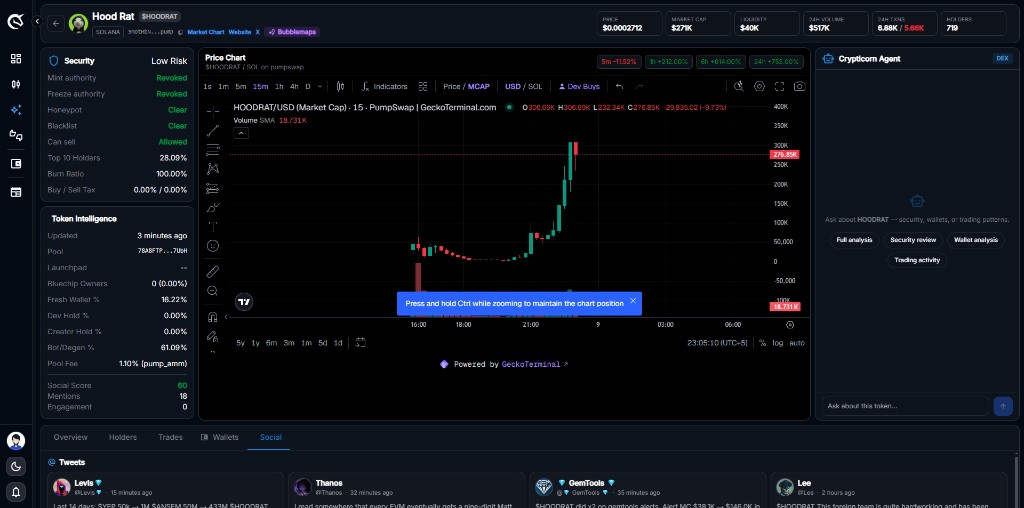
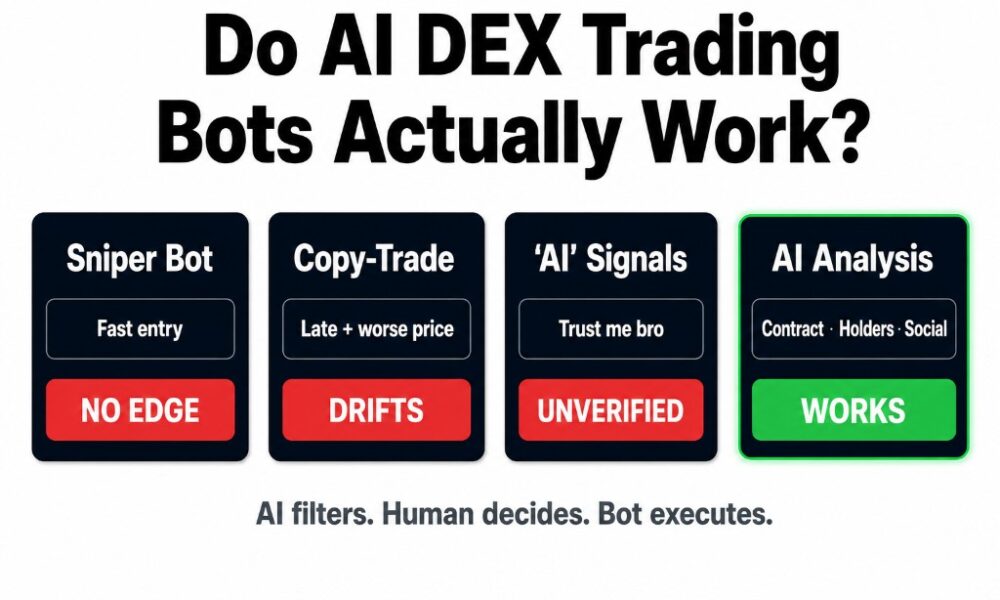
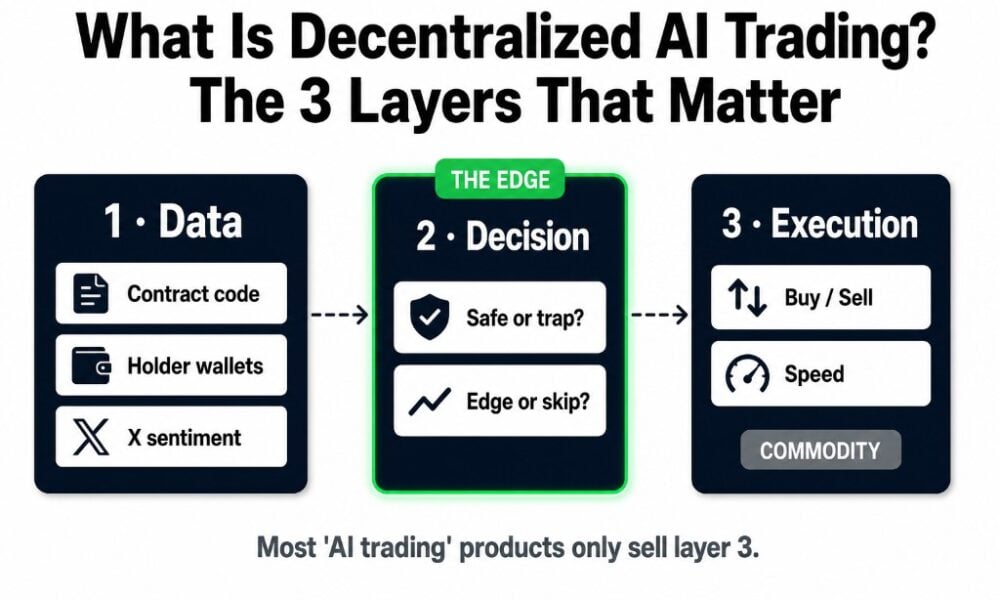
Compressing that check is precisely what we built our DEX AI for: the agent runs the security review, holder breakdown with wallet labels, creator context, and live X sentiment on any token in seconds — the same five steps, automated, with the same honest output pattern: it flags far more tokens than it clears. If a tool you use clears everything, the tool is part of the sales funnel. (The wider tooling landscape and where this fits: what is decentralized AI trading.)
FAQ: evaluating new DEX tokens
How do I check if a token is safe to buy?
Run five checks in order: contract safety (sell simulation, taxes, owner functions), liquidity (pool depth, LP locked or burned), holder breakdown (concentration, fresh-wallet clusters, dev allocation), creator history (the deployer wallet’s previous tokens), and social signal (real accounts vs bot farms). Automated scanners handle the contract layer; block explorers show holders and deployer history free. Any single failed check is a skip.
What is a honeypot token?
A honeypot is a token whose contract allows buying but blocks or punishes selling — through blocked transfers, extreme sell taxes (up to 99–100%), or blacklists applied after you buy. The chart can show profit while the contract guarantees you can never realize it. Sell-simulation scanners catch most honeypots before you commit funds.
How do I check for a rug pull before it happens?
Three places: liquidity (if the LP tokens are unlocked and held by the deployer, the pool can be pulled in one transaction), holder concentration (insiders holding a large supply share can dump at will), and deployer history (wallets that launched previous now-dead tokens tend to repeat). None of these guarantee a rug — but nearly all rugs show at least one in advance.
What percentage should top holders own?
There’s no universal threshold, but as a working rule: if the top 10 non-pool, non-burn wallets hold more than roughly 20–30% combined — or any single non-team wallet holds more than ~5% — the token’s price is controlled by a small group, and your position exists at their pleasure. Compare against established tokens, where supply is spread across thousands of unconnected holders.
Are automated token scanners reliable?
They’re a strong first filter, not a verdict. Scanners reliably catch simulated sell failures, visible taxes, and standard owner functions — but sophisticated scams deploy clean-looking contracts and rug through liquidity or coordinated holders instead, which is why the holder and deployer checks exist. Use the scanner to exclude the worst tokens fast, then verify the layers a scanner can’t judge.
Final takeaway
- Five checks, in order: contract → liquidity → holders → creator → social. The order is a funnel — each step only matters if the previous one passed.
- Most new tokens fail at least one. One failure = skip. The next launch is 15 minutes away.
- The chart is marketing; the contract and the wallets are the facts.
- Manual cost: 15–30 minutes. Automated: seconds. Skipped: eventually, everything.
If you want the five steps in one automated pass — security review, holder breakdown, creator context, live X sentiment on any on-chain token — that’s what we build at Crypticorn: our DEX AI is here. Not to pick winners, but to catch the tokens designed to take your money before they do.
Author: Johannes Thüroff, M.Eng. | Last updated: July 2026
Not financial advice. See Disclaimer.