Search for “DEX trading signals” and you’ll find two things: Telegram groups promising 10x calls, and articles recycling stock-market indicator advice onto tokens that are three hours old. Both miss what makes on-chain trading different — and both lose people money in ways that are completely predictable once you understand the mechanics.
I work with on-chain token data every week building Crypticorn’s DEX tooling, and this article is the honest version: what a DEX trading signal actually is, why the indicator playbook from centralized exchanges breaks on DEX pairs, what a signal stack that works looks like — and why most paid “DeFi signal groups” are structured so that you are the product. Last updated: July 2026. Not financial advice.
Direct answer
DEX trading signals are indicators for trading tokens on decentralized exchanges — but unlike CEX signals, price and volume alone are nearly useless on-chain. New DEX pairs have no price history, thin liquidity, and insiders who control supply, so a useful signal stack combines four layers: price/volume, holder data, contract safety, and social sentiment. Most paid “DeFi signal groups” fail a simpler test: the caller buys before the signal and sells into the followers. If you can’t see the incentive structure, you’re the exit liquidity.
Key takeaways
- CEX-style technical analysis breaks on DEX pairs: a token with 3 hours of history has no support levels, no meaningful RSI, and candles made of a handful of trades.
- On-chain, the contract and the holders are the signal: a perfect chart on a honeypot is still a 100% loss.
- A working signal stack has four layers: price/volume + holder data + contract safety + social sentiment. Each one catches what the others miss.
- Most paid signal groups are exit-liquidity machines: the caller accumulates, signals the buy, and sells into the pump their followers create.
- Evaluate any signal source on three things: verifiable track record, the caller’s entry timing, and their incentive structure (referrals, token bags, paid promotion).
- AI helps at exactly one point: compressing the four-layer check from minutes to seconds — not predicting which token pumps.
What are DEX trading signals?
A DEX trading signal is any indicator that tells you a token on a decentralized exchange (Uniswap, Raydium, PancakeSwap) might be worth entering or exiting. In practice the term covers three very different things:
- Data signals — measurable on-chain events: a liquidity add, a volume spike, smart-money wallets accumulating, holder count growth.
- Tool signals — alerts from screeners and analytics platforms when a token matches criteria you set.
- Social signals — someone in a Telegram or Discord group telling you to buy. These are the most popular and the least trustworthy, for reasons covered below.
The distinction matters because the first two are verifiable and the third is someone else’s trade idea with an incentive attached. If you’ve read my breakdown of crypto signals in general, the DEX version is the same story with higher stakes: faster markets, thinner liquidity, and far more outright fraud.
Deep dive on reading holder tables, wallet labels, and concentration: holder analysis for crypto trading (2026).
Why CEX-style TA breaks on DEX pairs
The indicator playbook — RSI, MACD, support and resistance — assumes deep markets with long price history and diverse participants. New DEX pairs violate every assumption:
- No history. A token launched this morning has no 200-day moving average, no support levels, nothing for pattern analysis to work with. Most indicator math needs more candles than the token has existed.
- Thin liquidity. When a pool holds $40k, a single $2k swap paints the candle. “Volume analysis” on ten trades isn’t analysis — it’s reading tea leaves that one wallet arranged.
- Insider supply. On a fresh pair, the deployer and early wallets often control enough tokens to end the chart whenever they choose. The trend is whatever the dev decides it is.
- Structural costs. Wide effective spreads, slippage on thin pools, and MEV bots sandwiching visible swaps mean the price you see is not the price you get — which invalidates the precise entries TA depends on.
TA isn’t worthless on-chain — on established pairs with months of history and deep pools, it works about as well as it does anywhere. But on the fresh pairs where signal groups operate, the chart is the least informative thing on the screen.
The four signal layers that actually work
| Layer | What it tells you | What it misses |
|---|---|---|
| 1. Price & volume | Momentum, liquidity depth, whether anyone is actually trading | Whether the volume is real or one wallet wash-trading; whether you can ever sell |
| 2. Holder data | Supply concentration, fresh-wallet clusters, smart-money entries, dev wallet behavior | Timing — holders can look clean right up until the narrative dies |
| 3. Contract safety | Honeypot code, sell taxes, owner functions that can change rules after launch | Nothing about direction — a safe token can still go to zero normally |
| 4. Social sentiment | Narrative momentum on X, whether real accounts or bot farms are talking | Sustainability — social spikes mark attention, not value |
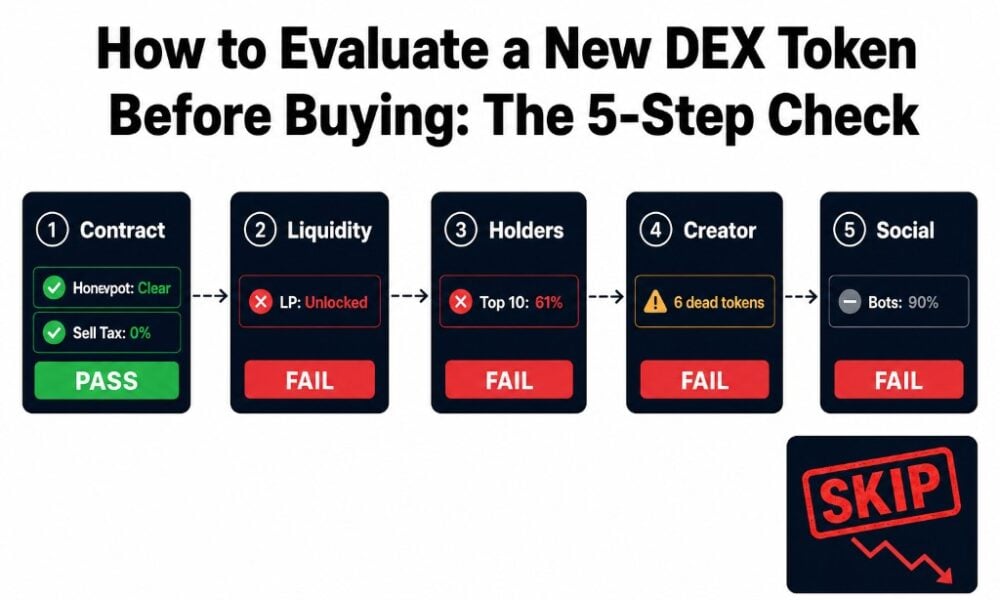
The reason the stack needs all four: each layer’s blind spot is another layer’s core competence. Price says a token is pumping; holder data says three wallets own 80% of it; contract safety says sells are taxed at 40%; sentiment says the “community” is 200 bot accounts created on Tuesday. Any single layer would have let that trade through. Together they catch what matters: most new tokens fail at least one check.
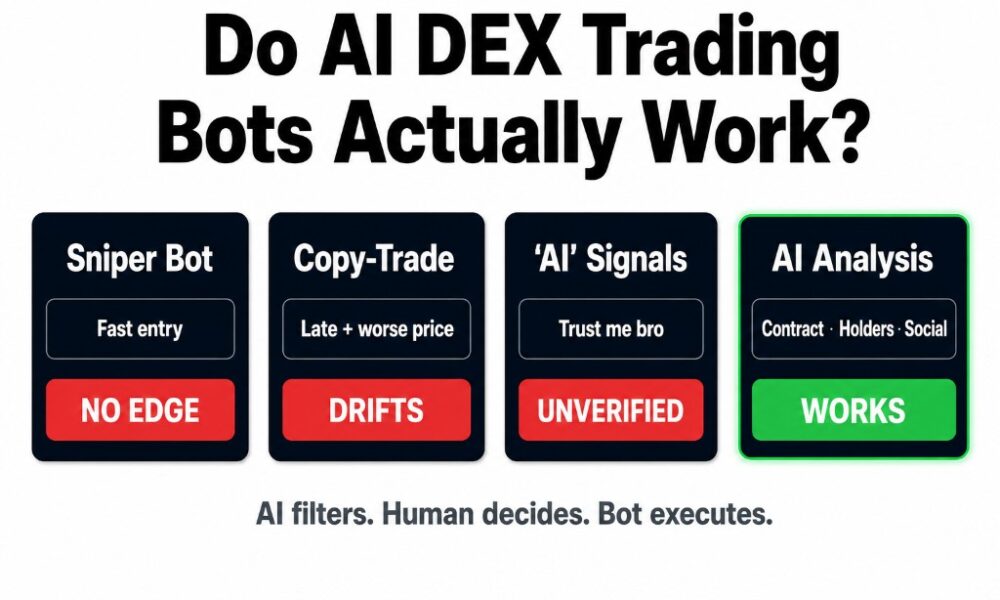
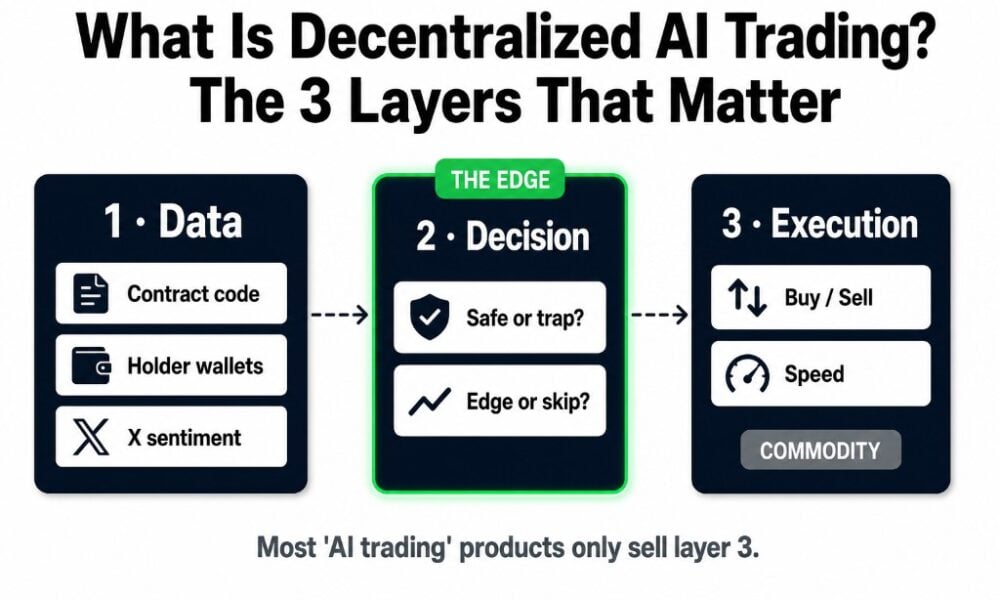
This layered approach is the practical core of decentralized AI trading — and it’s why speed-focused tools like sniper bots don’t produce edges on their own: they act on layer 1 while the outcome is decided in layers 2 and 3.
Why most “DeFi signal groups” are exit liquidity
Here’s the mechanic behind the majority of paid and “free VIP” DEX signal groups, and it’s worth reading twice:
- The caller (or their inner circle) accumulates a thin token quietly.
- The “signal” goes out to hundreds or thousands of followers: contract address, buy now, rocket emojis.
- Followers buy. On a thin pool, that buying is the pump the signal predicted — the prophecy fulfills itself.
- The caller sells into that demand. The chart rolls over. The group is told to “HODL” or blamed for weak hands.
- Repeat, with a fresh token, until the group’s reputation is spent — then rebrand and restart.
The signal wasn’t information. It was a coordination device for creating the caller’s exit. This is why “they were right, it did pump!” misses the point — of course it pumped; the followers were the pump.
Red flags that make the diagnosis easy:
- Contract addresses dropped with urgency (“next 100x, ape now”) and no analysis of holders or contract
- No verifiable track record — wins celebrated, losing calls deleted
- The caller’s wallet is never disclosed, so you can’t check when they entered
- Referral links to bots or exchanges on every message (they earn whether you win or lose)
- Paid tiers promising “earlier” calls — an honest description of the food chain: the cheaper your tier, the later you buy, the more likely you’re someone else’s exit
How to evaluate any signal source in three questions
- Can I verify the track record? Full history including losers, timestamped, ideally on-chain. If wins are screenshots and losses are silence, the track record is marketing.
- When did the caller enter? If the wallet behind the calls bought before the signal, you’re not receiving analysis — you’re receiving their exit plan. On-chain, this is checkable; sources that won’t disclose wallets have answered the question.
- How does the source make money? Subscription fees are the honest model. Referral kickbacks, token allocations, and paid promotions all pay the caller regardless of your outcome — and usually because of your entry.
Building a signal stack that works
The realistic version for a solo trader in 2026:
- Layer 1 (price/volume): any major screener covers this — new pairs, volume, liquidity depth. Free and commoditized.
- Layer 2 (holders): block explorers show top-holder tables free; the work is interpretation — concentration, fresh-wallet funding patterns, dev history. This is where most manual traders run out of patience.
- Layer 3 (contract): free checkers catch obvious honeypots; owner-function risks and post-launch rule changes need deeper review.
- Layer 4 (social): X search plus judgment about account quality — the layer most easily faked and most manually expensive to verify.
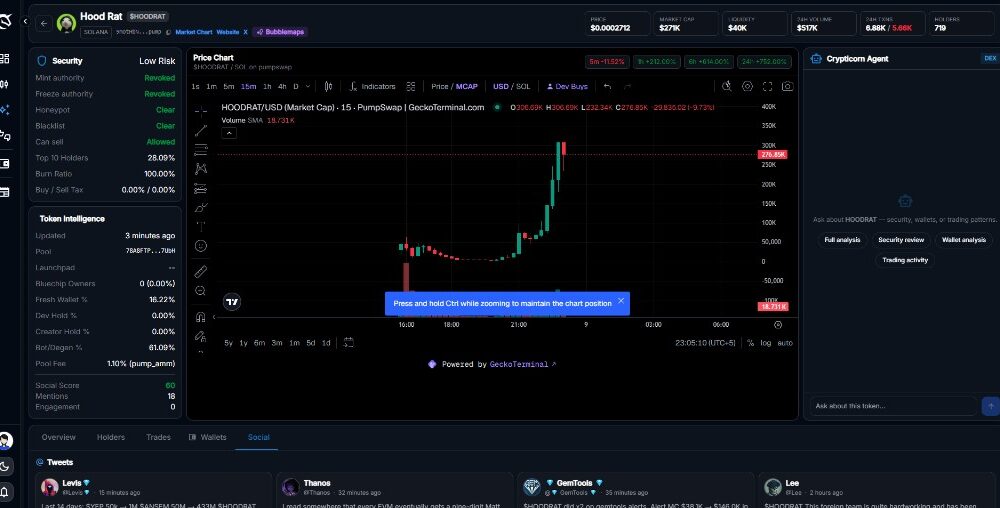
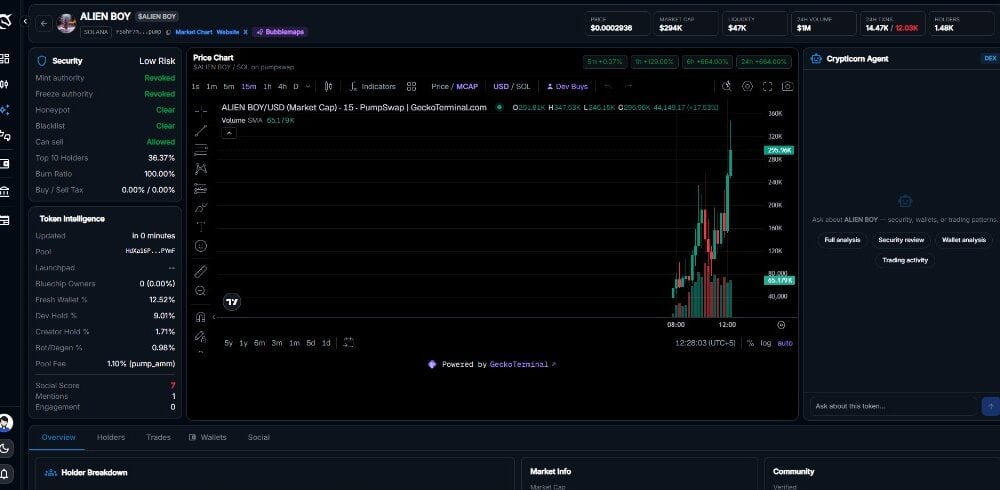
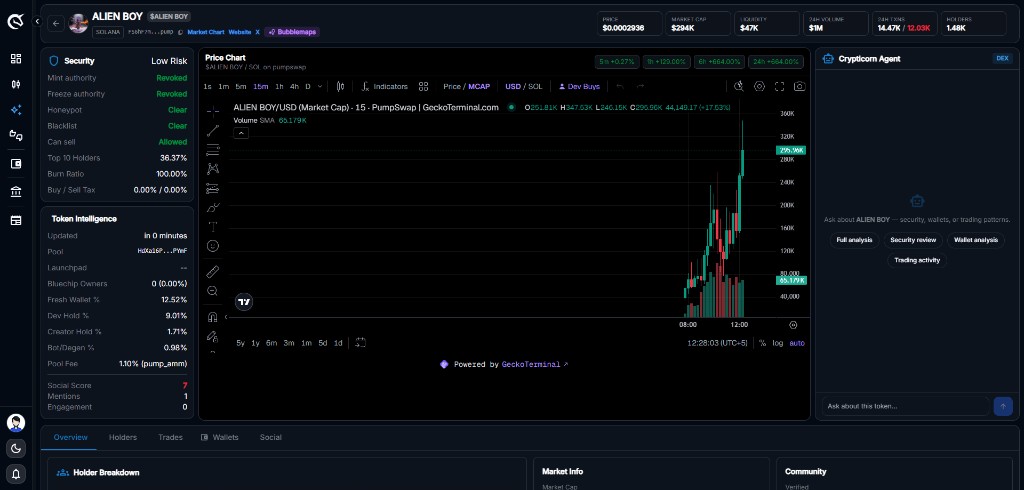
Doing all four manually takes 15–30 minutes per token, which is precisely why most people skip to somebody’s Telegram call instead. That time cost is the problem our DEX AI solves: the agent runs the full analysis — security review, holder breakdown with wallet labels, live X sentiment — on any token in seconds, and it flags far more tokens than it clears. That ratio is what an honest signal layer looks like: the most valuable signal on-chain is “don’t”.
FAQ: DEX trading signals
What are DEX trading signals?
DEX trading signals are indicators for entering or exiting tokens on decentralized exchanges. Unlike centralized-exchange signals, useful DEX signals can’t rely on price action alone — new pairs have no history and thin liquidity, so real signals combine price/volume with on-chain holder data, contract safety checks, and social sentiment.
Are DeFi signal groups worth it?
Mostly no. The common structure has the caller accumulating a thin token before signaling, then selling into the followers’ buying — the group’s own purchases create the pump, and members become the exit liquidity. Before trusting any group, verify the full track record including losses, check when the caller’s wallet entered, and understand how they’re paid. Sources that fail those checks are marketing operations, not analysis.
Do technical indicators work on DEX tokens?
On established pairs with months of history and deep liquidity, standard technical analysis works about as well as anywhere. On fresh pairs — where most DEX signal activity happens — it breaks: there’s no price history for the math, single trades paint the candles, and insiders control enough supply to override any pattern. On new tokens, holder data and contract safety are more informative than the chart.
What is the best source of DEX signals?
Verifiable on-chain data beats any caller: liquidity depth and volume from screeners, holder concentration and smart-wallet activity from explorers or analytics tools, automated contract safety checks, and social sentiment with bot-account filtering. Tools that combine these layers (including our DEX AI) are assessable and testable; anonymous Telegram calls are not.
Can AI generate DEX trading signals?
AI is genuinely useful for the analysis layer: running contract security review, holder breakdown, and sentiment classification in seconds instead of the 15–30 minutes a manual check takes per token. What AI can’t honestly do is predict which token pumps — any tool claiming guaranteed calls is marketing. The realistic value is filtering: identifying the majority of tokens that fail basic checks before you risk anything.
Final takeaway on DEX trading signals
- On-chain, price is one signal layer of four — holders, contract, and sentiment decide most outcomes on fresh pairs.
- Signal groups pumping contract addresses are coordination devices for the caller’s exit. Verify track record, entry timing, and incentives — or assume the worst.
- The four-layer check takes 15–30 minutes manually. That cost is why people outsource judgment to strangers — and why automating the check beats automating the trade.
- The strongest signal in DEX trading is the one that keeps you out: most new tokens fail at least one basic check.
If you want the four layers in one place — security review, holder breakdown, live X sentiment, on any on-chain token in seconds — that’s what we build at Crypticorn: our DEX AI is here. Not to call pumps, but to keep you out of the tokens designed to take your money.
Author: Johannes Thüroff, M.Eng. | Last updated: July 2026
Not financial advice. See Disclaimer.