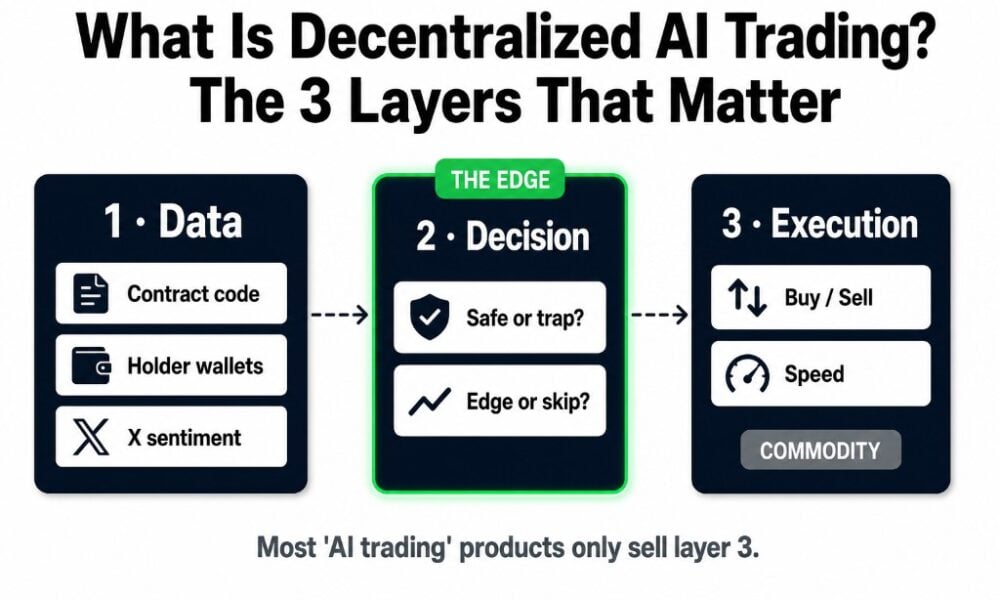
If you’ve spent any time around new token launches, you’ve seen the screenshots: someone buys a memecoin in the same second its liquidity goes live and sells it minutes later for 40x. The tool behind that trade is a sniper bot — and the screenshots are the most misleading part of the whole story.
I’m Johannes Thüroff, M.Eng., founder of Crypticorn. I build AI tooling for on-chain and DEX trading, and part of that job is running new tokens through security and holder checks every week — which means I see what launch sniping actually looks like from the data side, not the screenshot side. This article explains what sniper bots are, how they really work, the four types, and why most people who use them lose money. Last updated: July 2026. Not financial advice.
Direct answer
A crypto sniper bot is an automated tool that buys a token the moment a trigger condition is met — most commonly the second liquidity is added for a new token on a decentralized exchange like Uniswap or Raydium. Bots win by being faster than humans: they watch pending transactions and execute in the same block. Most retail snipers still lose, because speed doesn’t protect you from honeypots, rug pulls, sell taxes, or faster competitors.
Key takeaways
- A sniper bot buys automatically when a trigger fires — usually a liquidity-add event for a brand-new token, sometimes a price level or a copied wallet.
- Speed is the whole product: bots monitor pending transactions and buy in the same block liquidity goes live. A human clicking manually is minutes late — an eternity on-chain.
- Typical costs: 0.5–1% bot fee per trade, plus gas, plus priority tips paid for speed. A round trip through a 1% bot costs ~2% before slippage.
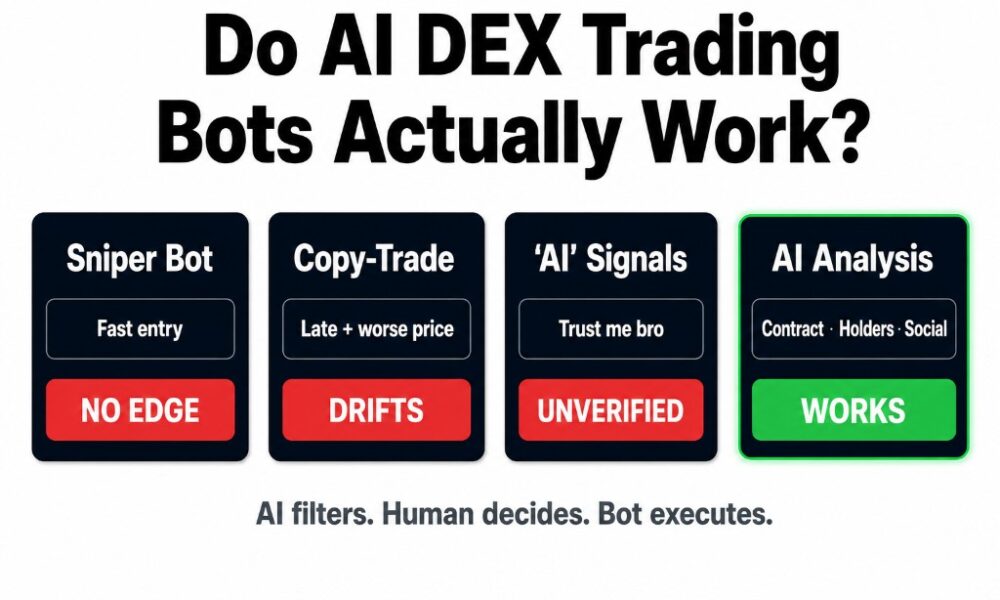
- The four common types are entry/exit (price) snipers, arbitrage bots, scalping bots, and AI-assisted bots — they solve different problems and fail in different ways.
- Most retail snipers lose to honeypots, sell taxes, rug pulls, and faster bots — not to bad entries. The contract, not the chart, is usually what kills the trade.
- Rule one is unchanged since 2024: never connect your main wallet to any bot. Use a funded burner and withdraw regularly.
What sniper bots actually are
Strip away the Telegram branding and a sniper bot is three components: a watcher, a trigger, and an executor. It’s one of the oldest tool categories in decentralized AI trading, and one of the most oversold.
The watcher monitors on-chain activity — new liquidity pools, pending transactions in the mempool, price levels, or the trades of a specific wallet. The trigger is the condition you set: “buy when this pair gets liquidity”, “buy at this price”, “copy whatever this wallet does”. The executor signs and submits the transaction the instant the trigger fires, usually paying extra gas or a validator tip to get placed as early in the block as possible.
In 2026, most retail snipers run through Telegram bots — Trojan, Banana Gun, Maestro, and BONKbot are the established names — with web terminals like Photon, GMGN, and Axiom covering the same ground outside Telegram. Fees cluster around 0.5–1% per executed trade, before gas and any priority tips you pay for speed.
That last part matters more than people think. A 1% fee bot costs you roughly 2% per round trip. Add slippage on a thin new pair and a priority tip, and your token has to move 3–5% before you’ve made anything. Sniping has a fee hurdle the screenshots never show.
How launch sniping actually works
The canonical snipe — the one the marketing is built on — targets the moment a new token becomes tradeable:
- A developer deploys a token contract. It exists, but there’s no liquidity — nobody can trade it yet.
- The developer sends the transaction that adds liquidity (say, pairing the token with ETH or SOL on a DEX).
- Sniper bots watching for exactly this event see the liquidity-add and submit buy transactions designed to land in the same block — before the price has moved at all.
- If the token pumps, the earliest buyers sell into the wave of later buyers — including everyone who found the token “early” on a screener and was still minutes behind the bots.
Two things follow from this mechanic. First, manual sniping is not sniping. By the time you’ve seen a token on DexScreener and opened a swap, block-0 buyers are already in profit and looking for exit liquidity — possibly yours. Second, sniping is a speed auction: whoever pays validators more and runs better infrastructure wins the earliest position. Retail bots compete against professional operations with co-located nodes. You are rarely first; the question is how late you are.
“I’ll just use a bot and get in at launch like the pros” — the assumption that funds most of the losses in this niche. The pros are in the same block as the liquidity. You’re bidding for the leftovers.
This is also where sniping overlaps with MEV — bots that reorder, front-run, or sandwich other people’s transactions for profit. If a sandwich bot spots your pending buy on a thin pair, it can buy before you and sell into your fill, worsening your price. I cover that whole ecosystem in what are MEV bots and how do they make profits.
The four types of sniper bots
| Type | What it does | Where it fails |
|---|---|---|
| Entry/exit (price) sniper | Buys and sells at predetermined price levels or launch events, with stop-loss and take-profit settings | The trigger fires on price, not on contract quality — it will happily buy a honeypot at your target price |
| Arbitrage bot | Buys a token cheaper on one DEX, sells it higher on another, repeatedly | Competing with professional MEV infrastructure; margins after gas are thinner than the marketing implies |
| Scalping bot | Takes many small profits from tiny price moves on established pairs | Death by fees: dozens of 0.5–1% round trips need a very high win rate just to break even |
| AI-assisted bot | Uses models to filter which launches or setups to take, instead of firing on every trigger | Only as good as its data; “AI” on a sales page is a claim, not a feature you can verify |
The sniper vs scalper distinction confuses people because both are fast, automated, and sold through the same channels. The difference is the target: a sniper waits for one event (a launch, a price level) and strikes once; a scalper grinds continuously, harvesting many small moves. Snipers have a few big-risk trades; scalpers have hundreds of small-fee trades. Both can lose, but they lose differently — snipers to bad contracts, scalpers to costs.
Why most retail snipers lose
Here’s the section the bot marketing leaves out. The failure modes, in the order I see them matter:
1. Honeypots: you can buy, but you can’t sell
A honeypot is a token contract written so that buying works and selling doesn’t — or sells are taxed at 90–100%. Your bot executes a perfect block-0 entry into a token you can never exit. The chart shows you in profit; the contract has already decided you’re not. Speed is worthless here, because the loss was in the code before the launch happened.
2. Rug pulls: the developer is your counterparty
If the developer holds a large share of supply or controls the liquidity, the exit plan may simply be to dump on the snipers. The launch pump the bots create is the product — you are the demand being farmed. Fresh wallets funded from one source buying early is the classic pre-rug pattern, and it’s visible on-chain if you look before you buy.
3. The speed auction you can’t win
During a hyped launch, entry position is auctioned via priority fees and validator tips. Professional snipers with dedicated infrastructure will outbid and outrun a retail Telegram bot. You still get filled — just later and higher, which on a launch curve is the difference between the winning side and the exit liquidity side.
4. Fees compound faster than skill
One percent per trade sounds small until you’re taking dozens of trades. A 1% bot fee each way plus gas plus slippage means every trade starts 2–5% underwater. That’s the same math that kills most high-frequency retail strategies — the edge required just to break even is bigger than most people’s actual edge.
5. Survivorship bias does the marketing
The winning screenshots are real. So are the thousands of losing wallets that don’t post. Referral links pay the people posting the wins, so the content you see is an ad, not a sample. I made the same point about MEV bots and Polymarket martingale bots: when a strategy is sold on win-rate screenshots, the catastrophic losses are always somewhere off-screen.
Security: the rules that are not optional
Sniper bots need signing power over a wallet to trade for you. Telegram bots typically generate a wallet for you and hold or share custody of its key. That means the bot operator — or anyone who compromises the bot — can drain that wallet. The 2023 Unibot exploit is the standing reminder: even the most popular bot of its cycle got hit.
- Never import your main wallet’s private key into any bot. No exceptions, no matter how established the brand.
- Use a dedicated burner wallet funded with only what you’re prepared to lose completely.
- Withdraw profits regularly to a wallet the bot has never touched.
- Verify bot links from official documentation. Fake clones of popular bots are a scam category of their own on Telegram.
- Review token approvals periodically and revoke anything you no longer use.
What I check before touching a new token
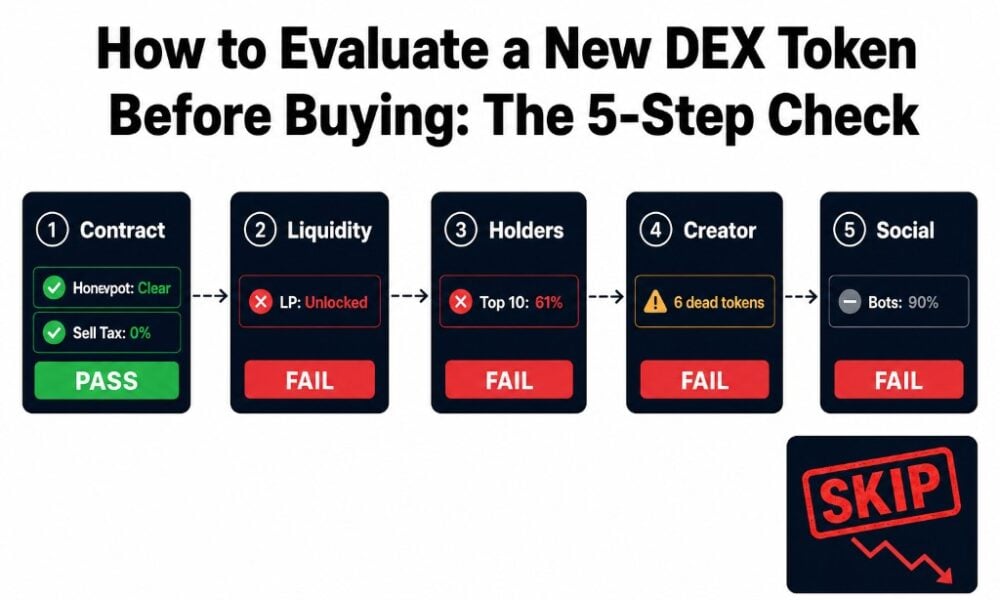
Whether or not a bot handles the execution, the decision to touch a new token at all is where the money is actually won or lost. This is the checklist I run — and building this workflow into our DEX AI product is how I ended up staring at more launch-day contracts than I can count:
- Contract safety: can the token be sold? Are there transfer taxes, blacklists, or owner functions that can change the rules after launch?
- Holder concentration: what share of supply sits in the top wallets? A launch where insiders hold most of the supply is a countdown, not an opportunity.
- Fresh-wallet mix: are the “early buyers” organic, or a cluster of new wallets funded from the same source minutes before launch?
- Creator context: what did the deployer wallet do before this token? Serial ruggers redeploy on a schedule.
- Social signal: is anyone real talking about this on X, or is the noise coming from accounts created last week?
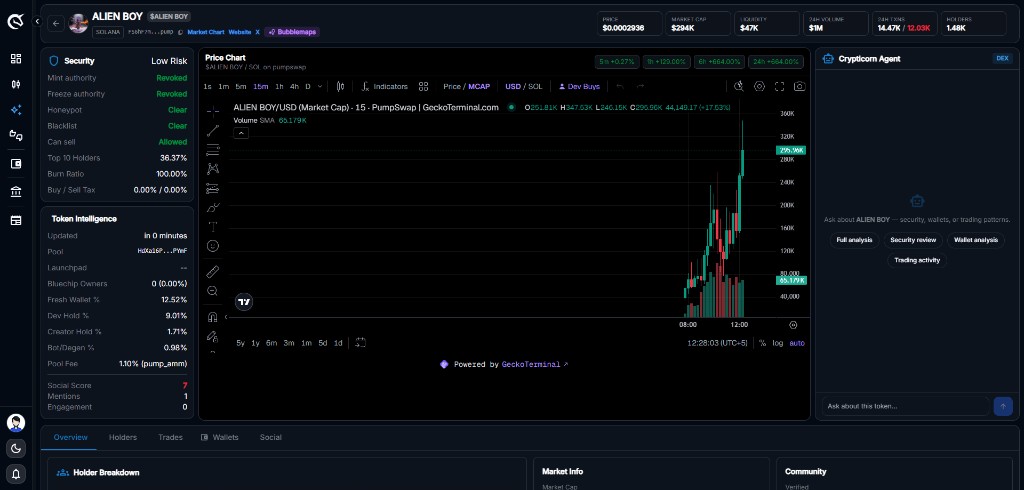
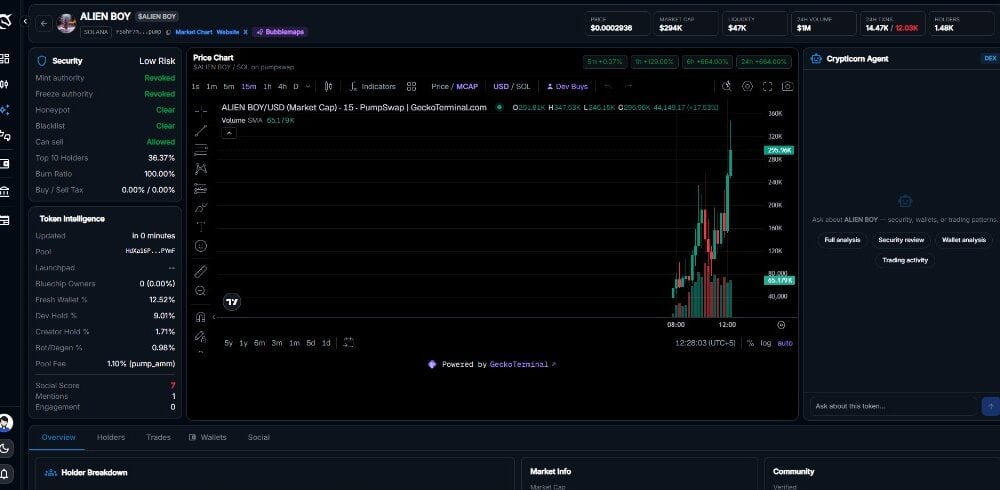
Most new pairs fail at least one of these checks, and that’s the honest pitch for doing the analysis before the trade: the biggest wins in sniping come from the trades you don’t take. Our DEX AI agent automates these checks — full analysis, security review, holder breakdown, live X sentiment — so the filter runs in seconds instead of you eyeballing a block explorer while the launch passes you by. It flags bad tokens far more often than good ones, which is exactly what you’d expect if you’ve read this far.
FAQ: crypto sniper bots
What are snipers in crypto?
Snipers in crypto are traders (or their bots) who buy a token at the earliest possible moment — typically in the same block that liquidity is added for a new token on a decentralized exchange. The goal is to enter before the price moves and sell into the demand that arrives later. In practice the term covers both the automated tools and the people running them.
What does a sniper bot do?
A sniper bot watches on-chain activity for a trigger — a liquidity-add event, a price level, or a tracked wallet’s trade — and executes a buy the instant the condition is met, usually paying priority fees to land early in the block. Popular examples in 2026 include Trojan, Banana Gun, Maestro, and BONKbot, with fees around 0.5–1% per trade.
How do sniper bots work?
Sniper bots monitor pending transactions and new liquidity pools. When a new token’s liquidity transaction appears, the bot submits a buy designed to execute in the same block, ahead of human traders. Configuration typically covers position size, slippage tolerance, priority fee, and automatic take-profit or stop-loss levels. The bot’s edge is purely speed — it does not evaluate whether the token contract is safe unless a separate filter does that.
Are sniper bots legal?
Using a sniper bot is not illegal in most jurisdictions — it’s automated trading on public infrastructure. But the surrounding activity often is: launching a honeypot or rugging liquidity is fraud, and some MEV-adjacent tactics operate in a legal gray zone. The practical risk for most users isn’t legal exposure — it’s losing money to bad contracts, scam bot clones, and custodial wallet compromise. Rules vary by country; nothing here is legal advice.
Can you lose money with sniper bots?
Yes, and most retail users do. The main loss paths are honeypot tokens you can’t sell, rug pulls where insiders dump on early buyers, fee drag (roughly 2% per round trip through a 1% bot, before slippage), and being consistently outpaced by faster professional snipers. A bot removes execution delay; it does not remove any of these risks.
What’s the difference between sniper bots and scalper bots?
A sniper bot waits for a specific one-time event — a token launch or a price level — and strikes once. A scalper bot trades continuously, taking many small profits from tiny price moves on established pairs. Snipers take few trades with high per-trade risk (mostly contract risk); scalpers take many trades where accumulated fees are the main enemy.
Do AI sniper bots work?
AI-assisted bots can add real value in one specific place: filtering which launches to touch, using contract analysis, holder data, and social signals instead of firing on every trigger. What “AI” cannot do is guarantee profitable snipes — execution speed is still an auction, and no model makes a honeypot sellable. Treat “AI-powered” on a bot’s sales page as a claim to verify, not a feature. The useful question is always what data the filter actually checks.
Final takeaway on crypto sniper bots
- Sniper bots are speed tools: they buy at trigger events faster than any human, for a 0.5–1% fee per trade plus gas and tips.
- The speed is real; the edge usually isn’t. Honeypots, rugs, fees, and faster competitors are why most retail snipers lose.
- The contract and the holders — not the chart — decide most launch trades. Filter before you fire.
- If you use a bot anyway: burner wallet, small size, official links only, withdraw often.
If you want the filtering side without building it yourself, that’s what we build at Crypticorn — our DEX AI runs the security review, holder breakdown, and X sentiment on any on-chain token in seconds. Not to guarantee winning snipes, but to keep you out of the tokens that were designed to take your money.
Author: Johannes Thüroff, M.Eng. | Last updated: July 2026
Not financial advice. See Disclaimer.