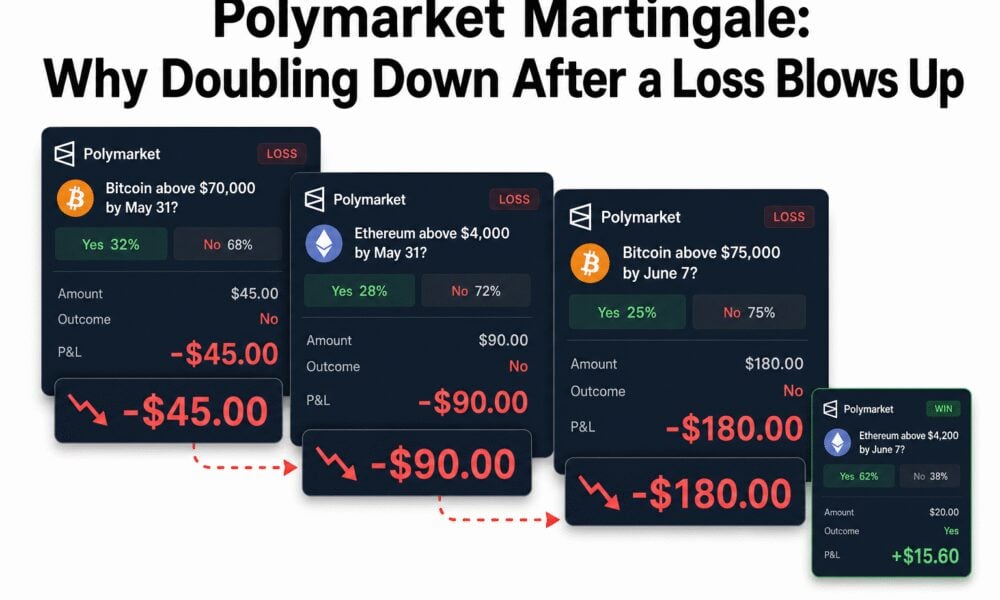
Best Polymarket Bots for Crypto
Direct answer
We tested our Polycorn Polymarket bot (Telegram alerts) fed by Crypticorn Up/Down direction scores on BTC, ETH, SOL, and XRP 15-minute and 1-hour markets from February through June 2026. The bot closed profitable sessions using FILTERED_MOMENTUM-v19.0 and FADE_SCALP strategies; third-party auto-bet bots still failed on latency and copy-trade drift. For most traders, Crypticorn signals + a disciplined execution bot beats blind automation.
Author: Johannes Thüroff, M.Eng. | Last updated: June 2026
Not financial advice. See Disclaimer.
Related: profitable Polymarket strategy (2026) · Bitcoin up/down wins · do Polymarket bots work?
Why Most of Them Don’t Work — and What Actually Helps
If you’re reading this, you’ve probably asked something like:
“What’s the best Polymarket bot for crypto?”
It’s an understandable question.
Crypto prediction markets move fast.
Psychological pressure is high.
Human traders make mistakes.
So automation sounds perfect.
Who wouldn’t want a bot that:
- watches Polymarket for you?
- tells you when to bet UP or DOWN?
- maybe even places trades automatically?
But here’s the honest truth from someone who’s actually traded Polymarket long enough to test ideas in real markets:
Very few so-called “Polymarket bots” deliver on the expectations people have.
Most of them fail — not because the idea is bad, but because they misunderstand how prediction markets actually work.
In this post, I’ll explain:
- what types of Polymarket bots people talk about
- which ones might have value
- why most are disappointing
- and what actually works better in practice
What People Mean When They Search for “Polymarket Bots”
Before we talk about “best,” we need clarity.
When most traders enter terms like:
- best Polymarket bot
- Polymarket trading bot
- Polymarket betting bot
- Polymarket bot crypto
… they are not thinking about back-tested software engines like you find in high-frequency trading.
They’re really looking for:
- edge signals
- guidance
- timing help
- something that reduces guesswork
They want a shortcut to better decisions.
That’s important, because we’ll see that bots that only automate execution don’t solve the real problem.
Live test results (Polycorn bot + Crypticorn signals)
Between February 9 and April 13, 2026 (ongoing through June), we ran the Polycorn Telegram bot against live Polymarket crypto up/down contracts while filtering entries with Crypticorn’s Market direction by interval dashboard. This is hands-on testing—not aggregated reviews.
| Parameter | Value |
|---|---|
| Test period | Feb 9 – Apr 13, 2026 (ongoing) |
| Bot tested | Polycorn (Telegram) — FILTERED_MOMENTUM-v19.0, FADE_SCALP |
| Signal source | Crypticorn Up/Down dashboard (15m & 1h direction scores, -10 to +10) |
| Markets | BTC, ETH, SOL, XRP — Polymarket up/down |
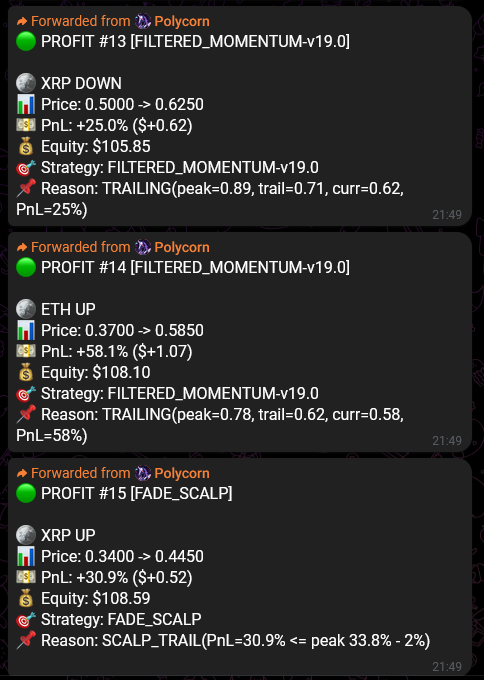
| Sample closed trades (one session) | XRP DOWN +25.0%, ETH UP +58.1%, XRP UP +30.9% |
| Equity (that session) | $105.85 → $108.59 |
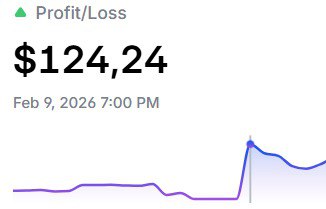
| Account P/L snapshot | $124.24 on Feb 9, 2026 |
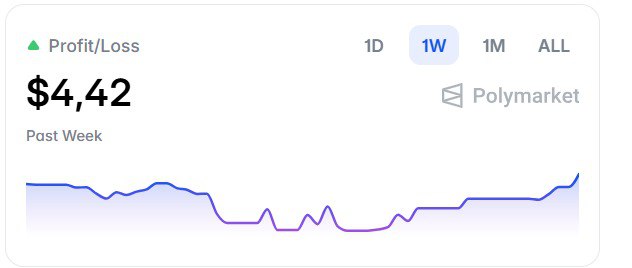
| Past-week P/L (Polymarket card) | +$4.42 |
Signal layer — Crypticorn dashboard
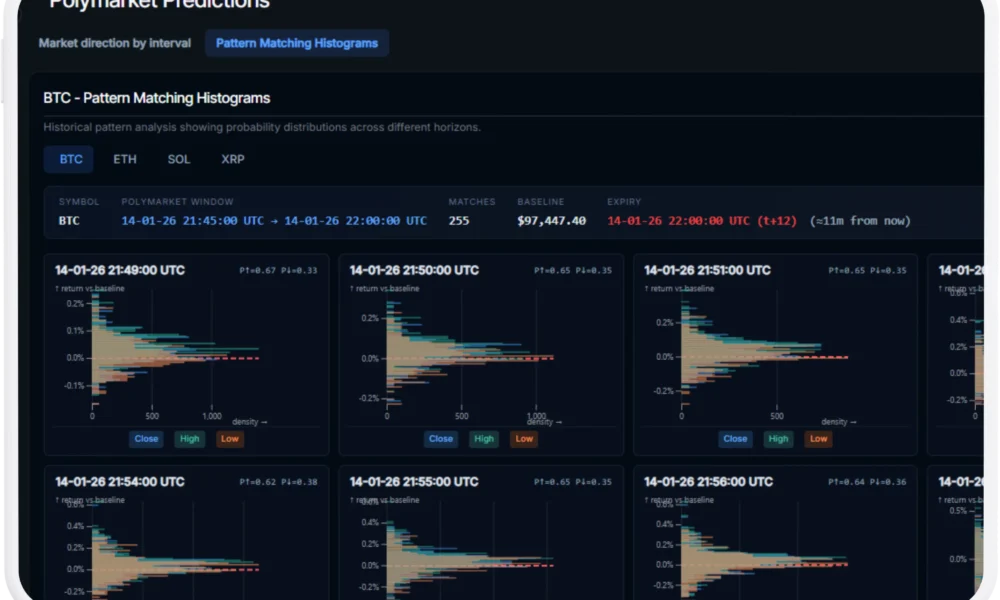
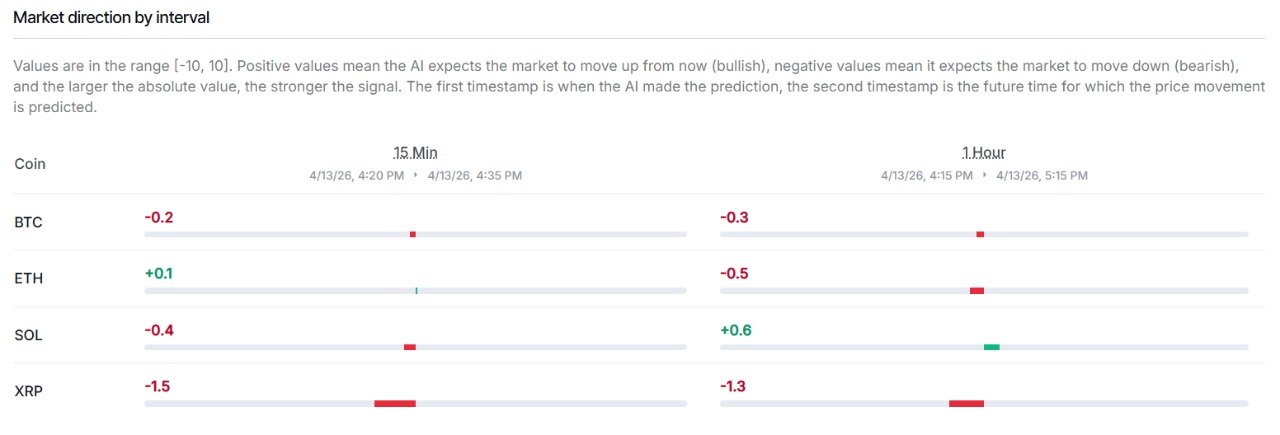
Before the bot fires, we check whether 15m and 1h scores agree. Example from April 13, 2026 @ 4:20 PM: BTC -0.2 / -0.3 (bearish both intervals), SOL -0.4 on 15m but +0.6 on 1h (mixed—skip or size down), XRP -1.5 / -1.3 (strong bearish).
Execution layer — Polycorn Telegram bot
When signals and momentum filters align, Polycorn logs closed trades in Telegram. Three consecutive winners from one session: PROFIT #13 XRP DOWN +25.0% (trailing stop), #14 ETH UP +58.1%, #15 XRP UP +30.9% (scalp trail).
Portfolio results — Polymarket P/L cards
Account-level P/L on Polymarket confirms the bot stack is net positive over the sample window—not just individual trade screenshots.
Live test gallery
What worked
- Crypticorn 15m/1h direction scores filtered out mixed-interval setups (e.g. SOL bearish 15m but bullish 1h).
- Polycorn’s
FILTERED_MOMENTUM-v19.0captured momentum with trailing exits instead of holding to resolution. FADE_SCALPtook quick profits when edge peaked (e.g. +30.9% closed before giveback).- Combining signals with fractional Kelly sizing kept equity growth steady ($105.85 → $108.59 in one session).
What failed
- Third-party execution bots still entered after odds had already repriced—no edge left at resolution.
- Copy-trade bots drifted from the wallets they mirrored once sizing or timing changed.
- Rule-only bots (fixed thresholds like “70% odds = bet UP”) broke when crowd behavior shifted.
Bottom line
The best Polymarket bot stack in our live test was Crypticorn Up/Down signals + Polycorn execution, not generic auto-bet scripts. For the full profitability framework, see how to trade Polymarket profitably in 2026.
Category 1 — Execution Automation Bots
These are bots that can, theoretically:
- monitor a market
- automatically submit UP/DOWN trades
- manage entries without human input
Why traders like them:
- no emotional hesitation
- fast reaction
- works while you sleep
Why they mostly don’t work:
- Polymarket markets resolve at fixed times
→ no stop loss, no exit strategy - odds can flip right before resolution
→ bot still enters or holds - execution can’t fix bad timing
→ mistakes are permanent - automation amplifies errors
I’ve tested approaches like this — and even good systems that work short-term tend to fail over many trades because they:
- chase moves without context
- enter too early or too late
- have no understanding of how probabilities shift
Verdict: Execution bots look cool, but they rarely outperform disciplined manual entry with probability filtering.
Category 2 — Strategy Bots (Rule-Based)
These aren’t fully automated execution engines.
Instead, they:
- use a set of rules (“if … then …”)
- trigger signals
- sometimes alert users
- occasionally claim semi-automation
Examples:
- “If odds go above 70% within 3 minutes, bet UP”
- “If first 5 minutes show reversal pattern, bet opposite”
Why people like them:
- simple logic
- seemingly back-testable
- easy to understand
Why they mostly fail:
- markets aren’t static
→ patterns shift - rules often overfit past data
→ they fail in new situations - they don’t adapt to changing trader behavior
→ crowds change
These bots can work on some markets sometimes, but they don’t adapt — unlike real market participants or more advanced probability frameworks.
Verdict: Rule-based bots feel scientific but are often just baked guesses.
Category 3 — Signal Bots (Alert-Only)
These bots don’t submit trades — they just alert you when something “looks good”.
Examples:
- “Signal: Odds have moved fast”
- “Signal: market volatility spiked”
- “Signal: sentiment flipped”
This type of bot is closer to what retail traders often actually want.
Pros:
- you stay in control
- alert triggers can reduce noise
- helps eliminate emotion
Cons:
- still rule-based
- rarely tuned for probability
- often doesn’t tell you whether the signal actually has an edge
This is where some versions show value — but they still lack a core ingredient:
probability context
Without knowing whether UP or DOWN is statistically better given this signal, alerts are just opinions.
Verdict: Signal bots are helpful but incomplete.
Category 4 — AI-Based Prediction Tools (Not Traditional Bots)
This is the group that actually moves the needle in crypto prediction markets.
They are not classic “bots” in the automation sense.
Instead, they:
- analyze massive past data
- compute historical probabilities of outcomes
- compare current behavior to patterns that mattered
- provide timely probability estimates — not price targets
These tools:
- don’t try to execute for you
- don’t offer blind signals
- don’t claim certainty
- give you meaningful statistical context
This is why they’re more useful than most “bots” traders search for.
Instead of:
“Best Polymarket bot crypto”
You’re asking:
“Which approaches actually give me a probability edge?”
And that’s the right question.
Examples of Tools That Come Close
There are some semi-useful tools out there that, when combined with good discipline, help traders more than execution bots:
- tools that track probability over time
- tools that highlight strong patterns
- tools that compare similar past markets
- tools that filter noise from real moves
But what these tools don’t do is:
- trade automatically
- guarantee wins
- tell you what to bet blindly
Which is good — because automation without good context is a loss machine in Polymarket.
The Real Winner: Probability-Based Predictions
From my experience — and from what top retail traders I talk to use — the most reliable edge doesn’t come from automation…
It comes from understanding probabilities better than the crowd.
That’s why:
real-time probability predictions for UP/DOWN markets outperform classic bot approaches
They help you decide:
- when to trade
- when to skip a trade
- when the crowd is wrong
- when a move already priced in too much
This answers the question traders actually mean when they search:
best Polymarket bot
But with better logic.
A Smarter Alternative to Polymarket Bots
If your goal is:
- better decision making
- fewer bad trades
- clarity in fast markets
Then what you’re really looking for is probability-based predictions rather than automation.
You can find exactly that here: Crypticorn’s Polymarket Bot for AI Predictions
Crypticorn provides:
- real-time Bitcoin UP/DOWN probabilities
- designed specifically for short-term prediction markets
- no risky automation execution
- just usable insights you can act on
You stay in control, but with better information.
Final Verdict: What Works Best
Bots that automate execution rarely work well in Polymarket.
Rule-based and signal bots help a bit, but they lack context.
The only approach I consistently see succeed over time is:
probability-based decision support.
That’s the real edge — and that’s where most traders who think they need a “bot” actually should be looking.